Equinox, by Lanesville poet Melissa de Haan Cummings

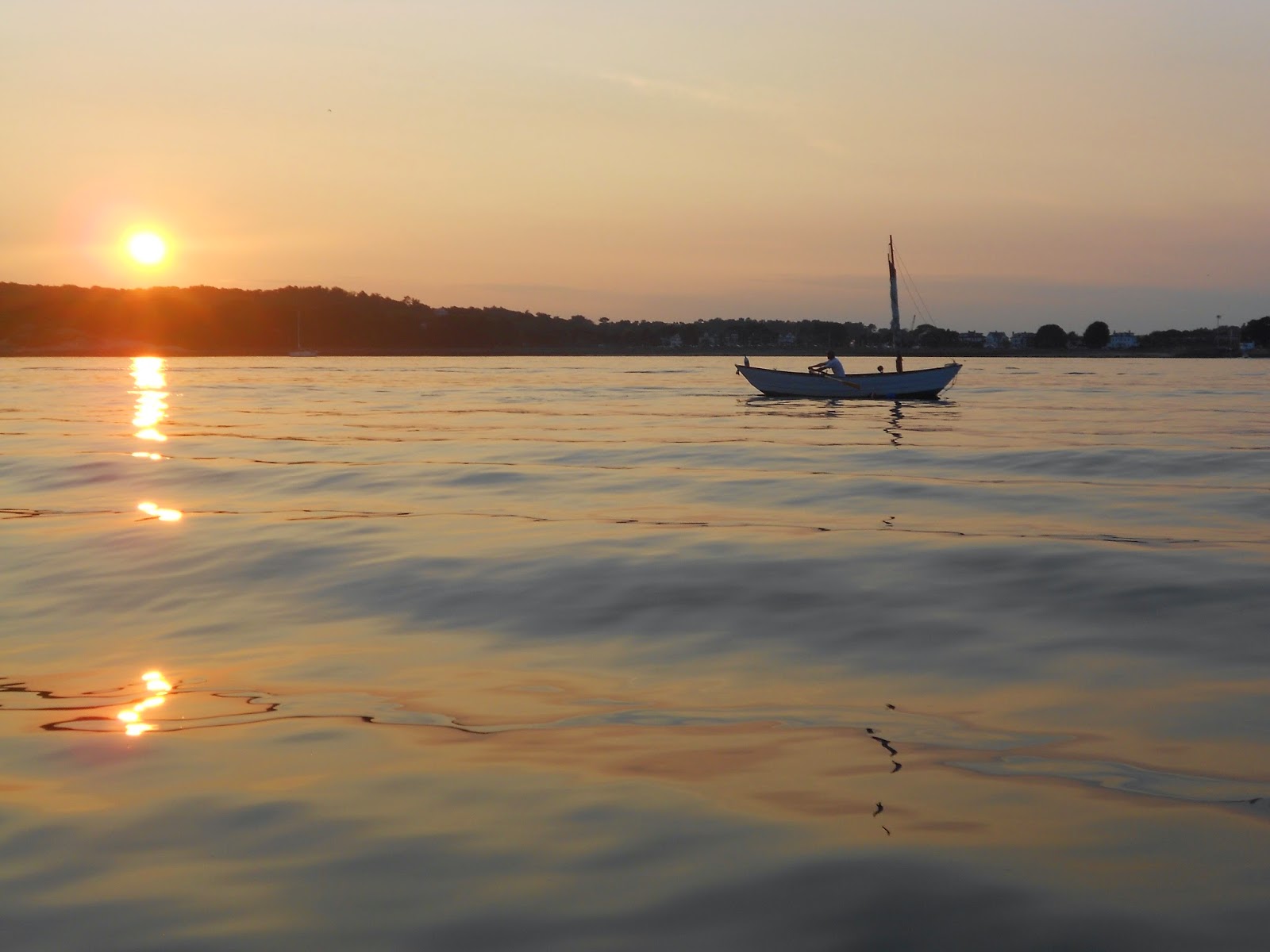
erika hillier lanesville (2)

Erika Hillier, Lanesville

Equinox

Sunny was slipping across the other side
with her black lab and her brown lab
treacherously icy
She was missing the twenty nine people
and seven dogs who celebrated sun
and warmth eight days ago
You counted?  Of course!
I want to tell people about it!
We parted at the foot of
Sunset Point Road after I
told her about the Black Man
found hanged from a tree
yesterday in Mississippi
she told me Judy and her guy
were Freedom Riders
in the Sixties  We passed
their house   I turned back
at the bottom of Ships Bell
met Lisa Dustin and Clayton
by Stowells where Dustin
told me the temperature is
supposed to be forty-seven
at time of year   I told him
we aren’t what we are supposed
to be either   Clayton said
It is what it is   Lisa thumped
me on the arm in a friendly
goodbye  Pirate climbed
under Claytons feet in the
warm Jeepster   I told Dustin
I knew his ex and we admired
her classy sexy way with
clothing   He told me how
an uncle used to have trouble breathing
when Gianna was around
I told him about Wink Sargent
We agreed wear a bikini
if you want   Lusting is
a guy’s problem
Forgetting to tell Dusty
Gianna teaches body combat
And how does he think
she looks then?

Went out on the Flatiron
to observe the clump
of brown weed
pretty much covers
the spot where the dock
rests from about May
to October
Sudden splash!
quick swim toward the gap
like a fish but wait to see
it is a cormorant

Melissa de Haan Cummings

Melissa de Haan Cummings majored in French and English Literature at 
Bryn Mawr. She has published poetry in a number of journals. 
 She describes her interests as including, “much small boating around Cape
 Ann, love of Charles Olson, Hatha yoga practice since 1969.”

Melissa Cummings

The Wealth of a Gloucesterman’s Soul by Thomas Welch

Eastern Rig

The Eastern Rig dragger “Annie,” a Gilardi family boat.

The Wealth of a Gloucesterman’s Soul

From the Maritime Provinces down to Cape May

and every Port in between

His eyes have been blessed, and he’s grateful today

For all the great wonders he’s seen

But it’s the experiences lived, again and again

ingrained in him year after year

The fish, the boats, the places, the men

are the memories his heart holds most dear

He’s seen sunrise and sunsets with no land in sight

Dolphins by the thousands at morning’s first light

Blue sharks feeding frenzy, Humpback whales as they breach

Graceful gannets a-diving, harbor seals on the beach

The delight at first sight of ol’ Thacher’s Light

The crew are beginning to pace

That sight means they’re sleeping home tonight

In their women’s, instead of Winters, embrace!

The deckhand sings, the Cook blows his nose

The bell-buoy rings and the foghorn blows

The cry of a blackback gull

These nautical sounds every Gloucesterman knows

Sure as storm waves will pound on the hull

The growl of the winch, the squeal of the block

The splash of the waterfall under the dock

as the wash-hose melts fish-ice above.

Knee deep haddock on deck,

a fat “shack money” check,

Special moments the fishermen love

The loud, constant rattle of Jitterbug forks

Bouncing over a broken wet floor

The yells from the Hold to the Hatch to the Wharf

keep the fish flowing quickly ashore

Muscles hardened by pulling, a thousand times each:

The oars of a dory, a dory up on the beach

Stern line aft, Spring line forward

Bow line taut, stern in, shore’ward

The Hatch cover off, Boots and Oilskins on

Penboards up and a boom hook down

Fighting sleep, he’s pulled the night watch from midnight ‘til dawn

Storms got bad then he’s pulled into town

A wire basket of whiting, the guts outta Cod

To spread wire on the reel? A heavy steel rod

A net full of fish up and over the rail

A rough wooden box of Large Dabs off the scale

A pallet off the stack, a good Captain’s leg

The Rum jug off a bar and the tap of a keg

Good men gather together

Whenever there’s weather

Northeast Gales keep boats tied to the pier

Fried Grey Sole down Mitch’s

Cold beer by the pitchers

Good friends, laughter, music and cheer

The waterfront abounds with these smells, sights and sounds

Rich memories more precious than gold

Building great strength of character which can only be found

In the wealth of a Gloucesterman’s Soul!

~ Thomas Welch

Drawn Together Toward Earth’s Molten Iron Core by Robert Gibbons

Drawn Together Toward Earth’s Molten Iron Core

Who’s to say we’re not drawn

by the same magnetic force

as any mariner’s compass,

because something drew

me down to the docks

on March 11, 2015,

when the thaw

finally arrived

after one

hundred

& one days

over the longest

winter in recent memory,

temperature of 54 degrees

the highest since December 1st

of the year before: there, just as

suspected, sprawled out for all to see,

the massive double-steel-hulled oil tanker

Atlantic Muse out of Hong Kong, no less!

Yes, I followed the unconscious pull, as if my body

adjusted to the magnetic declination mariners

have long been aware of as their compasses

pointed not at True North, but pulled by

variations in magnetic fields according

to each location. The Muse then drew

me back toward the map I’d

recently discovered, that

finely drawn isogonic

chart of the Atlantic

by Edmond Halley

in 1701 showing

lines of magnetic

variation, the

earliest such

publication.

It’s beautiful,

as most maps are

to any eye, but here

the early science adds

precision, & even the wording

of the cartouche drawn & written

there in the right-hand corner running

west from New England & New York down

to the Carolinas square in the heartland of North

America deserves quoting: The Curved Lines which are

drawn over the Seas in this Chart do shew at one View all

the places where the Variation of the Compass is the same.

The Numbers to them shew how many degrees the Needle declines

either Eastwards or Westwards from the true North  ; and the Double

Line passing Bermudas and the Cape de Virde Isles is that where

the Needle stands true without Variation.

There, almost at that point of no

variation, Halley draws a perfect

compass rose radiating wind

points out from the exact

center of the map.

It didn’t stop there, this Muse,

but drove me hard back

toward Olson’s own

handwritten poem

known as The Compass Rose

just to see his hand there hard at work

on November 20th, 1965, showing us the way

migration leads always to a new center, as if today

with temperatures reaching a new high after a long

one hundred & one days one could reach into the center

of oneself corresponding to the molten iron core

of the Earth, which produces those variations

in magnetic fields according to one’s location.

Such declinations in one’s sailing or daily

peregrination must be adjusted to by

what some might call Mind, but

which I prefer to call Soul.

A month later, it’s no accident that Olson,

cartographer at heart, writes his next poem

in which he designates the coordinates of the island

before his eye, that light & heavy jewel, Ten Pound Island

at 207 degrees from magnetic North, intimating that she, the island,

& he, the man, feminine & masculine are linked at the center, & drawn

together toward earth’s molten iron core.

~ Robert Gibbons

Robert GibbonsRobert Gibbons, a former Gloucester resident, is the author of nine books of poetry. In 2013, in addition to completing a Trilogy of prose poems with Nine Point Publishing,  he published Olson/Still: Crossroad, a brief study concerning the similarities in approach to art by Olson in words, and Clyfford Still in paint.

Crossing the Bar by Kent Bowker

254c0-ianfactor

Last Catch of the Day – 2012 by Ian Factor (b. 1969)

Crossing the Bar

Crossing the bar again
In the slosh and tumble of waves, around ledges,
at the favored lobster spots close to shore, the white working boat
maneuvers about rocks, gear shift growling,
runs down on pots, the men scooping them up,
hauling traps aboard, pulling the writhing bugs out, checking length
sometimes tossing most of them back in
thinking it's time to shift the pots further offshore.
It seems the hold is never quite full,
when they turn the helm to home.

It’s not all work, for there is a time
for awe and wonder in going
to and fro, in foggy uncertainty, or clear air
when the horizon is crisp and stark,
or when clouds boil, flowering in blue sky,
or when the black of a coming storm menaces,
or in the calm of sunrise, waters flat as can be,
never the same from day to day,

but same never-the-less.
You’re on your own out there.

They do not visit this place
as the yachtsmen do, to pleasure the day,
they live this world, all of it, its peace and hell alike.

Then back home again and out on the town
into dazzling lights, dark bars, a drink
having fun with women
punk rock songs and randy jokes.

Saint Joseph certainly must be there,
with faith’s wafer and wine certainty and protection
warding off threat of wave and rock
in the heave and thrust of swells
uneven footing, a dangerous winch cable
screaming on its spool.

There is a muscle taut energy
in this small 35 foot lobster boat

     heir to the fast Grand Bank fishing schooners, 
     proud large trawlers, the great hauls.

These rock crawling scavengers 
are all that’s left to harvest now,

     bend the muscles to.

It’s traps now, was nets then, always the haul, 
the heft of the prey on the deck 
in the heave and rolling wave of the sea 
The big thing to think about 
what many of us do not 
is who and where we are in this world. 
So few know, but those whose working rhythm 
is embedded in it, do. 

A Saint Joseph medallion dangles from the rear view mirror 
of their pickup loaded with traps and pots 
and its ‘screw you’ bumper stickers. But when some ignorant asshole on autopilot 
with cutters on his flashy yachts’ prop tears through a line of pots 
all the days moneys gone

     What’s Saint Joseph to do then 
     you have to keep asking.'

          Oh, they’re not paying what they used to, 3 buck a pound, 
          not worth it sometimes when they’re 10 bucks afterward.

Everyday, passing by the Dog Bar, offloading the stuff, 
tired, returning to the slip, tie up, disembark 
and, bone hope weary, might take to drink again. 

In the coherence of this life,
     (the faith and ceremonies, a cardinal’s blessing
          once a year doesn’t do much)
     no matter how small it seems
          faith punctuates the daily chores

but it’s the rhythm of the lobsterman’s life 
out and back again, bait and reap 
that sustains as it does for all working men, 
the doing of it.

Kent Bowker

Kent Bowker


Kent Bowker
  started with poetry at Berkeley in the Fifties, then became a physicist working mainly in optics.  His new book of poems is Katharsis: Sifting Through a Mormon Past.  He lives in Essex, next to the Great Marshes and is treasurer of the Charles Olson Society.

Aquaculture

Thursday, February 26, 2015

Does Gloucester Need Aquaculture?

aquaculture diagramSome say YES:

from the Boston Globe, Dec 3, 2014

The Future of Gloucester Could be in Biotech

Shirley Leung

“Serial entrepreneur Greg Verdine, Eastern Point,  is … exploring the idea of Gloucester raising its own fish. Over the summer, he and (former mayor Carolyn) Kirk visited fish farms in Japan. The types of species that could thrive in Gloucester Harbor will depend on the water temperature, and a team from Japan will come in the spring to help sort that out. …

‘It’s opening another channel to bring fish across the docks of Gloucester,’ said Kirk.”

Some say NO:

Ann (Parco) Molloy is director of marketing and sales at Gloucester’s Neptune’s Harvest, makers of organic fish fertilizer since 1986. The company depends on the by-product of high quality local fish to make its very effective and popular organic fertilizer. She has a few things to say about aquaculture:

“Farm-raised fish are not healthy fish. They are raised in pens where they can’t swim in the wild, so they become weak and sick. They are routinely fed on genetically-modified soy feed which results in questionable nutritional value of the fish itself, and when they inevitably get sick, they are fed antibiotics.

Any genetically modified Farmed Fish, raised in pens, have the chance of escaping into the wild, where they can cross-breed with local wild fish,risking the local wild stocks. When the genomes are compromised like this, you could lose a wild species forever. “I wish people would stop thinking they can outsmart, and do things better, than Mother Nature. We have the best fishing grounds in the world. Why would we want to risk losing them, for any reason? Do they want to raise fish inshore and onshore so they can get the fishermen, who are the eyes and ears of the ocean, off of it? Then big corporations can have their way it, mining it, and extracting whatever they can from it? The oceans were meant to feed the world, not feed greed!”

I won’t eat farm-raised fish. It’s not nutritious at all, and can actually be bad for you. We won’t even use it for our fertilizer.”


Gin by Philip Levine (1928-2015)

37af9-reisman

Corner Card Game (detail) Philip Reisman (1904-1992)

Gin

by Philip Levine (1928-2015)

The first time I drank gin
I thought it must be hair tonic.
My brother swiped the bottle
from a guy whose father owned
a drug store that sold booze
in those ancient, honorable days
when we acknowledged the stuff
was a drug. Three of us passed
the bottle around, each tasting
with disbelief. People paid
for this? People had to have
it, the way we had to have
the women we never got near.
(Actually they were girls, but
never mind, the important fact
was their impenetrability. )
Leo, the third foolish partner,
suggested my brother should have
swiped Canadian whiskey or brandy,
but Eddie defended his choice
on the grounds of the expressions
“gin house” and “gin lane,” both
of which indicated the preeminence
of gin in the world of drinking,
a world we were entering without
understanding how difficult
exit might be. Maybe the bliss
that came with drinking came
only after a certain period
of apprenticeship. Eddie likened
it to the holy man’s self-flagellation
to experience the fullness of faith.
(He was very well read for a kid
of fourteen in the public schools. )
So we dug in and passed the bottle
around a second time and then a third,
in the silence each of us expecting
some transformation. “You get used
to it,” Leo said. “You don’t
like it but you get used to it.”
I know now that brain cells
were dying for no earthly purpose,
that three boys were becoming
increasingly despiritualized
even as they took into themselves
these spirits, but I thought then
I was at last sharing the world
with the movie stars, that before
long I would be shaving because
I needed to, that hair would
sprout across the flat prairie
of my chest and plunge even
to my groin, that first girls
and then women would be drawn
to my qualities. Amazingly, later
some of this took place, but
first the bottle had to be
emptied, and then the three boys
had to empty themselves of all
they had so painfully taken in
and by means even more painful
as they bowed by turns over
the eye of the toilet bowl
to discharge their shame. Ahead
lay cigarettes, the futility
of guaranteed programs of
exercise, the elaborate lies
of conquest no one believed,
forms of sexual torture and
rejection undreamed of. Ahead
lay our fifteenth birthdays,
acne, deodorants, crabs, salves,
butch haircuts, draft registration,
the military and political victories
of Dwight Eisenhower, who brought us
Richard Nixon with wife and dog.
Any wonder we tried gin

Philip Levine, one of the last working class poets in America, died on February 14 at his home in Fresno, CA. We post this poem in his memory.


Aquaculture

Does Gloucester Need Aquaculture?

Some say YES:
from the Boston Globe, Dec 3, 2014
The Future of Gloucester Could be in Biotech
Shirley Leung
 “Serial entrepreneur Greg Verdine, Eastern Point,  is … exploring the idea of Gloucester raising its own fish. Over the summer, he and (former mayor Carolyn) Kirk visited fish farms in Japan. The types of species that could thrive in Gloucester Harbor will depend on the water temperature, and a team from Japan will come in the spring to help sort that out. …
‘It’s opening another channel to bring fish across the docks of Gloucester,’ said Kirk.”
Some say NO:
Ann (Parco) Molloy is director of marketing and sales at Gloucester’s Neptune’s Harvest, makers of organic fish fertilizer since 1986. The company depends on the by-product of high quality local fish to make its very effective and popular organic fertilizer. She has a few things to say about aquaculture:
“Farm-raised fish are not healthy fish. They are raised in pens where they can’t swim in the wild, so they become weak and sick. They are routinely fed on genetically-modified soy feed which results in questionable nutritional value of the fish itself, and when they inevitably get sick, they are fed antibiotics. 
Any genetically modified Farmed Fish, raised in pens, have the chance of escaping into the wild, where they can cross-breed with local wild fish,risking the local wild stocks. When the genomes are compromised like this, you could lose a wild species forever. “I wish people would stop thinking they can outsmart, and do things better, than Mother Nature. We have the best fishing grounds in the world. Why would we want to risk losing them, for any reason? Do they want to raise fish inshore and onshore so they can get the fishermen, who are the eyes and ears of the ocean, off of it? Then big corporations can have their way it, mining it, and extracting whatever they can from it? The oceans were meant to feed the world, not feed greed!”
I won’t eat farm-raised fish. It’s not nutritious at all, and can actually be bad for you. We won’t even use it for our fertilizer.”
See how Nova Scotia is doing with its offshore fish-farming:

On Gloucester Harbor, by Thomas Welch

2b317-jimmy2bdory

On Gloucester Harbor

The Dory seems to nod with glee

as I stride down the dock with my oars

She, like me, knows she soon will be free

of the lines that bind to the shores

Captain Gus shouts a sharp morning greeting

from the “Captain Dominic’s” deck

In the cool, green shade under Fisherman’s Wharf

a Snow Egret cranes her neck

My awareness expands with every stroke of the oar

out of Harbor Cove I row

to be at Sea, away from the shore,

is a joy only Mariners know

The feel, taste and smell of the crisp salt air

The Wind has the Ocean seething

Me and the boat and the Sea all share

The waves rise and fall, Nature’s breathing

The whole harbor now has come alive

A breathtaking, un-scripted show

Chortling Eiders gather close, the Cormorants dive

Chasing Minnows and Mackerel below

Peter’s sons by the thousands, the finest kind,

have called this Harbor port home

All possessing the genuine character you’ll find

in a Homer painting or an Olson poem.

Set my course for the shore, another day ends

In my wake sunset’s captured in foam

Though I’m blessed on land with fine family and friends

My heart knows this Harbor’s my home.

d7c70-dorywharvey

Spearing Flounder. circa.1890 George Wainwright Harvey (1855-1930


from The Maximus Poems, III, 206, by Charles Olson

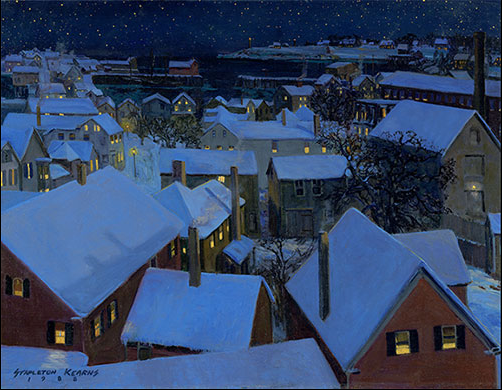
b3d05-stapleton2bkearns2b1952

Untitled. Stapleton Kearns (b.1952 )

from The Maximus Poems, III, 206

Full moon (staring out window, 5:30 A M March 4th
1969) staring in window   one-eyed white round clear
giant eyed snow-mound staring down on snow-
covered full blizzarded  earth after the
continuous 4 blizzards of February March   5 feet
of snow all over Cape Ann (starving
and my throat tight from madness of isolation &
inactivity, rested hungry empty mind all
gone away into the snow into the loneliness,
bitterness, resolvedlessness, even this big moon
doesn't warm me up, heat me up, is snow
itself (after this snow not a jot of food left
in this silly benighted house   all night long sleep
all day, when activity, & food, And persons)
5:30 A M hungry for every thing

~ Charles Olson (1910-1970)

Poem by Melissa de Haan Cummings

a73de-parade2b202142bdennis2bflavin

Parade 2014 Dennis Flavin

[huge slow flakes of snow float straight down]

huge slow flakes of snow float straight down

this windless morning

thick on the trucks

Joe and Dylan walk in it

Joe rolls snowpeople balls

Dylan flops down

for snow angels

first big fall of the season

check on the snow person

O it’s half the height

of the yellow slide!

Riley sits on his knees

on the fourth sphere

Dylan heaves snowballs at him

the three take off to find more snow

flakes thin supposed

to continue all day

the little snow person

has sticks for arms and fingers

both sport Patriots helmets

Dylan runs up the hill

stops surveys the guys

runs on

flakes thicken

a tiny avalanche

slides off the triangle

shaped boat cover

my black buddy told me

her kind is lazy

shiftless and

wears loose shoes

Game on!

Stop in Beverly

for hard boiled eggs

salt coffee and a hot

chicken sandwich

What’s up with the Pats scandal?

O everybody does it

The Pats got caught

What it is is

each team gets nine balls

They give them to the ref

Fifteen minutes before the game

the ref gives them the balls

So they could both

deflate their balls!

Yah.  They do

according to what

the quarterback wants

The balls have to be

between twelve and

thirteen pounds

Of pressure?

Yah

How come it isn’t

what the receiver wants?

It’s what the quarterback wants

Cape Ann Mites

defeat Marblehead Mites

six to four

but our goal keeper

chastised by

Coach Dad

for staying inside

the crease

is sulky

as well as

frustrated by

the four goals

Grampy said

he was so so

the Marblehead goalie

was pretty good

Is so so better

than pretty good?

Grampy remains Mum

Before sunset

snow becomes rain

helmets and heads

roll off snow bodies


Melissa de Haan Cummings
24 January 2015

melissa2bcummingsMelissa de Haan Cummings majored in French and English Literature at 
Bryn Mawr. She has published poetry in a number of journals. 
 She describes her interests as including, “much small boating around Cape
 Ann, love of Charles Olson, Hatha yoga practice since 1969.”