Memories of a Highliner’s Son

 
Memories of a Highliner’s Son
 
by Big Tom Brancaleone
 
 
My family fished out of Gloucester on the Joseph & Lucia I, II and III, for over 50 years- as boat owners, captain and crew. They worked hard and were successful in their labors. They were known for being fair to their crews and had a propensity for fishing in bad weather.
 
 
  As a child I can remember the worried look on my mother’s face as our home on the Boulevard shook and the storm windows squealed and shuddered. The boat was out in yet another storm. Their hope was to be the only boat to market and to fetch a big price when they finally made it back to port, and they often did just that. As a boy I did not realize the dangers they faced and the ordeal that life as a commercial fisherman posed. They truly were iron men on those small vessels that earned every penny with sweat and blood.
  I never could begin to understand what my father sacrificed for us and how hard he worked until he actually took me out on my first trip. After two or three days of preparation,  which normally included vessel maintenance and fishing gear upkeep the Joseph & Lucia lll  (J&L III) was almost ready to set sail. The fuel tanks were filled and the food locker in the fo’c’sle was stocked. Thirty-two tons of crushed ice was put down the fish hold and the seven man crew said good bye to their loved ones and braced for eight to 12 days of battle with Mother Nature.
 
 
  I was only 14 in 1972, and it was summertime so the backdrop for my first experience at sea was rather tame compared with what it was like in the winter. My main duty was to keep my eyes open and stay out of harm’s way. I did suffer from sea sickness the first night out but, though it was awful,  it subsided after about 24 hours and wasn’t a problem thereafter.
   We steamed along at about 12 knots for roughly 36 hours to reach the fishing grounds. Crew members were required to take a “steaming watch” when the boat was under way. This is a very important duty and the lives of all on board are in the balance.


 The rules of the ocean and general seamanship are practiced at all times and of course you can never fall asleep. The captain gives his instructions and retires to his quarters to rest up. He will not get much sleep once the fishing begins. The importance of being alert on watch was demonstrated many years later as the J & L lll ,when steaming home after a particularly arduous trip collided with an ocean going barge in the Massachusetts Bay at full speed with 140,000 pounds of fish aboard. The man on watch had somehow dropped the ball. They were very fortunate to survive that mishap with minor damage to the boat and injuries to the men. Crew members suffered a few lumps and the bow was slightly dented. The barge had over $125,000 in damages and the boat got a $1000 fine for speeding in the fog in the bay. The barge was being towed by a tug and was tethered to it by a massive cable. If they had hit the tow cable there is a good chance the boat could have rolled over. An alarm was then installed that warned of a possible collision after that near disaster.
 
 
  The haul back bell rang and all hands got up from their bunks put on their oil skins and boots then readied the net to be set out. We were on Browns Bank in what is now Canadian waters in June of 1972. There was no Hague line at that time and the ocean was not as restricted as it is today. The crew on my families’ boats were for the most part expert fishermen. Browns Bank was notorious for being “hard bottom” that often teemed with haddock. I was instructed to keep clear of all wires and blocks and the many dangerous things that were going on, on deck. Not long after that trip the dangers of working on deck were vividly brought to light when my oldest brother Joe had his arm severed while setting out the net aboard the J & L ll. He had just gotten out of the Navy after four years as a quartermaster aboard nuclear submarines. My mother was oh so worried about him being on a sub. The deck of an eastern rigged dragger is a far more dangerous place. I will relate that story later because it merits its own chapter in human drama and endurance.
Once the net is set out it will be towed or dragged along the ocean bottom for about three hours. Often on hard bottom like Browns the gear will hang up and suffer varying degrees of damage. Sometimes nets  needed immediate repair, but sometimes they could be fixed at the end of the tow when the net is hauled back on deck. In those days there were lots of fish and lots of damage incurred during normal fishing operations. This required expert crews with mending skills and the ability to get the gear back over and catching fish again. The men would often mend the damaged net for hours, then re-set it. Then they would still need to cut, gut, wash and ice down the fish and wash the deck. Less than three hours later the alarm would sound once more and it was time to do it all over again. They worked around the clock on a rolling deck in all kinds of weather for days on end. They missed being home when their children were born and many other wonderful events that we on land take for granted. I knew rather quickly that this would not be the life for me!
The first tow was completed and I was seated in the pilot house with the captain, my Uncle Tom. He was a high line skipper who had been fishing for over 30 years at that point and had earned a great deal of respect from fishermen up and down the east coast. As the crew brought the trawl aboard, the cod end popped up and confirmed a good haul. The bag of fish had to be split and swung over the rail in two parts. The deck swarmed with over 7,000 pounds of haddock and scrod. The crew re-set the net and began to cut fish, and the gulls followed the J & L lll as she plodded along in the dark of night.
It was during one of these nights when everyone had just gotten off the deck and we heard a loud BANG!  We hung up hard and parted the main wire while also causing serious damage to the net. Back on deck to recover the gear and put the net back together. This appeared to me to be a tricky procedure that the veteran crew handled with just a bit of difficulty. I had the greenhorn job of filling mending needles with twine as the men fixed the net under the watchful eye of the first mate, Frank D’ Amico who had been fishing with Captain Tom from day one and was one of the best twine men in the business. They used up the needles almost as quickly as I could fill them. After an hour and half or so the net went over the side, a lot more fish would soon be on the deck.
As instructed I watched and tried to learn and be aware of the endless toil that is part of being a dragger-man. I was only 14 and was allowed to go out fishing,  not to learn to be a fisherman, but in order to dissuade me from ever becoming one. My father was the engineer aboard the J & L lll and was known as “The Chief.”  He knew very well that it was a hard life filled with danger and hardship and wanted me to find that out for myself. I quickly did.
The trip continued, and within 3 days the J & L lll had over 40,000 pounds of fish iced down in her hold. We hauled the gear aboard and proceeded to steam to another fishing ground to the south to concentrate on a different species of fish. Here we caught more of mixed variety including flounder and red fish. As I became more aware of my surroundings and possible areas of danger I was allowed to venture out on deck and help the crew with cleaning fish and picking trash fish out of the pens on deck and tossing them over the side. We ate three square meals a day prepared by the cook Gil Roderick. The cook’s job aboard a dragger is a difficult one. He has his duties on deck as well as feeding seven or eight hungry men for the duration of each and every long trip. A small stipend for the extra work seemed hardly worth it to me. He has to order the “grub,” stow it, and prepare it in some sloppy conditions. He is also responsible for cleaning up after every meal. Tough job. A few more days passed with far less damage to the net and another 30,000 pounds of mixed fish.
Again we put the gear aboard and headed to the #8 buoy for some codfish. After about a 12 hour steam we neared our destination as the night was ending. This place, I was told, was fished during the day time and there were a number of vessels waiting for sunrise before setting out. Several were Gloucester boats I recognized. At that time there was a limit on cod. You could catch 30,000 pounds per trip. It was a beautiful summer day and all the boats set out together at sunrise. You could see the faces of other crew members on deck close by and it became a race to see who would catch their limit first. The cod were there and we quickly hauled back and put 5,000 pounds aboard on the first set. By late afternoon we had our 30,000 pounds aboard. The deck was full,  the net was aboard, and as we steamed out of there you could see and hear other men on the other boats waving and hollering at us as we passed. We were the first to leave and head for home! I felt such pride and accomplishment as we sailed out of there, and I will never forget that moment. The Joseph & Lucia lll was headed home!
I for one was extremely happy to be on our way in. I was tired and had never worked so hard in my life. I had witnessed some things that I had never imagined and got a small taste of the fishing life. We finally arrived in Boston in the wee hours of the morning and prepared the vessel to take out fish. The fish hold man was veteran Gaspar Palazolla, whose job it was to ice down the fish and also to give the skipper an accurate tally as to the amount of fish by species that were in the hold. At the pier an auction took place in the morning to determine the price of the fish on hand that day and to document which dealer bought what and how much. The names of the vessels in that day and the amount of fish was written on a huge chalk board grid,  and then bid on. There were a few boats in port that day and J & L lll topped the board with 106,500 pounds. Not a bad trip. I was responsible for washing pin boards and did perform this somewhat tedious task that day. By 3:00 pm we were finished taking out.  We untied the lines and headed for Gloucester. I can remember climbing down the fish hold with my cousin Joe,  and Gaspar and rebuilding it with pen boards. We were a bit giddy by this time and Joe and I began to sing in high pitched voices as we worked, much to the chagrin of Gaspar! After that I went up in the wheel house with my dad and uncle and enjoyed the ride home. As we sailed past the dog bar breakwater I could see my house on the Boulevard. I wondered what my friends were doing and how my mother was. I knew she was more worried than usual this trip, with my dad and me out together. We got to the dock at Rocky Neck and as I put my feet down on solid ground I let out a sigh of relief.
I got home and my father asked me if I wanted to go on the next trip-  in about three days.  My immediate response was no. I wanted to ride my bike and go to the beach and enjoy school vacation. He did not press me at all. Three days later the captain called with orders for 8:00 am for another trip. I traveled down to the ice wharf on Harbor Loop with my brother and mother to see my dad off. As they untied the lines and the boat pulled away from the wharf I began to cry. For the first time I had an idea of what he did for my family. Year in and year out, trip after long trip he and all working fisherman put their lives on the line and endure.


Vice President of  St. Peter’s Club,  and a director of the Gloucester Marine Railways Corporation since 1998, .Tom Brancaleone resides with his family overlooking the “Man at the Wheel” on the Boulevard.

Editor’s note:

 “Highliner”  is the commercial fishermen’s term for their own elite, the skippers and crews who bring in the biggest hauls.


Cultural Districts, Tourism and Art

Cultural Districts, Tourism and Art
February 12, 2015

Peter Anastas

2f910-photo2b14

Photo provided by Document / Morin

Gloucester is now the first city in Massachusetts to have two cultural districts, with all the national and international recognition that implies, and with multiple doors open to new opportunities. The name for this new cultural district is the Gloucester Harbortown Cultural District.

 All cultural districts are very special areas within municipalities and focal points of pride and collaboration.  They possess an absolute “it” quality for arts & culture and sense of place.

–Massachusetts Cultural Council

0fd4b-stuart2bdavis2bnets

Landscape with Drying Sails, 1931-32. Stuart Davis (1894-1964)

I don’t trust “cultural districts” or the thinking behind them. I believe they are just another scheme to sell out communities under the guise of supporting the arts. In Gloucester, the arts have become a way of attracting tourists, not enhancing the quality of local life for people who live here, much less supporting those who make art and need spaces to work and live in.

Cultural districts are a form of ghettoizing communities, separating the arts from other indigenous activities, mostly in the service of tourism. Monies are appropriated for the cultural districts but not for the good of the community as a whole. Case in point: Gloucester’s crown jewel, Stacy Boulevard, was allowed to languish in disrepair while money was appropriated for the Harbor Walk, which trivialized our history, and for the painted crosswalks that clashed with our redbrick, Colonial and Federal period architecture and ultimately washed away. Now comes the proposed David Black sculpture, sterile and technocratic, imposed on the city with no real process for citizen input. What’s worse is that in creating the downtown cultural district the name of the city was changed from Gloucester to Harbortown, the ultimate in trivialization and banalization.

Gloucester has a history of art richer than that of most communities.  We also have a long tradition of tourism.  The two should not be incompatible. We cannot and must not separate working Gloucester, which includes fishing and the industrial waterfront, from our indigenous arts, which are largely inspired and nurtured by our working port and the people it sustains. Artists like Winslow Homer and John Sloan, to give two of many possible examples, did not come here as tourists, they came to live among the people and render our life in art for the world to experience and enjoy. Our own local artists are trying to do the same thing today and we must make every effort to see that they have affordable housing and places to work, and, above all, to make Gloucester affordable to them and to natives who live and work here. A sustainable, authentic community, where people live and work in comfort, not a community that has given itself over to tourism, is the basis for a sound local economy. It is also that authenticity–real people, living real lives, in a real place–which makes visitors want to come here to experience the working landscape and the arts which it has generated.

But there is another issue that lies beneath the surface of the controversy surrounding the proposed Black sculpture.  It’s not merely about its potential location, who will pay for it, why and how it was chosen, or whether we want it at all.  The deeper question is one of public policy, specifically the lack of public input, not only having to do with the Black sculpture, or the vanishing crosswalks, but the way our democracy functions in Gloucester.  More and more, citizens feel they have been shut out of the decisions that affect their lives, not just about art or tourism, but about the kind of community we all want to live in.  At the core of this concern is not merely that people do not feel listened to or consulted, or that forums, when offered, are structured to limit citizen participation.  It is the lack of planning that leaves the community vulnerable to outside influences, rather than placing crucial decisions in the hands of citizens, buttressed by a viable Master Plan that has been crafted after the widest possible citizen involvement.  Gloucester’s Master Plan is out of date by fourteen years.  Not only is this a breach of public policy, it is a deliberate foreshortening of the future of our city and the lives of every one of us who live here.


2.  Further Thoughts on Cultural Districts
February 19, 2015

“There is simply ourselves and where we are has a particularity which we’d better use because that’s about all we got…the literal essence and exactitude of your own.  I mean the streets you live on, or the clothes you wear, or the color of your own hair.”

~ Charles Olson

e324d-rn

Evening Rocky Neck, John Sloan, 1871-1951

When I was coming of age on Rocky Neck during the 1950s, I did not think of myself as living in a “cultural district,” any more than we believed downtown Gloucester, where you could buy anything from a pair of socks to a coping saw, would one day be branded “Harbortown.”

Rocky Neck was a diverse neighborhood, many of whose residents were fishermen, or worked on the waterfront cutting and packing fish, or at the various freezers on the State Pier.  Some worked at the Rocky Neck Marine Railways at the end of the Neck, caulking, painting and repairing ships, or at the Tarr and Wonson Paint Company on Horton Street, where the internationally recognized copper bottom ship’s paint had been invented and continued to be refined and produced—the company even employed a full-time chemist.   There were residents who had jobs at the telephone company or in the city’s various machine shops and retail stores.  Two school teachers lived on the Neck, along with the owner of a marina, a postal worker and one year-round painter, Emile Gruppe.  Like in the rest of the city, there was a sense of community on Rocky Neck, which was connected by the bus line to downtown Gloucester and greater Cape Ann; just as the city was connected by train to Boston and the rest of the nation.

In the summertime there were art galleries, restaurants and antique and gifts shops.  The Rockaway Hotel, a family-owned hotel whose guests arrived in June and left on Labor Day, harked back to a more genteel era of summer life in East Gloucester.  In the summer, Rocky Neck also drew artists and art students from all over the country, and even from Europe.  They came because of the affordable rents for studios or single rooms and for the sense of community they found.  They also came, as John Sloan and Stuart Davis had come beginning in 1914, because of the proximity to the subjects they were drawn to paint—marine life, the working waterfront; ships, rocks, ocean; the beauty and density of 18th and 19th century houses crowded together on the Neck and up along Mt. Pleasant Avenue, and the people themselves, largely of Yankee heritage, with an admixture of Italian and Portuguese immigrant families, or Greeks, like my own.

Rocky Neck during my teenage years, was a melting pot of artists and craftspeople of various ethnicities and geographical backgrounds.   You could hear Hungarian spoken on the deck of my father’s luncheonette, and there were two New York City school teachers, who came each summer to stay in the rooms that local residents rented out, who spoke to each other in Yiddish.  Painters conversed in the languages of their countries of origins—Italian, German, Swedish, French—and at night there was a veritable “passeggiata” on Rocky Neck Avenue as natives, summer people and tourists mingled.  Then, suddenly, the day after Labor Day, it was all over.  Except for a few stragglers, artists mostly, who knew that the light was fantastic in early fall, or that once things had quieted down, they could do their best work, “the Island had been turned back to the Indians,” as my neighbors used to comment.

Though referred to as an art colony, Rocky Neck was much more than a place where artists came to work in a congenial, affordable environment, such as Bearskin Neck in Rockport had once been, or Provincetown, Ogunquit in Maine or Mohegan Island.

Artists were drawn to these places because of their great natural beauty and also because of the affordable housing, the congenial summer life of parties, and nights of talk among colleagues, which nurtured the art they would return to in the morning.  Renowned artists like Albert Alcalay and Umberto Romano came to teach art as well as to paint, and gallery owners from the large cities opened summer annexes, so that these places also became nurturing places of art.  Organizations like the Rocky Neck Art Group,  the North Shore Arts Association and the Cape Ann Society of Modern Artists grew organically from the lives and needs of artists; they were not imposed on the community by government entities, using public funds, with the ultimate agenda of promoting tourism.

There were tourists, to be sure, and even some day-trippers, but most people came to stay longer than a day or two, or a week.  Visitors were integrated into the community more than they are today, arriving, as many now do, on bus tours or in cruise ships and quickly spirited way on a bus to Salem, or allowed a chaperoned morning or afternoon in Gloucester, given the Harbor Walk’s virtual history of the country’s oldest seaport, told where to eat or shop, or directed to the Crow’s Nest, which they remember from the film of The Perfect Storm, except that the film did not show the real tavern, only a Hollywood mock-up on the waterfront, where the original venue is not located.

What I’m trying to indicate here is that not only Rocky Neck but the entire city, in its ethnic diversity and authenticity as a working seaport, its history as a place where artists came to live and work, eventually becoming part of the community, was, in effect, already a cultural district of great richness and did not need the tourist hype of designation or branding.  What I am also trying to make clear is that once you impose these designations, this branding and commodification, on a place like Gloucester for the sole purpose of promoting it in the tourist economy, you have already begun to cheapen and degrade it, to turn its citizens into extras in a movie about a place that is no longer real but is, tragically, a simulacrum of its former reality.

3.  Gloucester vs Harbortown
March 2, 2015

3cf3d-anastas2c2bcox2band2bhancock

Peter Anastas, with writer Hyde Cox and sculptor Walker Hancock, members of the Steering Committee for the Cape Ann Festival of the Arts, Gloucester High School. 1955

As to Harbortown, it’s purely a label for a condo development scheme, having nothing to do with Art or Culture by word choice; that’s obvious. The truth is there is no artist space to rent at any price. There is certainly none that is artist-affordable. As to artists, none are moving to Harbortown or establishing themselves in cultural districts here. Just like the fishing, it is of our past more than present or future. The reasons most artists came here to work no longer exist sans the quality of light; however, what that light now shines upon, aside from nature, isn’t inspiring or compelling to the current generations of artists. The economic inequality will only increase that phenomenon. This is no longer a city where an artist can be left to be one. A bohemian life isn’t possible here without a fat trust fund and Trustafarians don’t typically create meaningful works of art. They live in places like Harbortown for the pose.  

–Ernest Morin

One cannot look critically at the deleterious impact of government funded and imposed “cultural districts” on a community like Gloucester without first considering the city’s long history of indigenous art and its role in nurturing the work of artists whose reputations were based on living in Gloucester or coming here to work.   Let me speak first from my own experience.

My understanding of art did not begin when we moved to Rocky Neck in June of 1951, though Rocky Neck with its rich mix of artists and marine industry, constituted a new world for my younger brother Tom and me.  I was actually introduced to art in the first grade at Hovey School by the school department’s remarkable art supervisor and teacher, Hale Anthony, later known to us after her marriage as Mrs. Johnson.  When we first graders initially encountered Hale Anthony, who came once a week to teach us how to draw and paint and to introduce us to art history, especially to the art that was being created around on Cape Ann, it was 1943 and I was six years old.

83fd7-hale2banthony2b2

Local artists, including my own elementary school art teacher, Hale Anthony Johnson, delivering their paintings to the high school for the Cape Ann Festival of the Arts exhibition, 1955


I remember Hale Anthony as having an olive complexion and glossy dark hair.  She dressed beautifully—“very artistically,” as our envious mothers put it—in colorful clothing, much of which she designed and made herself .  We were always excited when our teachers announced that today would be the day that Mrs. Johnson was coming to do art with us because she was a lively teacher, who led us in a series of projects such as creating tiger swallowtail and monarch butterflies whose wings we would cut out of plywood or thin pine, paint with bright yellows, rust browns and blacks and glue together at ninety degree angles (their antennae made of black-stained pipe cleaners) to make them look as if they were actually in flight. Once the paint was dry, we proudly took our butterflies home, where they remained objects of pride and delight.

At Central Grammar our art teachers were Jean Nugent in seventh grade and Edna Hodgkins in eighth grade.  Both were professional artists themselves, excellent painters and designers whose classrooms, hung with our drawings and paintings, always looked more like art galleries.  At Gloucester High School who could ever forget studying art with the legendary painter Howard Curtis?  Not only did one receive a thorough grounding in the history of art and its materials, one also had the pleasure of knowing a gifted teacher and mentor, who connected local art history to the world’s.  One must also remember that when the new high school was being designed in the late 1930s, the building itself was sited to take advantage of the northern light so that its extensive art studios could receive its benefit.  Gloucester thought that much of art while around us the Great Depression was still raging!

So it was not without some background in art that I arrived on Rocky Neck in June of 1951.   My art education continued during the summer of 1952, when the first Cape Ann Festival of the Arts was launched.  Initiated by the son of a fisherman, Joseph Grillo, the city’s first Italian-American mayor, who had been an English teacher at Gloucester High School, the festival was the largest and most panoramic celebration of local art ever mounted.  It included exhibits of painting, sculpture, ceramics, crafts and weaving, along with musical, literary and dramatic events.  James B. Connolly, Olympic champion and author of several highly regarded books about Gloucester fishermen, spoke at a ceremony during which his contribution to the city’s history was honored (Edo Hansen painted his portrait).  The Gloucester Story by local playwright and plumber Clayton P. Stockbridge won the first Cape Ann Drama Festival Award, a cup donated by famed playwright and Annisquam summer resident Russell Crouse.  Vibrant with local dialect and set aboard a Gloucester fishing vessel, the play was staged at the Gloucester School of the Little Theater on Rocky Neck.  The Festival, which continued until 1962, became a summer tradition, drawing international crowds, while introducing natives to the richness of Cape Ann’s artistic heritage.

The Festival was an indigenous event, planned and funded locally.  A steering committee of local residents, including artists, representatives of the business and professional communities, and students, organized the dozens of events, performances and exhibitions, with the support of the mayor’s office.  There were no state or federal grants; and though the events drew people from everywhere, they were intended primarily for the benefit of the residents of Cape Ann and generously supported by local businesses.  Artists organized their own events, including lectures and demonstration, and they participated jointly in mounting a massive show of art in the gymnasium at Gloucester High School, where one could experience examples of the entire range of art that was being created locally.

Art in Gloucester was as indigenous as fishing or any other industry.  Just as we were given a thorough grounding in art in school, by simply living here we were equally able to experience the art that was being created locally.  We were able to hear artists talking about what they did, on the street, in coffee shops or in their own studios.  One did not have to leave Cape Ann to receive a comprehensive education in the making of art—painting, sculpture, theater, poetry—and its appreciation.

I do not believe for one minute that the creation of “cultural districts”—in effect, the partitioning of an organic community into ghettos, where one activity is privileged over another—could ever compare to what I have described as an indigenously created and supported culture, in which the arts are integrated into daily life as they were during the time I was nurtured, not only by art itself but by growing up in a multi-lingual, multi-ethnic city like Gloucester.  We must continue this tradition.  We need no help from outside.  We could do it here, all of us working together—artists, citizens, public officials—because communities exist primarily for those who live in them, not for those who would impose their will or their economic, social or cultural agendas on us.

Freedom of Speech

Freedom of Speech in Gloucester
Freedom of Speech by Norman Rockwell
An open letter from Gloucester Citizen Kathryn Goodick, with a response from Enduring Gloucester Board Member James Tarantino:


To the Citizens of Gloucester:
 
Following  the “sticker shock” we received with the most recent real estate taxes, many residents came to the Jan 24City Council meeting, during which we had requested to speak about the $2.6 million shift in debt services to the residents.  Mayor Theken’s team opened the meeting with a presentation from CFO Jim Destino  and Nancy P  who provided a  44 minute presentation that even Stephen Hawking couldn’t follow.  The presentation focused on how real estate properties are  assessed, how real estate tax bills have two estimate and two actual tax bills, and some examples of the effects on homeowners which was nice information to hear but had nothing to do with the shift in debt services.

When it was our turn to speak, we were told we had the same 44 minutes to speak and Amanda Kesterson began the speeches for the public.  However, Mr. McGeary stopped Amanda after less than 2 minutes into her speech to challenge her and all of us on what we could and couldn’t speak of.  It was offensive to have the President of the City Council arguing with a resident who was being respectful and had a well written speech to present. Then a 10 minute debate among the city councilors ensued so he could bully the other councilors to censure what we, the public, could discuss – which ultimately was taken to a vote!   Wasn’t this the purpose of holding a separate public hearing so that the public that was blindsided by outrageous property tax invoices to speak about our concerns?  The behavior of Mr. McGeary was extremely unprofessional and should not be allowed for someone in his elected position.  What is further appalling is that  the restrictions he tried to handcuff the public with, were not the same guidelines that Mayor Theken’s team was held to.   In the end, the council voted against McGeary and Lundberg and allowed the public to speak.

Mr. McGeary needs to understand that he works for us, he was voted in by the residents to serve us and work for us.  His unprofessional bullying of Amanda Orlando Kesterson was a disgusting display on the part of an elected official and should not be allowed.  I certainly hope that the general public will remember this come the November elections and vote this out of touch pompous man out of office!!

 
The presentation did NOT answer the real questions that still should be answered to explain to the residents the breakdown of the $2.5 million shift in debt – what does this expense break down to, why did the council vote for the most expensive plan proposed and shoved it down the throats of the residents,  why wasn’t the cost spread out to a more reasonable length of time rather than just two quarters which would not have been as disruptive to the financial budgets of so many residents.  As our group has discovered, the bigger picture is that the city budgets are out of control and have ballooned to an astronomical amount that needs to be reined in.  

Although Mr. Ciolino and Mr. Verga voted to stop the insanity of the bully by allowing us to speak, the meeting was a futile demonstration of the lack of democracy plaguing this city. We were not allowed to have a meaningful dialogue of any kind with the council.  We all worked very hard to produce the information, prepared our speeches and tried to work with the city council to no avail.  What are the next steps?  Nothing was told to us, and I for one was left with the feeling that they were hoping that we would just walk away and never to be seen again despite his comments to come to more meetings including budget meetings (although we were told we couldn’t speak at!!).

The ranting of Paul McGeary highlight his “true colors”, that he has no regards for the constituents who voted him into office,  and he appears to believe that he has the power of Captain Marvel as he pontificated to the residents who remained until the 11 p.m.conclusion of the public hearing.  He indicated that he was happy with the vote to shift the debt to the residents, compared the increase amount to that of a cable bill, and more shocking, he was “gleeful” in stating that he plans on voting again to shift another $2.5 million to the tax payers in the FY2016 budget .  Again, his conclusion speech to us was very immature, condescending  and left me feeling like Kevin Bacon from the movie Animal House….”Thank you sir, may I have another”.

 So I am forewarning Gloucester residents, please line up, bend over, and get ready for the City Council and Paul McGeary to slap you with another outrageous “debt shift”  and remember to recite “Thank you sir, may I have another (property tax increase!)”.


We are not going away but we sure hope that he does!

 
Kathryn Goodick
Gloucester
From James Tarantino:
Sound familiar?
 
She describes, to a t, the exact way so many of us felt before WE were bullied out of City Hall with the feeling, “Why waste our time ?”  Mission accomplished. It now strikes me that is the obvious intent of these well-planned, social engineered “Public meetings”:
 
1.)  Start with a long, confusing speech that will confuse and exhaust citizens. Some may leave disgusted. Some may leave because they have to work in the morning. Those who endure will be in the proper state to accept the next treatment.
 
2.) Bully and belittle anyone who opposes what you are forcing on them. This will not only intimidate the speaker but sends a loud, clear message to others: You will be punished for expressing your concerns. You will be made to look foolish and your concerns will NOT be addressed….next?
 
3.) Anyone who endures all this abuse must be addressed before they leave, “Make no mistake, this City Administration is not interested in the concerns or well-being of its citizens. There is a gentrification in process and nothing you do or say is going to change that. Their message to us (their constituents.) is:  “You can’t afford to live here? MOVE!”

Aquaculture

Thursday, February 26, 2015

Does Gloucester Need Aquaculture?

aquaculture diagramSome say YES:

from the Boston Globe, Dec 3, 2014

The Future of Gloucester Could be in Biotech

Shirley Leung

“Serial entrepreneur Greg Verdine, Eastern Point,  is … exploring the idea of Gloucester raising its own fish. Over the summer, he and (former mayor Carolyn) Kirk visited fish farms in Japan. The types of species that could thrive in Gloucester Harbor will depend on the water temperature, and a team from Japan will come in the spring to help sort that out. …

‘It’s opening another channel to bring fish across the docks of Gloucester,’ said Kirk.”

Some say NO:

Ann (Parco) Molloy is director of marketing and sales at Gloucester’s Neptune’s Harvest, makers of organic fish fertilizer since 1986. The company depends on the by-product of high quality local fish to make its very effective and popular organic fertilizer. She has a few things to say about aquaculture:

“Farm-raised fish are not healthy fish. They are raised in pens where they can’t swim in the wild, so they become weak and sick. They are routinely fed on genetically-modified soy feed which results in questionable nutritional value of the fish itself, and when they inevitably get sick, they are fed antibiotics.

Any genetically modified Farmed Fish, raised in pens, have the chance of escaping into the wild, where they can cross-breed with local wild fish,risking the local wild stocks. When the genomes are compromised like this, you could lose a wild species forever. “I wish people would stop thinking they can outsmart, and do things better, than Mother Nature. We have the best fishing grounds in the world. Why would we want to risk losing them, for any reason? Do they want to raise fish inshore and onshore so they can get the fishermen, who are the eyes and ears of the ocean, off of it? Then big corporations can have their way it, mining it, and extracting whatever they can from it? The oceans were meant to feed the world, not feed greed!”

I won’t eat farm-raised fish. It’s not nutritious at all, and can actually be bad for you. We won’t even use it for our fertilizer.”


Gin by Philip Levine (1928-2015)

37af9-reisman

Corner Card Game (detail) Philip Reisman (1904-1992)

Gin

by Philip Levine (1928-2015)

The first time I drank gin
I thought it must be hair tonic.
My brother swiped the bottle
from a guy whose father owned
a drug store that sold booze
in those ancient, honorable days
when we acknowledged the stuff
was a drug. Three of us passed
the bottle around, each tasting
with disbelief. People paid
for this? People had to have
it, the way we had to have
the women we never got near.
(Actually they were girls, but
never mind, the important fact
was their impenetrability. )
Leo, the third foolish partner,
suggested my brother should have
swiped Canadian whiskey or brandy,
but Eddie defended his choice
on the grounds of the expressions
“gin house” and “gin lane,” both
of which indicated the preeminence
of gin in the world of drinking,
a world we were entering without
understanding how difficult
exit might be. Maybe the bliss
that came with drinking came
only after a certain period
of apprenticeship. Eddie likened
it to the holy man’s self-flagellation
to experience the fullness of faith.
(He was very well read for a kid
of fourteen in the public schools. )
So we dug in and passed the bottle
around a second time and then a third,
in the silence each of us expecting
some transformation. “You get used
to it,” Leo said. “You don’t
like it but you get used to it.”
I know now that brain cells
were dying for no earthly purpose,
that three boys were becoming
increasingly despiritualized
even as they took into themselves
these spirits, but I thought then
I was at last sharing the world
with the movie stars, that before
long I would be shaving because
I needed to, that hair would
sprout across the flat prairie
of my chest and plunge even
to my groin, that first girls
and then women would be drawn
to my qualities. Amazingly, later
some of this took place, but
first the bottle had to be
emptied, and then the three boys
had to empty themselves of all
they had so painfully taken in
and by means even more painful
as they bowed by turns over
the eye of the toilet bowl
to discharge their shame. Ahead
lay cigarettes, the futility
of guaranteed programs of
exercise, the elaborate lies
of conquest no one believed,
forms of sexual torture and
rejection undreamed of. Ahead
lay our fifteenth birthdays,
acne, deodorants, crabs, salves,
butch haircuts, draft registration,
the military and political victories
of Dwight Eisenhower, who brought us
Richard Nixon with wife and dog.
Any wonder we tried gin

Philip Levine, one of the last working class poets in America, died on February 14 at his home in Fresno, CA. We post this poem in his memory.


Aquaculture

Does Gloucester Need Aquaculture?

Some say YES:
from the Boston Globe, Dec 3, 2014
The Future of Gloucester Could be in Biotech
Shirley Leung
 “Serial entrepreneur Greg Verdine, Eastern Point,  is … exploring the idea of Gloucester raising its own fish. Over the summer, he and (former mayor Carolyn) Kirk visited fish farms in Japan. The types of species that could thrive in Gloucester Harbor will depend on the water temperature, and a team from Japan will come in the spring to help sort that out. …
‘It’s opening another channel to bring fish across the docks of Gloucester,’ said Kirk.”
Some say NO:
Ann (Parco) Molloy is director of marketing and sales at Gloucester’s Neptune’s Harvest, makers of organic fish fertilizer since 1986. The company depends on the by-product of high quality local fish to make its very effective and popular organic fertilizer. She has a few things to say about aquaculture:
“Farm-raised fish are not healthy fish. They are raised in pens where they can’t swim in the wild, so they become weak and sick. They are routinely fed on genetically-modified soy feed which results in questionable nutritional value of the fish itself, and when they inevitably get sick, they are fed antibiotics. 
Any genetically modified Farmed Fish, raised in pens, have the chance of escaping into the wild, where they can cross-breed with local wild fish,risking the local wild stocks. When the genomes are compromised like this, you could lose a wild species forever. “I wish people would stop thinking they can outsmart, and do things better, than Mother Nature. We have the best fishing grounds in the world. Why would we want to risk losing them, for any reason? Do they want to raise fish inshore and onshore so they can get the fishermen, who are the eyes and ears of the ocean, off of it? Then big corporations can have their way it, mining it, and extracting whatever they can from it? The oceans were meant to feed the world, not feed greed!”
I won’t eat farm-raised fish. It’s not nutritious at all, and can actually be bad for you. We won’t even use it for our fertilizer.”
See how Nova Scotia is doing with its offshore fish-farming:

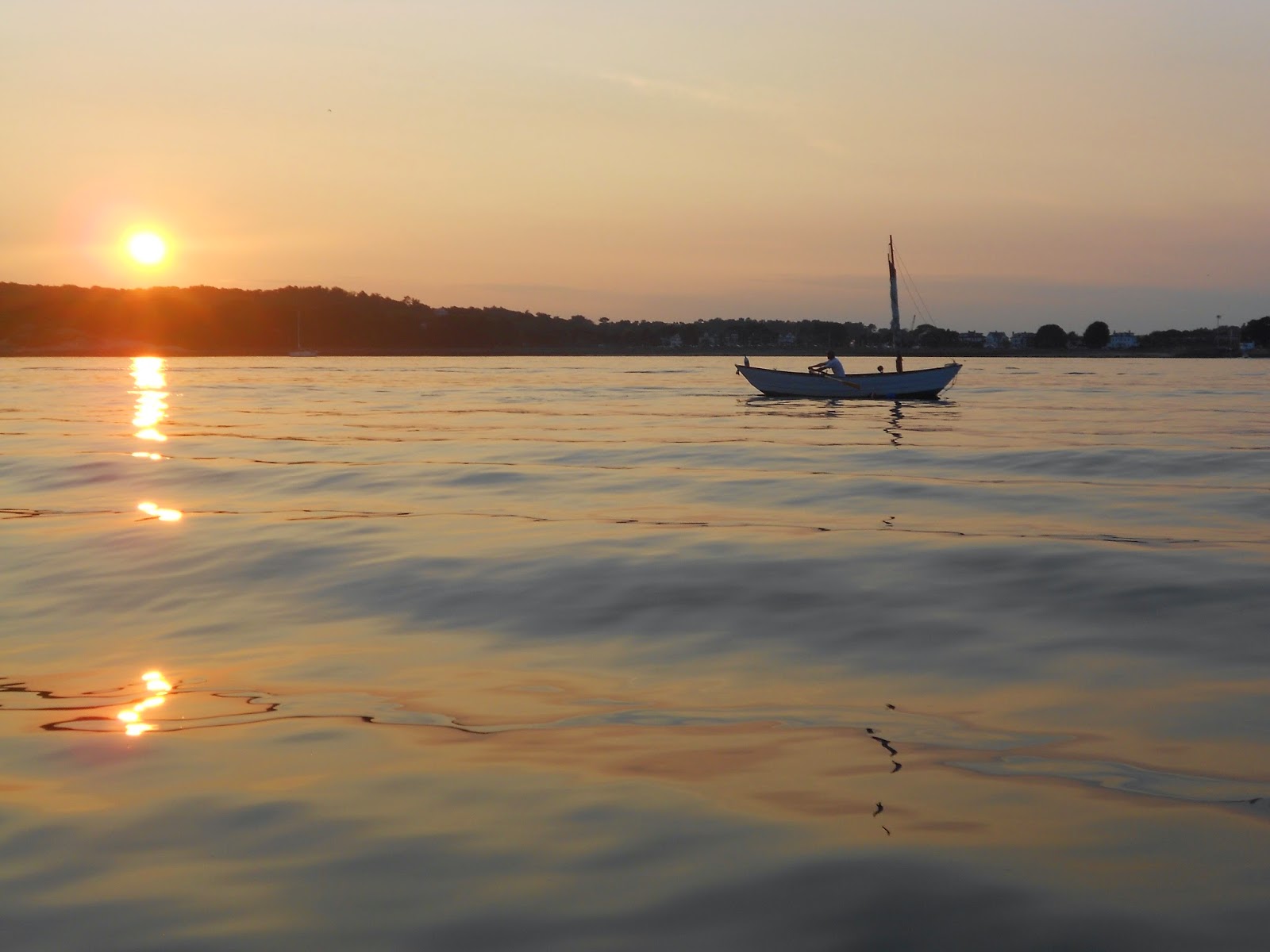
On Gloucester Harbor, by Thomas Welch

2b317-jimmy2bdory

On Gloucester Harbor

The Dory seems to nod with glee

as I stride down the dock with my oars

She, like me, knows she soon will be free

of the lines that bind to the shores

Captain Gus shouts a sharp morning greeting

from the “Captain Dominic’s” deck

In the cool, green shade under Fisherman’s Wharf

a Snow Egret cranes her neck

My awareness expands with every stroke of the oar

out of Harbor Cove I row

to be at Sea, away from the shore,

is a joy only Mariners know

The feel, taste and smell of the crisp salt air

The Wind has the Ocean seething

Me and the boat and the Sea all share

The waves rise and fall, Nature’s breathing

The whole harbor now has come alive

A breathtaking, un-scripted show

Chortling Eiders gather close, the Cormorants dive

Chasing Minnows and Mackerel below

Peter’s sons by the thousands, the finest kind,

have called this Harbor port home

All possessing the genuine character you’ll find

in a Homer painting or an Olson poem.

Set my course for the shore, another day ends

In my wake sunset’s captured in foam

Though I’m blessed on land with fine family and friends

My heart knows this Harbor’s my home.

d7c70-dorywharvey

Spearing Flounder. circa.1890 George Wainwright Harvey (1855-1930


Gloucester on National Public Radio

Did you hear this Gloucester story
 on National Public Radio? 

This story was heard across the country, via Boston radio station WGBH,  on  Feb 17, 2015

What do you think? Please add your comment below.

Note: The print version you see  here and the audio version of the story are not the same.

Click on the LISTEN button to hear the audio version, with the voices of former mayor Carolyn Kirk, Sheree Zizik, Valerie Nelson, and Mayor Sefatia Romeo-Theken.

Why Is The State Paying Millions To Subsidize A Gloucester Beach-Front Hotel?

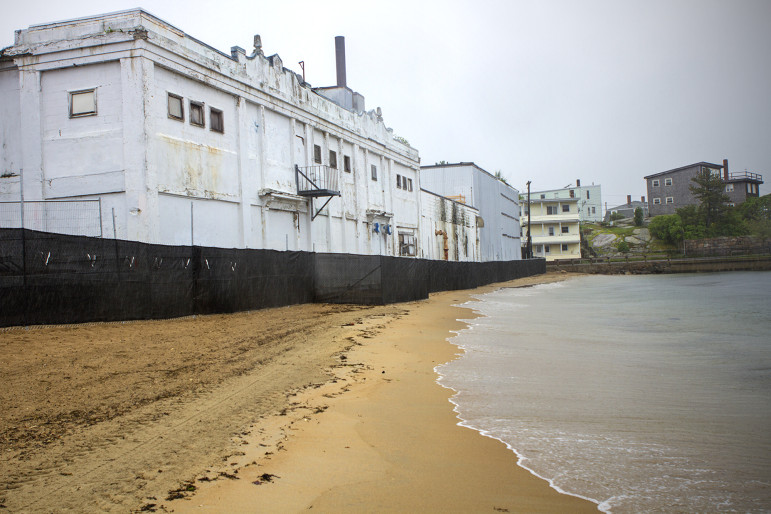
The Birdseye plant, birthplace of the flash-freeze process, stood on a barrier beach in the center of “the Fort,” a historic neighborhood packed with marine industry in Gloucester, Mass. The new Beauport Hotel is rising – with the aid of state subsidies –
The Birdseye plant, birthplace of the flash-freeze process, stood on a barrier beach in the center of “the Fort,” a historic neighborhood packed with marine industry in Gloucester, Mass. The new Beauport Hotel is rising – with the aid of state subsidies – in its place, despite the fact that it’s likely to be under water sea levels rise as predicted.
Credit Lauren Owens / NECIR
On one of the grittiest stretches of the historic waterfront here, the peaks of the Beauport Hotel will soon rise above the truck noise and smell of fish. Yet when the last drop of water fills the rooftop swimming pool, the luxury hotel will be more than incongruous with the neighborhood theme. It will also stand as a challenge to even mild climate change predictions.
For the past century, storms during high tide have flooded this neighborhood. In the next century, a two-foot rise in sea level, projected by an international consortium of scientists, would put the hotel’s property line underwater.
Despite Massachusetts’ very public stance against development on beaches like this one, the state is providing $3 million for roadway and other improvements around the controversial Gloucester hotel development, an examination by the New England Center for Investigative Reporting has found.
The issue is starkly illustrated in Gloucester, but it is a story up and down U.S. seaboards: Regulators are pinched between development pressure and the desire to keep people and property safe from the steady rising of the sea.
“That has pushed regulators to be a little more lenient, particularly when you have a big money developer,” says Jessica Grannis, adaptation program manager for the Georgetown Climate Center, in Washington, D.C.
The $25 million, 96-room hotel is financed by Jim Davis, the billionaire chairman of New Balance, and is touted by proponents as a necessary addition to its gritty working waterfront in order to survive the economic fallout of drastic fishing limits.
The hope is to save the city’s ice plant and fish auction house by generating awareness and tax revenue from tourism.
Yet vocal opponents say given what is known about climate change, it is not prudent to build a grand hotel on a low-lying, flood-prone beach – and importantly, taxpayers should not be helping ensure it gets built.
The first line of defense
Between a metal fence and the concrete of the old Birdseye plant, sand dunes with native plants naturally rebuilt. The Beauport Hotel is being constructed on a specific type of barrier beach – one with an active dune system – that would make any building
Between a metal fence and the concrete of the old Birdseye plant, sand dunes with native plants naturally rebuilt. The Beauport Hotel is being constructed on a specific type of barrier beach – one with an active dune system – that would make any building a non-starter, based on Massachusetts law. But hotel construction is underway.
Credit Lauren Owens / NECIR
In Massachusetts, coastal municipalities largely control the zoning that directs development, and they have broad power to enforce the state’s environmental regulations.
But this dynamic is inherently a conflict of interest. A study from the University of Rhode Island found municipalities might not share a state’s environmental goals, while the University of Vermont concluded coastal tax revenue is enticing to local governments because property owners and federal taxpayers subsidize flood losses.
Gloucester has a track record of exercising questionable zoning authority. In 1996, the state overturned a city decision to allow a shopping mall in an area federally designated as a port. In 2008, a lawsuit brought by residents caused a developer to back out of a proposal to convert an old paint factory into condos—a project the city had approved within the city’s marine industrial zone.
Still, over the past decade, political momentum grew supporting gentrification of the abandoned Birdseye plant – the birthplace of flash freezing. It stood in the middle of “the Fort,” a historic neighborhood packed with marine industry and middle class homes, and bordered by a sandy public beach– a big draw for developers.
After Davis purchased Birdseye in 2011, says Valerie Nelson, a working-waterfront activist and former city councilor, “There was never a serious discussion about whether this was a good place for a hotel.”
Gloucester’s Mayor Carolyn Kirk disagrees, saying most of the city’s residents want the hotel to shore up the city’s property tax base.
“The hotel is the cake, the frosting and the ice cream,” Kirk says. “It’s the property tax, the meals tax, and the lodging tax.”
Nelson says local opposition to rezoning the Birdseye property – including a petition signed by more than 200 residents – was shut down by the City Council in 2012 when it voted to rezone before a full hearing of objections took place.
The missing sea rocket
Paul Godfrey, a retired University of Massachusetts Amherst professor and barrier beach expert, did a pro-bono study for opponents on the hotel’s environmental impact. He found that the waves during high tides and hurricanes hit dead center of the buildin
Paul Godfrey, a retired University of Massachusetts Amherst professor and barrier beach expert, did a pro-bono study for opponents on the hotel’s environmental impact. He found that the waves during high tides and hurricanes hit dead center of the building and contributed to beach erosion.
Credit Lauren Owens / NECIR
As the city and the state reviewed appeals to the hotel’s permits, Paul Godfrey, a retired professor from UMass Amherst and renowned barrier beach expert who has been a consultant to the US Department of the Interior, did a pro-bono study for opponents on the hotel’s environmental impact.
He found the unique shape of the harbor would focus a hurricane’s energy “dead center of the Birdseye building.” He also found that storm waves crashing into Birdseye and deflecting back had significantly eroded the beach.
Godfrey says climate predictions show these patterns will only worsen in time, and that the Beauport Hotel will likely be the first building on this street to be underwater. According to the Intergovernmental Panel on Climate Change sea levels worldwide are expected to rise between 1.7 to over 3 feet by 2100 as the oceans absorb most of the temperature rise from the release of heat-trapping gas from factories, cars and power plants.
“These things have been ignored,” says Godfrey. He was more blunt in a letter to the City Council in 2013: “Have the impacts of Hurricane Sandy had no effect on decisions made in Gloucester?”
The hotel’s development team contested Godfrey’s report, noting a planned new seawall protecting the building will be 20 feet farther from the ocean than the Birdseye building. They also said that the first floor will be raised above a parking area, higher than the federal government’s required height for coastal building.
Les Smith, the hotel’s coastal geologist, says there has been virtually no erosion on this beach for the past 100 years.
“You have to work with what you have and develop good designs based on good engineering,” says Smith.
Godfrey and opponents have claimed the hotel is being built on a specific type of barrier beach – one with an active dune system – that would make any building a non-starter, based on state law. But succulent, thick-leaved plants known as sea rockets – that only grow on barrier dunes – disappeared from the beach in front of the Birdseye site soon after Godfrey identified them in his 2013 report. Some hotel opponents considered it destruction of evidence.
Taxpayers on the hook?
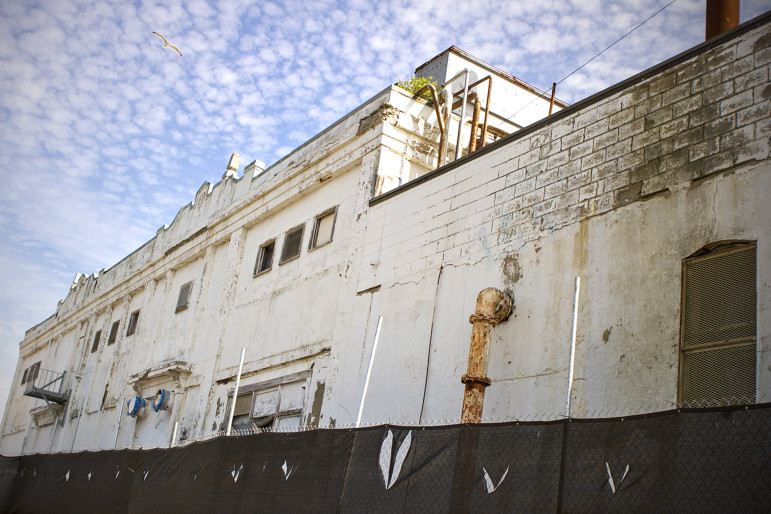
The Birdseye plant in Gloucester, was torn down in the fall of 2014 to make way for a luxury hotel. The site has been inundated repeatedly by storms.
Credit Lauren Owens / NECIR
In November 2013, the Massachusetts Department of Environmental Protection decided the Birdseye property and much of the Fort was once a barrier beach, but no longer.
“The dune form no longer changes in response to wind and waves because it is ‘locked-up’ beneath pavement and buildings,” the agency concluded. In other words, a developed barrier beach should not be regulated as a pristine barrier beach would be.
That determination conflicts with best-practice recommendations from the 1994 state Barrier Beach Task Force, which stated, developed or not, a barrier beach is a barrier beach: “This is an important point that should [not be] overlooked by barrier beach managers.”
As far back as 1980, the state recognized barrier beaches were risky investments. An executive order passed by then-Gov. Ed King – and which the Patrick Administration advised expanding – says the state should not funnel taxpayer money to encourage development on hazard-prone barrier beaches.
Yet that is what is happening in the case of the Beauport Hotel.
Businesses in the Fort say plumbing, drainage, and roads along this developed barrier beach are inadequate for commercial needs.
When the hotel proposal came through, Gloucester fast-tracked an infrastructure upgrade for the Fort, and secured a $3 million grant through the MassWorks Infrastructure Program to do it. MassWorks supported the grant because the hotel was considered a job creator and spur to economic development.
Yet even the city’s director of public works says the new infrastructure – particularly new drainage pipes – won’t prevent flooding, because the Fort’s elevation is simply too low to fix.
Walking a fine line
Despite Massachusetts’ stance against development on barrier beaches like the one where this Birdseye plant stood for a century, the state is providing $3 million for roads and other improvements around the controversial hotel being built there.
Public officials – both elected and appointed – are in an awkward position on climate change.
“We essentially live on a different planet than the planet where these laws and regulatory systems were put in place,” says Seth Kaplan, vice president for climate policy at the Conservation Law Foundation.
Martin Suuberg, state undersecretary for energy and the environment, points to numerous actions Massachusetts is taking to meet the challenge of climate change. For example, the state is giving Gloucester $50,000 to identify its most vulnerable low-lying areas.
Suuberg said replacing the dilapidated Birdseye plant with the Beauport Hotel will be an environmental win-win. “In this particular case, this was a site with a lot of problems that [the Beauport Hotel], frankly, addresses,” says Suuberg.
Suuberg refused to answer questions about the $3 million state grant, which seems to be in violation of King’s executive order.
Yet a 2011 report from Suuberg’s office advises enforcing and expanding that executive order, known as 181. It also says existing rules do not go far enough to protect the coasts: “New construction and redevelopment are likely occurring in areas that will erode and flood within the lifespan of these projects.”
The New England Center for Investigative Reporting — an independent, nonprofit newsroom based out of Boston University and WGBH News.


from The Maximus Poems, III, 206, by Charles Olson

b3d05-stapleton2bkearns2b1952

Untitled. Stapleton Kearns (b.1952 )

from The Maximus Poems, III, 206

Full moon (staring out window, 5:30 A M March 4th
1969) staring in window   one-eyed white round clear
giant eyed snow-mound staring down on snow-
covered full blizzarded  earth after the
continuous 4 blizzards of February March   5 feet
of snow all over Cape Ann (starving
and my throat tight from madness of isolation &
inactivity, rested hungry empty mind all
gone away into the snow into the loneliness,
bitterness, resolvedlessness, even this big moon
doesn't warm me up, heat me up, is snow
itself (after this snow not a jot of food left
in this silly benighted house   all night long sleep
all day, when activity, & food, And persons)
5:30 A M hungry for every thing

~ Charles Olson (1910-1970)

Anastas and Buckles : Two Generations, Two Perspectives


POSTPONED UNTIL SPRING 
BECAUSE OF SNOW AND PARKING ISSUES

‘Two generations, Two Perspectives’ 

Writers Center event features authors age 28, 77


BY GAIL MCCARTHY 

Two writers representing two generations of Gloucester natives a half century apart will talk about their recent work at an event at the Gloucester Writers Center.

The program is titled “Two Generations, Two Perspectives, TwoGloucesterWriters” featuring Casey Buckles, 28, and Peter Anastas, 77, both of whom will read from their novels about Gloucester on Wednesday Feb. 18 at 7:30 p.m.

Buckles’ book is titled “Plain of Ghosts,” while Anastas will read from his novel-in-progress “Nostalgia.” 


Casey Buckles, 28, will read from his novel about Gloucester during a program titled “Two Generations, Two Perspectives, Two Gloucester Writers” on Wednesday at 7:30 p.m. at the Gloucester Writers Center. 


Peter Anastas, 77, will read from his novel about Gloucester during a program titled “Two Generations, Two Perspectives, Two Gloucester Writers” on Wednesday at 7:30 p.m. at the Gloucester Writers Center. 


For starters, Anastas grew up in the nation’s oldest seaport when it had a thriving fishing industry that employed thousands of residents working at sea and in the shore-related businesses. 

Downsizing industry 

Buckles, on the other hand, grew up at a time when fishing was greatly downsized with the onslaught of government regulations, and when local drug abuse made recurrent headlines as it continues to do so today. His generation is also the first to compete in a global marketplace that’s seen U.S. jobs vanish overseas where the labor market is cheaper. 

A lifelong writer and columnist, Anastas holds degrees in English from Bowdoin College and Tufts University. He also studied Medieval Literature at the University of Florence, Italy. 

Commenting on the value of the young writer’s work coming as it does from his experience growing up in the heart of Gloucester, Anastas noted: ”The city has been the subject of a great deal of poetry and prose, of history and fiction; yet until the recent publication of Casey Buckles’ novel, ‘Plain of Ghosts,’ we have not had an account of what it feels like to come of age at this very moment in a community in dramatic transition.” 

’Locally crafted’ 

Buckle’s novel, he further noted, should be experienced as a “locally crafted and produced work of art.” 

The novel tells the story about the struggles of its main character, Noah, and his friends, as they attempt to make lives for themselves after high school, and while they may dance and drink in local bars and clubs, they are searching for deeper connections of love, companionship and the meaning of community, explained Anastas. 

”For Casey, the bleakness comes from the fact that he is looking at the lives of his generation in Gloucester. What do they have for work? What is in store for them if they stay here? In many ways Casey is a poet,” said Anastas. 

Buckles said this book grew out of years of note taking when he was attending school at the University of Massachusetts, Boston. 

”It was a lot of reflection that turned into what the book is now,” said Buckles, who studied philosophy, anthropology and English. 

Seaport issues 

In addition to Buckles’ reading, Anastas will read from his own work in progress, which is described as a post mortem investigation of how the city came to be what it is today. Anastas has cherished his life in Gloucester, though he too has critical views about the issues that face the seaport today. 

Anastas asked Buckles about what he sees as the future in Gloucester for his generation. 

”The world didn’t end when the Bird’s Eye fell, so there is still a future. Will it include my generation or any type of working waterfront? That will be easier to answer in retrospect,” wrote Buckles in response. “…For those who are here, spread over its 41.5 square miles, for however we live to survive, there is a future in this city.” 

Gail McCarthy can be reached at 978-675-2706, or via email at.