New Poem by Melissa de Haan Cummings!


Russell1946.jpg.450x600_q85

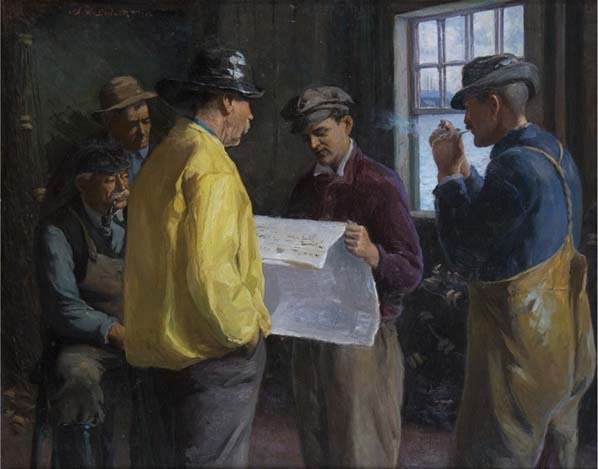
The Wonson Twins. c.1846. ~ Moses B. Russell

FOUR HOURS

What to do with four hours
in chilly weather 
Follow Chuang Tzu
read the night before
"Let your mind wander
in simplicity..."*

First Dylan wants 
shootouts names himself
several players from
various teams
achieves tremendous
excitement with his scores
Did you see that?
Did you see that move?
Yar it was me you scored on

Dylan's turn with the iPad
games finds Riley restless
Want to wash the kitchen floor?
You who love pushing 
the Wet Jet button  Yah!
Riley sprays half a dozen spots
says he will scrub later
Yah!  Out of liquid 
Fetch another jet  from upstairs 
Out of energy
Leave them in Damon's
Computer Room

Riley asks for eggs wants more
eats less has an urge
for Butterfinger
so the boys race next door
with an unneeded key
limited to one dollar each
which Dylan gives Riley
who claims Eli stole
forty dollars from his bank

O K take dogs along
insist on walking the whole
block up Tucker
O you eat the chocolate first?
Yah   It's really good this way
I got a Kit Kat Bar!
Guess what my favorite
candy is!  Kit Kat   Yah
Riley asks for batting practice
O K thinking it will be short
lasted two hours in yesterday's 
warm sweatshirt weather 
Dylan thanked me I loved 
pitching buckets of tennis balls
ducking as the hits fired
from aluminum bats
which wintered in 
the outdoor toy box
under a yard of snow
catching  and batting 
gloves inside
on October steps

Riley says he doesn't really
want to do that is bored
Is Sata bored?  Yup
What can we do?
Learn poker?  Yahtzee
is a preliminary 
Go ask D to print poker directions 
Sata to the attic looks for Yahtzee
Dylan goes to call Mum
says she will be home 
in five minutes
Find Yahtzee which is 
a good challenge 

Directions for poker
will take a dozen pages!
No No   Just ask 
for beginning poker
Two pages
You only left me one bottle 
The other one has fluid
needs batteries   
O

Discover that Riley
who has memorized
some multiplication and division
of the fancy Core Mathematics
tutored by Grandfather Ph.D
for the two day examinations
coming this week
cannot add a column of numbers
What about addition?
What use is the elaborate math
for the practical tower
of numbers which will tell
who wins the game?

Riley calls Mum
says she will be home
in half an hour
Riley takes the iPad
Dylan plays Yahtzee
Sata wins everything
not knowing that the next
morning Riley will
score two Yahtzees
earn one hundred
and fifty points!

Mumma does come
In time for a ninety minute
walk to the end of
Bianchini Road
so sweet with south
easterly stung cheeks
and a tired chihuahua 


*Chuang Tzu, Basic Writings, Burton Watson, trans., Columbia University Press,
N Y, 1966, p.91


Melissa de Haan Cummings
8 April 2015
melissa2bcummingsMelissa de Haan Cummings majored in French and English Literature at 
Bryn Mawr. She has published poetry in a number of journals. 
 She describes her interests as including, “much small boating around Cape
 Ann, love of Charles Olson, Hatha yoga practice since 1969.”

Easter, a poem by Eric Schoonover

Easter

A motorcycle blats down Prospect,

downshifts at Destino’s curve then to

roar off beneath the Virgin’s startled eyes,

the schooner still cradled in her arms


atop Our Lady of Good Voyage.

A neighbor’s pool holds koi floating on

their sides amidst great chunks of ice

residue of an unholy winter. Ichthus.


The icons confuse: no baby but a ship,

fish dead but no loaves. What I’d really

like to know, Where is that baby? Perhaps

the Harley hogger on the way to Mom’s

and ham with yams will tell.

erik schoonover

Eric Schoonover is a writer, boatbuilder and watercolorist living in Gloucester. He is the author of the award-wining The Gloucester Suite and Other Poems and a novel, Flowers of the Sea.


Hard Luck Danny


Jeff Rowe's father Vietnam (2)

Dan Rowe, in Vietnam


By Jeff Rowe

The drive to the hospital was rainy and anxiety laden. My wife, Alissa, was driving us up Route 128 at a hurried pace. It was grey, raining, and my father was lying in a bed at Addison Gilbert Hospital—dying. Dying in the same hospital that I’d been dragged to for all my ills and injuries. A very familiar place that brought upon me nothing but dread. It was fitting, really.


My  father and I had been estranged for the last three or four years leading up to this day. We used to be like good friends. Always joking and carrying on as if the world around us held little sway. Be it an afternoon beer, an old war movie, or arguing over politics—we were friends. But something fractured along the way. Something that neither of us could fix, or at least that’s what I tell myself. The delicate relationship between father and son walks on a thin wire, on a blustery day, with greying skies that only point to the storm ahead.


We were driving from Boston to Gloucester, which is usually a forty-five minute drive down the line. About thirty minutes into that drive, my sister called to say that my father had just passed away. I didn’t cry. I felt anger. Anger that his death would serve as a last act of defiance to me, that he wouldn’t let me sit next to him and say that I’m sorry for the time that we had lost, whether I truly felt that way or not. For in the moment of his death, a cliché was born. A story as old as time itself had once again been played out on the grand stage of life. The bitter artistry of bloodlines and the dissent therein. But somewhere in my own turbulent tidal wave of thoughts there was a crying sister, a concerned wife, and a lost boy who looked like a man, a man that had the same tattoo as the man that was lying in a bed at Addison Gilbert Hospital.


My first memories of my father are of him crawling on the floor. Sometimes, but rarely, he would have a knife in his mouth. If you’ve not yet seen the sincere fragility of life, I suggest you live with someone who has PTSD. Back then, that’s not what we called it. We called it depression, anxiety, night terrors etc… Honestly, you can call it whatever you want. But what it really is, at its very core, is the reality of someone who is coming undone. When someone ordinary is forced to do extraordinary things, extraordinary things become ordinary. And somewhere in between, like a boat steadily taking on water, all is lost. It’s a real life human being replicating the sound of a limb cracking off a tree in a violent storm. Just before it fully snaps off, you can hear the splitting. And when it finally does split, the only thing left is the white noise of silence and what was left in its wake.


I always wanted to take his place during those fitful nights of waking up screaming. I would wonder if I could take it. I would wonder how long he was going to be able to take it. At some point, he had a valve replaced in his heart and it would make a ticking sound, not unlike that of a watch. Standing in the doorway of his room, I would listen for the tick, waiting to hear the metronome that signified his beating heart. I’m not sure what that says about me, but I would stand there and listen for that tick. In fact, I still have dreams in which the ticking sound plays a walk on roll.


Daniel James Rowe, Sr. was once in the 101st Airborne. He served three tours in Vietnam and was so intent on enlisting that he lied about his age, joining up at the youthful age of seventeen. Danny was a scrapper who by all accounts needed a sense of order. People around him thought that going into the service would be a good thing for him. He would stay out of trouble, out of the fights that he constantly found himself in. My mom told me that when my father was about to get on the plane to go to war, his father gave no hug or warm words, he just said, “Do not embarrass us”, coldly. My mother obviously never forgot that. And thinking back to my relationship with my father, it makes sense that he could be one of the funniest people you’ll ever meet in one moment, and cold and callous in the next. Yeah, that was our relationship.


My father never talked much about his time in Vietnam. Sometimes, when he would talk in his sleep, I would listen to him reliving his days of war. He would often say that he was sorry, to whom I do not know, but sometimes he would yell out for us to get down, at the top of his lungs. Sleep was a volatile event in the Rowe household. I remember crying for him, then. I would never know what it was like to experience what he went through, but I felt his pain—his agony. I would sometimes wake up to the sound of him falling. I would rush down the stairs to see if he was ok, careful to keep my distance because if he was still at war… well, he was dangerous. It was a delicate relationship that we were forging. There would be times of laughter and memories made, but always deep down there was a weariness—a strain. A feeling of knowing that there is a limit, but wanting to see how far we can get before reaching it. Is that normal?


I guess my father never really left Vietnam. He had so many memories, good and bad, wrapped up in that war. I would have loved to meet my father before the war; or if we could alter history, I would have loved to know my father who never went to war. It’s hard to imagine because everything in his life, his politics, his belief, his pride, all centered around the war. I wonder what he would have become. I wonder if he and I would have become estranged at all. It makes little to no sense for my mind to go there, but it does.


When I was young, my father would teach me how to walk with my eyes forward, never looking down, balanced on the curb. We would do this for hours. He would also teach me how to restrain someone, how to use pressure points, and how to blend in should a dangerous situation arise. I wanted to be like him. The truth is, we actually shared very few similarities; an intense and off putting sense of sarcasm, a temper, and an ease for which we could become cold. That was really what we shared. I actually liked knowing that we shared that. I would, after all, take what I could get.


dead trees hopper

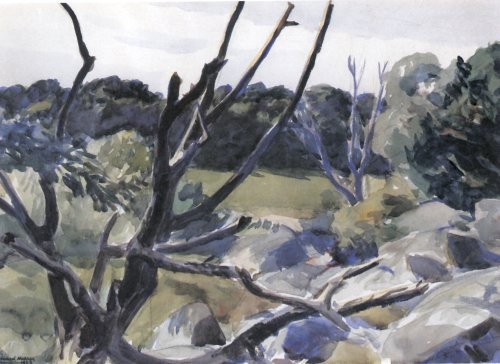
Dead Trees, Gloucester, 1923. Edward Hopper (1882-1967)


When we arrived at the hospital, I saw his bed surrounded by my weeping siblings, all of whom had even rockier relationships with our father than I. And there he was; he looked so frail and haggard. I remember thinking that maybe beyond the fear of dying, of knowing that your life is about to be over, that maybe there was also a sense of relief. I truly hope there was. His eyes were filled brightly with blood, so much so that I could barely make out the vibrant blue that his eyes usually project. He looked bloated and when I touched his arm for the last time, touched the tattoo that we both share, it was cold to the touch. A definitive cold. I think about that moment on a daily basis. That was when I began to weep, not just because my father was dead, but also for the absence of life in a body, which is so profound that to not be shaken by it—is to feel nothing at all.


The doctors told us that he bled out, hence the reason for the blood in his eyes. He had overdosed on a combination of blood thinners and other medications. My whole life he had always taken so many medications. So much so, that it was nearly impossible to keep track of what does what. Lying there, his body looked like one big scar. He had many surgeries in his time, including open heart surgery, which left one raised scar running crudely from his chest to his stomach, which may have been when he was given the tick. Life was not easy for hard luck Danny, and I guess death wasn’t much different. I could wish all day for things to a have turned out differently, but in the end, all we have is the reality that is in front of us. And in that moment, my reality was telling me that my father had bled out and his life had come to an end.


While we were at the hospital, I felt a deep sense of resentment toward my siblings. There were five of us: Kristen was the oldest, Daniel James, Jr. came after her, followed by my half-sisters, Ruthie and Rian. I am, of course, the baby of the brood. My resentment stemmed from the years of hearing from them just how much of an asshole my father was. They would go years without talking to him, and whenever they would rekindle their respective relationships, it always ended in an epic fight. It’s funny, now that my father has been gone for some years, I’m realizing that what I just described is exactly how my relationship ended with my father.


We stood around his bed and made small talk. I had never seen my brother cry before. It looked awkward, like someone trying on a shirt that’s too tight. Also, I couldn’t recall ever seeing all my sisters in one room. Our family always had a distance about it. It made sense. But I think what was most striking to me in that moment was the fact that we were a family of strangers. That was the truth of it. We were a family of strangers, who were gathered around their dead father, who was also a stranger.


     We decided to head back to our father’s apartment as a group to discuss arrangements for a funeral. When we arrived at his place it looked so familiar. I had been visiting there for years, but it had been long enough since my last visit that it was hard for me to recollect the layout. I remembered that he had his walls full of pictures. That was another thing I found odd; he had surrounded himself with pictures of his life’s failed relationships. Was it a reminder? A comfort? I don’t have the answer, but I like to think the walls represented the way he wanted things to be. The smiles and the good memories that were caught in a fleeting moment—how if you could just capture the memory of a certain photograph and clutch it to your heart, you would have captured happiness. That’s what I like to think. Our pictures were a reminder of something that he couldn’t hold onto, but he would have if he had the strength to hold us in a moment, forever.


Gloucester carries a weight with it. Not all get to experience it, but most do. We weren’t at my father’s apartment for more than ten minutes before one of my siblings had the idea to rummage around for his pain medication. I’m not sure who had the initial idea to do this, but it seemed that they wanted to ease the pain of his death with the very pills that took his life. Honestly, I couldn’t blame them,  but the irony was not lost on me. Don’t get me wrong, I have my vices and to call me an angel would put you in the realm of science fiction, but this moment ate away at the pit of my stomach. It’s the very reason that I left Gloucester at such a young age. This city would always haunt me with its beauty, but once you peel back the layers, down to the seedy underbelly, she ain’t so pretty.


My city has two very distinct faces. One face shows a warming smile that gives the very salt that lingers in the air, like a gift. There is no air like it. This face is the view of the ocean from the Boulevard, Stage Fort Park standing toothed and strong to its right. This face is the ocean, sparkling like millions of pieces of shattered glass, on a spring afternoon. But there is another face. And this face tells a very different tale. One of inherent class division, drugs, and rampant alcohol abuse. A tale of frustration brought about by stagnation. This face has a view that rarely changes for those who see it.


I’ve lived with the memory of both faces. I guess in a lot of ways, Gloucester and my father are similar. They both have two distinctly different sides. And in my own way, I loved them both very much. Gloucester is much like the ocean that surrounds it. A thing of staggering beauty, but very dangerous at the same time. I’ve never seen anything like Gloucester, not in all my seemingly endless travels. But then again, I’ve never crossed paths with someone like my father. They have both proved themselves to be two very unique, double-sided, islands.


I don’t remember driving home from Gloucester that night. I remember drinking a beer, in the comfort of my apartment. I remember thinking that even though it seemed like we hardly knew each other—I felt his absence. The loss of a parent gave me a different feeling than that of the loss of a friend. It has something to do with shelter, something to do with the expectations of our individual roles as father and son. I fell asleep that night thinking about his sense of humor and his wild streak that brought out a laugh of unbridled freedom. The kind of laugh that you could liken to a dog with its head out the window of a passing car. For that night, I fell asleep with no anger in my heart. I thought of his blue eyes, not clouded by blood. I thought of the way that he would call me “my guy,” as opposed to using my actual name. I thought of the tattoo that we shared and the blood that runs through us all. And somewhere, hidden deep in my heart and imagination, I heard a tick.


Jeff Rowe (2)
 Jeff Rowe lives on Winter Hill, in Somerville. He grew up in 
Gloucester and has since traveled the world playing music and 
collecting memories. 
He is a brewer by trade and is now in the process of writing a 
collection of short stories/memoirs of his childhood in Gloucester.
 

Gloucester- Playground for the Affluent?

news from the fleet

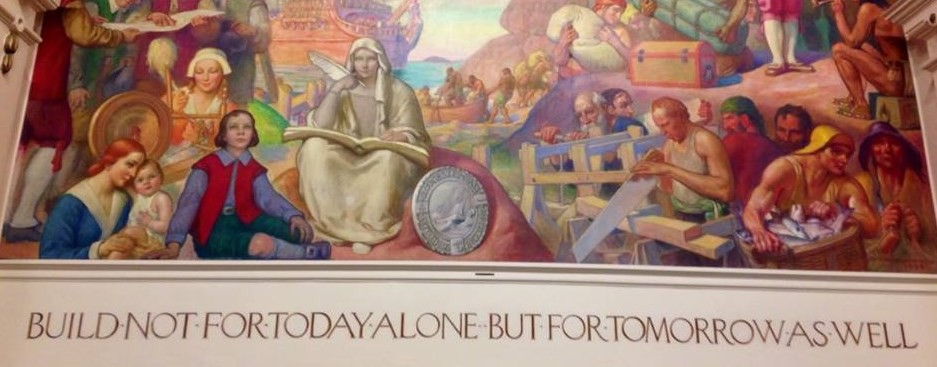
News from the Fleet. 1918. Augustus Buhler (1853-1920)        

Coastal Communities as Playgrounds for the Affluent

I read the Gloucester Daily Times’ story March 27, 2015 (see the Enduring Gloucester post What Does Gloucester Need? March 27) about the community and economic  development expert’s assessment of what Gloucester supposedly needs to do to address the issues confronting it in the face of the decline of the family fishing industry and industries associated with it.

I was struck by the intense focus on the shortcomings of the city’s website, of all things.Now, not for nothin’, but with all the issues confronting Gloucester today, it seems absurd that a focus on the city’s website would be such a centerpiece of both the expert’s assessment and the Daily Times’ story.But then, a flawed website is a much easier issue to wrap one’s head around than a housing market growing so expensive that more and more people cannot aspire to rent an apartment in Gloucester, let alone buy a home.

It is a much easier issue to wrap one’s head head around than the reality that tourism, although an important element of Gloucester’s overall economy, will not provide the  jobs that produce the kinds of incomes that will allow people working in the industry to actually live in Gloucester – despite what those who view high end restaurants, slips for yachts, and three hundred dollar a night hotel rooms as Gloucester’s economic salvation, may think.

What I have realized in recent years is that more and more communities by the sea, whether in temperate or tropical locales, are rapidly becoming places where only the affluent will be able to live.

Here on the Outer Cape, particularly in Provincetown, that sad reality has resulted in this once viable, if not always terribly busy, year round community devolving into a virtual ghost town from November to mid April.

To scan the Provincetown Banner for a seasonal rental to live in while working for the summer tourist season is all one needs to do to see why tourism and hospitality industry businesses are desperate for employees to staff their establishments. It would make no economic sense for me to work here this season if I did not have the network of old friends that I do.

Dumps are renting for seven and eight thousand dollars a season. People are taking in boarders who clandestinely sleep in their basements on air mattresses for 175 and 200 dollars a week.

More and more businesses are staffed by English speaking eastern European college students and migrant workers from Jamaica and Central America, not because Americans don’t need work, but because the cost of housing is so prohibitively high it makes no sense for American workers in the hospitality and tourism industries to come here to work.

But I’ve realized the very same thing is happening in Puerto Viejo, CR, the sleepy little surfing and fishing hamlet at the end of a long dirt road to nowhere I washed ashore in fifteen years ago. It is happening in Vieques, where I worked two years ago.

Now, change is indeed inevitable. But given what is at stake, especially for ordinary working people, be they gringo, Latino, or Martian, those who view themselves as the leaders of these increasingly desirable coastal communities, from Cape Ann to the Caribbean coast of Costa Rica, really need to  not focus on  just short term gains and quick bucks for the affluent few, but on the well being and quality of life of the workers who make these coastal communities the kinds of places tourists want to visit in the first place.

If that doesn’t happen, all these coastal communities are likely to go the way of Key West, a place that these days is a far cry from the funky, bohemian and diverse place it once was.

And that would be very sad, very sad indeed.

Michael Cook
Gloucester and Truro

Fisherman’s Statue Was Never Controversial!

April 10, 2015

Letter to the Editor of the Gloucester Daily Times:

1177767855

Today’s Editorial, City’s arts policy must define room for public input, leads off with the insinuation that every new work of public art is always met with some degree of negativity, followed by this statement: “Indeed, reports indicate that some local folks didn’t immediately warm even to sculptor Leonard Craske’s 1923 Man at the Wheel…” What reports are you citing here? Whatever the source, this is absolutely untrue.

Curiously, just the day before, I saw the same misstatement (on a local Facebook page)… only this time, it was a quote from none other than Bruce Tobey who, as noted in your editorial, is spearheading the drive to place the controversial David Black sculpture in Solomon Jacobs Park. As a former mayor of Gloucester, Mr. Tobey should have a firmer grasp of his city’s history, or at least check his facts before making false assertions. However, this is just another example, like the continually cancelled public hearings, of how our elected representatives have been dismissive of any input from concerned citizens.

The problem is not David Black, an artist of considerable talent, world renown and a graduate of Gloucester High School, although he moved away long ago. His gift to the city is quite generous and I’m sure sincere. High Seas, the sculpture in question, is a  large, wildly abstract piece. Whether you like it, or not, is obviously a matter of taste. Personally, I’m a fan. It is the placement of this colossal work in compact Solomon Jacobs Park that is the problem. Far from there being a unanimous consensus, this issue has resulted in considerable public outcry, especially on many highly active social media sites.  Mr. Tobey, Mr. McGeary, Ms. Cox and Mayor Romeo Theken are well aware of these numerous, impassioned, online voices. Now it remains to be seen how they will respond to them.

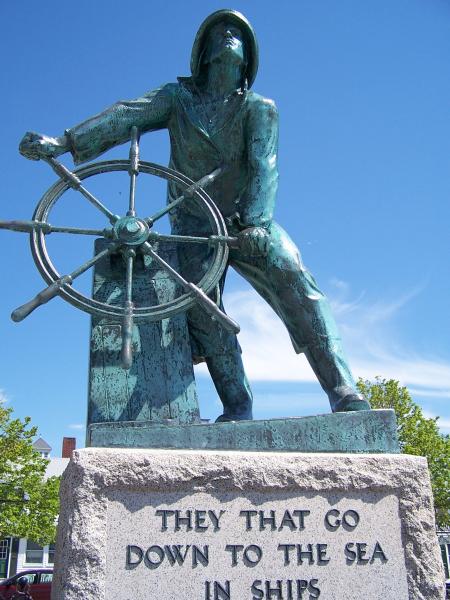
Just to clarify how wrong the aforementioned comparison is, Craske’s now iconic Fisherman’s Memorial Statue had a very clear purpose from conception to completion: to honor the brave local men who risked their lives and would continue to do so, by going to sea to provide Gloucester with its economic lifeblood, a thriving fishing industry. It was a most fitting tribute, applauded by all, for Gloucester’s Tercentenary Celebration in 1923, when the first model was unveiled. Empowered and inspired, Craske continued to work intimately with a committee of 60 including the Master Mariners. He even went on a fishing trip to the Grand Banks on the schooner Elizabeth Noonan to have as much authenticity in his finished work as possible. The exact positioning, wherein the fisherman faces out to sea, was also carefully considered. All these facts and much more can be easily accessed in the archives of the Cape Ann Museum, if facts are what you are interested in.

However, I’m afraid Mr. Tobey is no more interested in facts than he is in public scrutiny. Let me close with the words of the late author, historian and GDT columnist Joe Garland ~ “Beware those who would use Gloucester for their own ends.”

Bing McGilvray

Gloucester MA

Forest Street, 1986

IMG_0598 (1)
 by Jeff Rowe

I remember playing baseball in the front of our house on Forest Street. There would usually be six of us, but depending on how many kids from nearby streets we could get to join us, we could get as many as ten. We’d stay out there until dark, or until our parents called us in. And even then we’d wait until there was a certain amount of noticeable hostility in their voices before we actually gave in—red faced, heads down, shoulders slumped, defeated.

I call it baseball because we played by the general guidelines of the game, but it was more like a bastardized version of street ball. Our bat was a whiffle ball bat that had been thickly taped with black electrical tape around the barrel. The balls were tennis balls, as they could be hit the furthest with our make-shift bats. The bases were whatever we could find—cardboard, rugs, broken pieces of wood. But often they turned out to be car door mirrors. This never sat well with the owners. Our home run marker was the line where Forest Street ended and Trask Street began. Our automatic catcher was an old, beat up floor hockey net. The joy we’d get out of hitting those tennis balls in the dying light of our neighborhood was unparalleled. From a safe distance our young, scratched throats could be heard screaming out the various rule violations until the voices of our parents rose, beckoning us back home.

My family moved to Forest Street by way of a trailer. The trailer resided in my uncle’s backyard on Cherry Street, on the opposite side of our fair seaport city. It was the kind of trailer that construction sites typically use for an office. I guess it was cramped, but I never thought twice about the fact that we lived in a trailer. It was all I’d ever known of a home. Somewhere along the line my parents had managed to save some money. This still strikes me as a miraculous feat, given the fact that my father was universally terrible with money. But either way, we were out of the trailer. We had officially moved up in the world. Out of the trailer and into a house! This was quite the luxury for us. I was going to have my own room, but above that, I was going to have a backyard. We’re talking American dream here.       The year was 1986. I remember the year vividly. It was the first time I’d learned what real heartbreak was: It was game six of the world series. Red Sox vs. Mets. You might laugh, but I can see it like it was yesterday. I’m watching the game with my father. The sliding glass door left slightly ajar, inviting the quenching breeze to come right up off the ocean, and into our TV room (we actually called it a TV room). My dad is sitting in his ratty, old recliner. I’m sitting dead center on the couch. I loved watching baseball. I was mesmerized by the simplicity, comforted by the sounds of leather and wood, lost in the subtle nuances of a sport that was stealing my heart. And then… just like that, the sport I held so dear had broken my heart like an inside fastball would a bat. Bill Fucking Buckner. That poor bastard let the ball go right through his legs on a routine ground ball. It would take 26 years for Red Sox fans to forgive him for this one mistake. He picked the wrong city for that kind of bush league error. A city that rarely forgets let alone forgives. And here I was sitting there with my old man of whom I’d never seen cry, and all I could do was weep. My six year old heart, shattered by Bill Fucking Buckner.

My family consisted of my mom, dad, brother, and sister. I was the youngest by ten years. I believed from a young age that this one, undeniable fact meant that I was clearly an accident. To this day I believe I have math on my side in making this assumption. We were the only non Italian family on Forest Street. In those days, Gloucester still had a very old world view about it—a divided view. It wasn’t easy for an Irish kid to move to an Italian or Portuguese neighborhood, nor was it easy for an Italian or Portuguese kid to move to an Irish neighborhood. Needless to say, it took a bit of strife for me to settle in to our new surroundings. It took a few scraps, and a lot of creative cultural epithets (for your sake I’ll leave examples out). But when I did settle in I became a part of the crew.

Chris was the oldest, Matt was good at everything, Anthony was almost as good as Matt, Peter was Anthony’s scrawny younger brother, and Joey was always the last picked despite having an off putting sense of self confidence. Then there was Evan. Evan had a speech impediment. Kids are known for their unbridled cruelty, but a speech impediment will take that to the next level, only serving to fan the flames of malignity. We stood up for Evan because he was one of us. Don’t get me wrong, he got a rash of shit from us, but he was off limits to anyone outside of our little crew. This resulted in more than a few of the aforementioned “scraps”. As for myself? I fell somewhere in between. Though not the best at anything—I was certainly not the worst. We were a rag tag bunch, but we were friends.

Chris was the most physically advanced, but had little interest in playing sports. This was a point of endless frustration for us. Especially on the rare occasions when we’d play pick-up games against other neighborhoods. Chris was more into music. He would be the one that would help cultivate my love of heavy metal music. Chris also held the ominous distinction of being the only one of us who had lost a parent—his mother. None of us had any basis of identification with this. He rarely talked of his mother, nor of the loss associated with her. He had a seriousness about his pale, blue eyes. But he was always quick to make a joke, as if in contrast of the apparent weight that he carried.

I became closest with Chris. He liked to stay up late, eat cool ranch Doritos, and watch Headbangers Ball. And that was good enough for me. Chris stayed at our house more often than he would stay at his father’s house, down the road. His father was not at all a bad father, but he wore the scars of his life for all to see, and that scared some people. He had a hell of a time with the death of his wife, and understandably he wound up turning to the bottle for solace, rarely looking back to see what was being left behind.

One afternoon, we went to Chris’s house for lunch. A pretty rare event at the time. When we got to the front door we could hear Tom Petty playing loudly on the stereo, but the door was locked, and the house seemed vacant. We tried the back door as well but to no avail. Just the sounds of sweet Tom singing to us—singing at us. We decided to give up and head to my house for lunch. A not so rare event.     Later that night, we learned that Chris’s father was actually inside the house when we were knocking. He was dead of a drug overdose.

Chris’s dad would be the first of many people I would come to know in my life to die like this. I remember the look on my mother’s face when she told me what had happened. The shelter had been compromised, the true cold of the world was leaking in. She looked helpless. In some ways I think it was better for me to get to the hard stuff early, but not for Chris. No, definitely not for him. In one fleeting moment, Chris had no parents. He was an orphan. In a matter of days he was off to Florida to live with an Aunt. I lost my best friend. There would be no more late nights of Headbangers Ball, no more dreaming of starting the best metal band since Metallica, no more long arguments trying to convince him to play ball with us, no more Forest Street. Though I felt a deep sadness over losing my friend, I mostly thought of  how lonely he must have felt right then—how lonely I felt for him. Chris leaving town was one of many changes that would take place within our crew of street ball obsessed miscreants.

As the years went on our little gang drifted further apart. It’s an old, familiar story. The games that had once raced the falling sun had become less and less. Our interactions became strained. We were shedding our first skin. In some ways we were trading it for a tougher coat. One that would hopefully endure what was to come. We had unknowingly, or blatantly, grown out of each other. And the only thing harder than becoming a friend, is becoming a stranger. It matters little how things change—just that they do.

Matt earned himself some level of popularity in school. He had started running with a different crowd, you know, the popular kids. Therefore, he could no longer hang out with the long haired kid that was prone to wearing torn, oversized shirts that read such socially unacceptable slogans as Metal up your ass!. It was certainly not cool for someone like him to be spending time with the slovenly metal head I’d become. Not cool at all. At one point we may have shared a street, but now we were on different plains of social existence.

Anthony and Peter went to a private school a few blocks away. A few blocks away may as well have been another world to us. Looking back, in actuality, we only spent time with them during our games. Their parents were never fond of them hanging out with the rest of us. Maybe they feared our foul language and predilection for sports would bring about some uncouth character traits. Either way, they both wound up becoming lawyers. Maybe their parents were on to something.       Joey remained a fuck up with an inflated sense of self confidence. So much so, that he  must have believed that girls wanted him to leer through their windows when they took showers. I never much liked Joey. I hate to say it, but I did feel a warming sense of satisfaction when I heard that he was locked up. For some reason, Joey being designated a sex offender, just suited him.

Evan stuck around Forest Street longer than any of us. I always liked Evan, he had an honest way about him. He seemed to only exist within the bounds of truth. I’m certain that he couldn’t tell a lie if his life depended on it. Luckily for him, he had grown heavy over the years, and learned how to carry himself. Less fights were picked with him due to the speech impediment. I still keep in touch with Evan from time to time. His impediment is gone, but I fear the years of coping with it have left him woefully anti-social. I can’t blame him for that.

As for me… I wound up immersing myself in music and books. I could get lost in a book, forget where I was, or forget what was going on around me. I still have a bit of an escapist quality. I’ve tried hard to suppress it—selecting reality over escape. I’ve found life to be short and fragile. I feel myself not wanting to miss the intricacy of the passing moment. What was in the past and what will become the future is projected in front of me, as if they are one in the same. It sounds crazy, but some moments can be held for a lifetime. I feel a part of me is still playing a bastardized version of street ball on cracked pavement in Gloucester, still a part of that rag tag crew, still so sheltered from the hardness of the world, still knocking on Chris’s door while Tom Petty created a soundtrack to tragedy, still on Forest Street, in 1986.


Jeff Rowe (2)
 Jeff Rowe lives on Winter Hill, in Somerville. He grew up in 
Gloucester and has since traveled the world playing music and 
collecting memories. 
He is a brewer by trade and is now in the process of writing a 
collection of short stories/memoirs of his childhood in Gloucester.

The Blizzards of 2015 – A poem by Ruth Maassen

Photo  Sargent House, Main Street, Gloucester, Massachusetts,  winter 2015,  by Bing McGilvray

Sargent House, Main Street, Gloucester, Massachusetts,
winter 2015, by Bing McGilvray

The Blizzards of 2015

The storms crawled by with fearsome power,

snow blowing sideways hour after hour.

Shovel a shovel-wide path to the door.

Oops, snowed again! Shovel once more.

Dig out the driveway, the car—what a slog.

Dig a path to the hydrant, dig a path for the dog.

Heave the snow high up over your head.

Try to forget what the weatherman said:

Another one’s coming! Man oh man.

With a bull’s-eye painted right on Cape Ann.

There go the plows scraping and rumbling

all through the night—we shouldn’t be grumbling,

we’re snug in our beds, while the heroic

crew on the roads, exhausted but stoic,

battle the stuff coming out of the sky,

ton after ton, but they never say die.

Another one’s coming! Can we hope for

a break between blizzards to get to the store?

No train, no T, no parking, no walking

the kids stir-crazy, the grouch not talking.

Trapped in a snow globe! Let me out, let me out!

the snowsick, slap-happy denizens shout.

At least we broke the record snowfall,

though that doesn’t begin to make up for it all.

The leftover filthy snow piled up high

no doubt will be gone by the Fourth of July.

So step aside, Blizzard of ’78.

You’ve had your day, you really did rate,

but you weren’t as gargantuan and messy and mean

as the Blizzards of 2015.

~ Ruth Maassen

ruth maassen (2)

Ruth Maassen, Rockport’s poet laureate, arrived on Cape Ann in 1980. She does proofreading and book design for independent authors.

J. Jeffrey Grant’s Gloucester

“My favorite sketching ground is Gloucester…” J. Jeffrey Grant

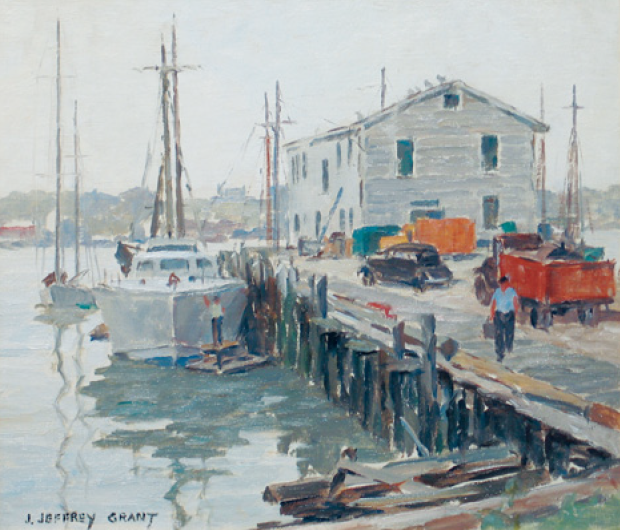
J. Jeffrey Grant (1883 ~ 1960)

After the death of both his parents, Grant left his native Scotland, ultimately establishing himself in Chicago as one of the city’s most important and prolific artists. Still, something in him longed for the seaside life he had loved as a boy.

This longing was resolved in 1931 when he visited Gloucester. He returned almost every summer for the rest of his career. He was inspired by the vibrancy of life he saw here. The ocean’s fishermen, the dockside workers, rooftop vistas accentuated by iconic spires, busy urban streets and residential alleyways with washing on the line and children at play… all this and more he captured beautifully with impeccable precision.

Here are just three of his Gloucester paintings which still have a very familiar feel.

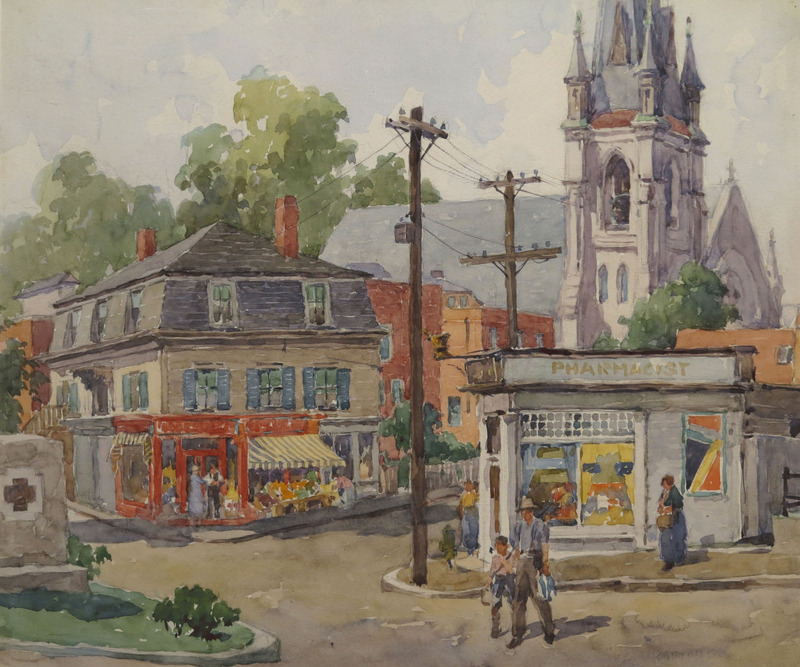
gray day

Gray Day, Gloucester Docks

StAnn (2)

St. Ann’s Church, Prospect St.

hanging Laundry (2)

Hanging Laundry, Portagee Hill


Artist: Tommy Heinsohn (!)

heinsohn

Pink House on Portuguese Hill. Tommy Heinsohn (b. 1934)

Folks who are my “friends” on Facebook know that every day I try to feature a work by a different artist, past or present, who has come to Cape Ann for inspiration. Some call it home, others are just passing through. There are so very many to choose from that rarely do I repeat a post. While searching this morning I came upon a lovely painting by an artist who really surprised me…and he probably will you too. ~ Bing

I have provided a link for more information on this unique talent.

Click here >> Tommy Heinsohn

Birdseye Photo Montage by Gloucester artist Louise Welch

eve of destruction

Montage ~ Eve of Destruction, 55 Commercial Street Flashback…Birdseye Building.

This photo montage came about when I was photographing the destruction of the Birdseye Building.

To me it was very sad and I was not happy with what was replacing this historical landmark.

I started to edit my shoot and all I could think of were the ghosts of the past who spent time working there, and I became upset on its eve of destruction.

I added a real photo of Clarence Birdseye, workers looking out windows, hands trying to stop the demolition, seagulls who hung out there to feed on discarded cod…. and tried to make it look like ghosts of the past.

Louise Welch

Gloucester photographer
Louise Welch