Chief Campanello Breaks Down Barriers

campanello

Kudos for Gloucester Police Chief’s Innovative Drug Policy

by Mike Cook

As a follow up to my  essay chronicling the history of the heroin/prescription opioid epidemic in Gloucester, I wanted to praise Gloucester Chief of Police Leonard Campanello for his courageous decision to offer active addicts an opportunity to avoid all but inevitable arrest if they come forward, surrender whatever drugs they may possess, and agree to enter a treatment program.

One can be sure Chief Campanello will take some heat for his willingness to treat addiction as the public health problem that it is from some on the Gloucester police department, along with  more than a few uninformed and judgmental “civilians” in the city.

In fact, that criticism is already brewing on the city’s right wing version of “Enduring Gloucester”. One blog site is already full of posts criticizing Chief Campanello, with dire predictions  the chief’s actions  will result in a tsunami of addicts coming down the line and over the bridge to “beat the rap” and take advantage of Gloucester’s sucker mentality – thanks to all of us “mentally defective liberals”  who become fabulously wealthy running social service empires paid for by all the aggrieved right wing, law abiding, over taxed, Christian residents of Cape Ann.

But let’s get back to Chief Campanello’s policy shift. This is a major positive step in the right direction for several reasons.

Perhaps the biggest positive is that Chief Campanello’s initiative will, finally, help  break down the barriers that long prevented social service and substance abuse treatment providers in the city from working with law enforcement in ways that actually might have helped address drug addiction in a truly substantive manner.

I recall, at the height of the anxiety in the early 1990’s over how HIV might impact the city’s needle using population, their sex partners, and, sadly, their children, doing a presentation at City Hall on needle exchange programs and why the Massachusetts Department of Public Health saw Gloucester, given its long entrenched heroin problem, as a prime candidate city for a pilot needle exchange program.

Law enforcement at that time was one of the most vociferous opponents of even discussing such a public health intervention and, given its influence in the city, it quickly became clear there was no point in trying to educate the community about such programs.

It mattered little such programs were highly structured. Needles, for example, were all numerically coded. Addicts didn’t just come in with any needle to exchange for another. They had to enroll, anonymously, in the program. They then would receive a numerically coded clean needle. When they brought that needle back, they would receive another coded, clean needle.

There were “no questions asked”, but participants in such programs were constantly provided with information and encouragement regarding treatment and the various services available to them when they decided they had had enough and wanted to get clean.

Needle exchange programs also provided epidemiologists with the opportunity to get solid data on the extent to which blood borne pathogens like HIV and Hepatitis B & C were present in injection drug using populations because the returned needles were sent to the state laboratory so that antibody screenings could be done on any residual blood  in the returned syringes.

But it was the “bridge to treatment” the exchange programs  created in communities like Provincetown and Springfield that proved so beneficial in getting other wise out of treatment addicts connected to services that ultimately led many into treatment.

Unfortunately, community resistance to a Gloucester needle exchange program two decades ago, with much of that resistance coming from law enforcement at the time, meant Gloucester missed out on the benefits such programs were shown to provide.

Chief Campanello’s proposal has all the potential of needle exchange programs of twenty years ago to serve as a genuine “bridge to treatment” for addicts looking to break the mad cycle of their addiction.

It represents a major shift in thinking on the part of law enforcement and will allow the police department and service providers to begin to work more closely together and build the kind of trust between the two systems that was missing for far too long.

Chief Campanello is to be commended for this bold shift in direction and, if the need arises, members of the community who understand the old punitive, enforcement approach to addiction has failed will need to raise their voices in support of the Chief because there are still those others who refuse to accept that addiction is a disease that requires a public health approach to addressing it – not just the “lock’em up and throw away the key” attitude that was prevalent in Gloucester for far too long.

mike_cook

Mike Cook  is a long time liberal and gay rights activist who saw the uniqueness of Gloucester from the first moment he drove over the bridge during his move from Cambridge to Cape Ann in 1991 to run NUVA’s AIDS education and services programs.
Of Cavalcades and Dropouts- Essay by Jeff Rowe

Cavalcade


photo (3)

photo by Ernest Morin courtesy of Document/Morin

We used to walk around the back shore and make jokes about the rich folks. Their big houses and supple green grass. Their tennis courts that had a better view than any of us could dream of having. Their fancy cars that we would make quips about running our keys along. Their everything. It was always us and them. Or was it us versus them? I’m not sure anymore. But for this brief moment in time, I can say with absolute certainty that it was the latter. Growing up in central Gloucester had a way of firmly planting that class chip right on your shoulder. We would head out to the back shore to drink cheap beer on their golf courses, fool around on the rocks beside the ever looming ocean, and in our own way—take a little back.


I’ll be the first to admit that I sometimes drive around the back shore when I visit Gloucester. It’s beautiful in its turbulent nature. The merciless ocean, unafraid to reveal itself. The way the land is jagged and seems to invite the water forward, like a weathered boxer, ready for another blow. But I see it from a different view than that of my youth. Back then, in our uneducated minds, it represented the bourgeoisie (think Marxism). I still have the same political desires as I did then, but now I can articulate them. I differ from my teenage self in two profound ways: 1) I know how to pick my battles. 2) I actually know what the word bourgeoisie means.


My group of friends were a touch political. I was on the intense side of our political spectrum. I wanted to hoist a black flag and call it a day on everything that I perceived as oppressive. I thought then, and for the most part still do now, that racism, sexism, hegemony, and homophobia were all oppressive bi-products of capitalism. But I had yet to begin to dig into Chomsky, Kropotkin, or Marx and Engels. In many ways, I had little knowledge to back up my convictions—just a blind sense of rage. It was convenient in that sense. I felt as though the city offered us little to do. I thought it was a city for the old, that had little regard for its youth. In actuality, maybe I was just looking for an excuse to raise a little hell.


Ben had a beat up Volvo that we would drive around in for the better part of our youthful nights. We’d be listening to cassettes, smoking cigarettes, and constantly looking for someone to buy us beer. Ben was the perfect mode of transportation, mostly because he didn’t drink. That was rare in our group of friends. We liked our booze, but we were also well aware of the consequences of drunk driving. Ben was bean pole skinny, with reddish brown hair that came down well past his shoulders. In the warmer months he would always wear the same pair of cut off jean shorts. Hailing from Corpus Christie, Texas—he was a ways from home. He had a sense of humor that cut like a razor and he was older than us. I liked him for a myriad of reasons, but mostly because he was up for almost anything—at any given time. And that was exactly where I was at the moment. It was an in-between time for me; I wanted to drop out of school and work full time, but mostly I wanted my own apartment. I was too young for the apartment, so I was really pulling for the other two.


One memorable night, we “borrowed” a shopping cart from the grocery store in East Gloucester. We proceeded to tie it to the Volvo, by way of a long bungee cord. We set it up in such a way that it was dragging behind the dented blue monster we were cruising in. That night, at around 3am, we dragged that shopping cart all through the rich neighborhoods of the back shore. The sound of the shopping cart shearing through the calm repose of night. Sparks flying in a cavalcade of concrete, steel, and plastic. It was a sight. You could see the lights turning on in each window as we passed. It was harmless (besides the obvious damage to the cart), stupid, and more fun than you would think. I remember one of our friends asking why we would do something like that. The answer was swift: “Because fuck them, that’s why”. That was just who we were; good-timers, wanna- be dropouts, fledgling activists, misfits, and for a fleeting moment—friends.


We were reckless. I wouldn’t dispute that. And in our own way, we were naive. I don’t miss my inexperienced, wayward youth too often. But when I do, It’s usually when I’m pulling memories like Ben and his Volvo out of thin air. Those moments have become apparitions of my past. They come around to visit from time to time, like an old friend that reminds you of an embarrassing moment. And I’m not afraid to say that when they do come around, I smile just as much as cringe.


Dropout

I was never long for school. Most of the time I would be reading books in class that weren’t the prescribed curriculum. I was once suspended for reading Thoreau when I was supposed to be reading with the rest of the class. To be fair, I’m sure the suspension was partially hinged on my hostility towards the book I was supposed to be reading, which I had already read. I’m sure my general attitude towards the teacher also didn’t help. School was never my thing. I loved learning, but there was something about a controlled environment of predominately useless information that felt senseless to me. Not all of it, but I think we can all agree that the vast majority of what we learned in school was either false, or useless.


I wasn’t a dumb kid, by any means. I could pass any test, and I’m not saying I was some kind of Will Hunting, but that was the easy part for me. School gave me anxiety. The thought of the cafeteria, where to sit, made my head spin. Obviously, I sat with the other freaks with dyed hair and piercings. Where else? We were outcasts, but given the confined populace, we took that as a compliment. The table I sat at during our lunch period was packed with malcontents from all over Gloucester. Their stories were all similar to mine, differing in small ways, but similar just the same. We shared the same loathing of school and its captivity, the same love of sub-cultural music genres, and we all called the crust of a slice of pizza, “the pizza bone”. All of which were very important, at the time.


Skipping school became an art form. I would show up to school just to go to my comparative religions class (by far the most interesting), then I would sneak out in mischievous fashion. Maria was the grounds monitor. A short, red haired, fiery Italian. She spoke English, but when she was yelling at you to stop from exiting the school grounds, she was most certainly swearing in Italian. We would devise distractions so that I could run out the back, past the auto class, and up the short hill to freedom. Emerson Avenue and The Cape Ann Food Co-op resided just over the crest of that short hill. The Co-op, where I also worked part time, would act as my place of refuge until the heat died down and Maria had given chase to some other delinquent trying to play hooky.  Maria could give hell as well as she could take it. She would often be waiting for me the next day, grin firmly in place—punishment set to be delivered. I like to think that somewhere deep down, she liked the chase. If not, I guess now would be a bit late for an apology.


Most of my afternoons, when I skipped school, were spent at George’s Coffee Shop. I’d get grief from the owner, Fast Eddie, but mostly he would let me sit there and drink endless coffee while reading from whatever books I had tucked away in my backpack. Fast Eddie was a rough and tumble looking fellow with a thick northeastern accent. His nose was pointed and beak-like, further lending to his direct, ominous nature. We called him “Fast Eddie” because he would brush through general conversation like rapid fire. You couldn’t get a word in edge wise. There would be a 50/50 chance of actually understanding what he was saying to you. It felt like you needed an interpreter just to navigate what would normally be an easy exchange. Therefore, Fast Eddie and methamphetamine’s became synonymous. Hey, kids are cruel.


George’s was also our morning spot, where we would meet up and grab coffee and breakfast before school. But it was the afternoons that I really enjoyed. Fast Eddie would start off treating me like I had done something wrong, and if skipping school was wrong, I certainly had. He would warm up after a bit and offer me endless coffee and leftover home fries—the best home fries in town. I still think about those home fries. I wonder if Fast Eddie skipped school. I’d put good money down on that bet.


As you may have guessed, I didn’t last long at Gloucester High School. I know that I disappointed people, but I would have disappointed myself if I had stuck it out. It all seemed like time wasted. I felt as though I was getting very little out of it. In my experience, though I certainly wouldn’t advocate that everyone dropout, I would say that school can become a setback for some. It was for me. But I see education and time spent in school as being two very different things. Maybe that’s my Gloucester attitude shining through. Or maybe, and I’m just saying maybe, it’s the truth.


My personal experience of schooling wasn’t all bad. I had a few teachers that literally changed my life, despite the curriculum of Gloucester public schools at the time. Let’s face it, Gloucester doesn’t exactly churn out brilliance on a conveyor belt of molded intellect. My moments of breakthrough with teachers were spawned from unlikely moments. The last thing I want is to demonize teachers. The drastically underpaid, incredibly noble people that would dare to take hundreds, if not thousands of peoples children under their careful tutelage. I don’t. But it’s a grave miscalculation to not come to the conclusion that the very spirit of learning is unique, and subject to one’s desires. A brain does not deserve a cell anymore than a a bird does a cage. The cold persistence of hand me down education is as much to blame for class division as the almighty dollar itself. It ensures that each generation is doomed to repeat the falsehoods of the last (end rant).


I had very few teachers along the way that really inspired me. But I could fill up page after page for those that did. I was a difficult kid to reach. I desired to be treated like an adult at such an age that it was inconceivable for the vast majority of adults to do so. I was sarcastic and held the belief that everyone shared my sense of humor—which was often fraught with trenchant attitude. In reality, a precious few actually shared and understood my sarcasm. Essentially, I was the joke that everyone listened to eagerly, only to find out, disappointedly, that they didn’t get the punchline. Leaving myself to take on the form of the actual punchline. One of the few that really understood me and inspired me was my second grade teacher. He’s another person that randomly makes his way into my thoughts. If he were alive today; I would very much want to know what became of his life.


Mr. Ritondo had a flamboyant nature about him. In the very least, you could call him effeminate. He was my second grade teacher. He painstakingly taught a group of flippant Gloucester kids their times tables. I was always good with math, as was my friend, Strider Kolodzik. We were the first in our class to learn our multiplications tables through the 9’s. I know that doesn’t sound like a big deal now, but trust me, it was at the time. Mr. Ritondo took us both out for ice cream at Friendly’s to celebrate our accomplishment. Most of the kids made fun of Mr. Ritondo. It was obvious why, even though putting a name on it was a bit out of grasp for us second graders. I was really fond of him. He was kind, he let me read Stephen King books (as long as I gave him a book report), and most of all—he listened to every word that was said to him. He literally clung to every word. He had a way of making those around him feel important.


Kids are barbarous by their very nature. They assiduously seek out all the differences, no matter how small. Mr. Ritondo didn’t seem to mind the way the kids would whisper about him. I don’t think any of us had met a man that openly displayed his femininity. I know I hadn’t. But in all probability, if it wasn’t his effeminate attributes, it would have been something else that the kids would have found to exploit. When you’re young you tend to make fun of what you don’t understand. It’s the very definition of savagery.


I can’t remember exactly when I heard that Mr. Ritondo had died. It was a few years after I moved on from his class. But I do remember that I had since learned the words that the kids in my class had been grasping at to draw blood. He may have been unlike the men we were accustomed to, but still, he was undeserving of the cruel children that he was carefully teaching the mechanics of life to. When I think of Mr. Ritondo, I don’t think of the name calling, or the blood thirsty ignorance. What I choose to remember is that triumphant ice cream at Friendly’s with Strider Kolodzik , my multiplication tables, and my mentor.


jeff-rowe-2

Jeff Rowe lives on Winter Hill, in Somerville. He grew up in Gloucester and has since traveled the world playing music and collecting memories. He is a brewer by trade and is now in the process of writing a memoir. 


Gloucester’s INSPIRING Police Chief

campanello

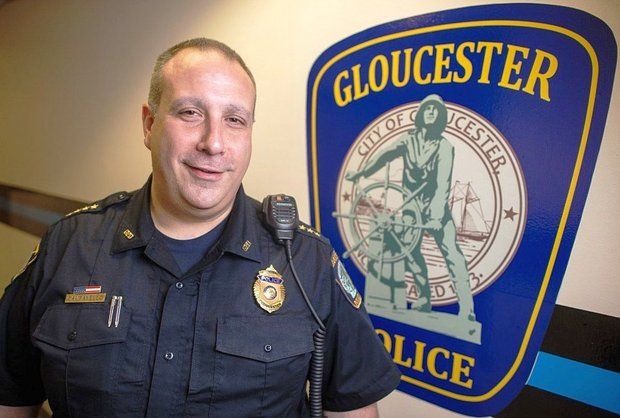
Gloucester’s police chief, Leonard Campanello

“I have been on both sides of this issue, having spent 7 years as a plainclothes narcotics detective. I have arrested or charged many addicts and dealers. I’ve never arrested a tobacco addict, nor have I ever seen one turned down for help when they develop lung cancer, whether or not they have insurance. The reasons for the difference in care between a tobacco addict and an opiate addict are stigma and money. Petty reasons to lose a life.”

Chief Campanello is boldly changing the way addicts will be treated by the Gloucester Police Department.

Read his entire press release of May 4 here:

On Saturday, May 2, the City held a forum regarding the opiate crisis, and on how Gloucester has many resources for help. We are poised to make revolutionary changes in the way we treat this DISEASE. Your Police Department vowed to take the following measures to assist, beginning June 1, 2015:

Any addict who walks into the police station with the remainder of their drug equipment (needles, etc) or drugs and asks for help will NOT be charged. Instead we will walk them through the system toward detox and recovery. We will assign them an “angel” who will be their guide through the process. Not in hours or days, but on the spot. Addison Gilbert and Lahey Clinic have committed to helping fast track people that walk into the police department so that they can be assessed quickly and the proper care can be administered quickly.

– Nasal Narcan has just been made available at local pharmacies without a prescription. The police department has entered into an agreement with Conleys and is working on one with CVS that will allow anyone access to the drug at little to no cost regardless of their insurance. The police department will pay the cost of nasal narcan for those without insurance. We will pay for it with money seized from drug dealers during investigations. We will save lives with the money from the pockets of those who would take them. We recognize that nasal narcan is not the answer, but it is saving lives and no one in this City will be denied a life saving drug for this disease just because of a lack of insurance. Conleys has also agreed to assist with insurance requests from those who do not have any.

– I will personally travel to Washington DC, with the support of Mayor Theken, the City Council, Sen. Bruce Tarr, and Rep. Ann-Margaret Ferrante, on May 12 and 13. There I will meet with Senators Elizabeth Warren and Ed Markey and Congressman Seth Moulton. I will bring what Gloucester is accomplishing and challenge them to change, at the federal level, how we receive aid, support and assistance. I will bring the idea of how far Gloucester is willing to go to fight this disease and will ask them to hold federal agencies, insurance companies and big business accountable for building a support system that can eradicate opiate addiction and provide long term, sustainable support to reduce recidivism.

I am asking for your help. Like this post, send it to everyone you can think of and ask them to do the same. Speak your comments. Create strength in numbers. I will bring it with me to show how many voters are concerned about this issue. Lives are literally at stake. I have been on both sides of this issue, having spent 7 years as a plainclothes narcotics detective. I have arrested or charged many addicts and dealers. I’ve never arrested a tobacco addict, nor have I ever seen one turned down for help when they develop lung cancer, whether or not they have insurance. The reasons for the difference in care between a tobacco addict and an opiate addict is stigma and money. Petty reasons to lose a life.

Please help us make permanent change here in Gloucester.

Thank you,
Chief Campanello


Memories of a Highliner’s Son

 
Memories of a Highliner’s Son
 
by Big Tom Brancaleone
 
 
My family fished out of Gloucester on the Joseph & Lucia I, II and III, for over 50 years- as boat owners, captain and crew. They worked hard and were successful in their labors. They were known for being fair to their crews and had a propensity for fishing in bad weather.
 
 
  As a child I can remember the worried look on my mother’s face as our home on the Boulevard shook and the storm windows squealed and shuddered. The boat was out in yet another storm. Their hope was to be the only boat to market and to fetch a big price when they finally made it back to port, and they often did just that. As a boy I did not realize the dangers they faced and the ordeal that life as a commercial fisherman posed. They truly were iron men on those small vessels that earned every penny with sweat and blood.
  I never could begin to understand what my father sacrificed for us and how hard he worked until he actually took me out on my first trip. After two or three days of preparation,  which normally included vessel maintenance and fishing gear upkeep the Joseph & Lucia lll  (J&L III) was almost ready to set sail. The fuel tanks were filled and the food locker in the fo’c’sle was stocked. Thirty-two tons of crushed ice was put down the fish hold and the seven man crew said good bye to their loved ones and braced for eight to 12 days of battle with Mother Nature.
 
 
  I was only 14 in 1972, and it was summertime so the backdrop for my first experience at sea was rather tame compared with what it was like in the winter. My main duty was to keep my eyes open and stay out of harm’s way. I did suffer from sea sickness the first night out but, though it was awful,  it subsided after about 24 hours and wasn’t a problem thereafter.
   We steamed along at about 12 knots for roughly 36 hours to reach the fishing grounds. Crew members were required to take a “steaming watch” when the boat was under way. This is a very important duty and the lives of all on board are in the balance.


 The rules of the ocean and general seamanship are practiced at all times and of course you can never fall asleep. The captain gives his instructions and retires to his quarters to rest up. He will not get much sleep once the fishing begins. The importance of being alert on watch was demonstrated many years later as the J & L lll ,when steaming home after a particularly arduous trip collided with an ocean going barge in the Massachusetts Bay at full speed with 140,000 pounds of fish aboard. The man on watch had somehow dropped the ball. They were very fortunate to survive that mishap with minor damage to the boat and injuries to the men. Crew members suffered a few lumps and the bow was slightly dented. The barge had over $125,000 in damages and the boat got a $1000 fine for speeding in the fog in the bay. The barge was being towed by a tug and was tethered to it by a massive cable. If they had hit the tow cable there is a good chance the boat could have rolled over. An alarm was then installed that warned of a possible collision after that near disaster.
 
 
  The haul back bell rang and all hands got up from their bunks put on their oil skins and boots then readied the net to be set out. We were on Browns Bank in what is now Canadian waters in June of 1972. There was no Hague line at that time and the ocean was not as restricted as it is today. The crew on my families’ boats were for the most part expert fishermen. Browns Bank was notorious for being “hard bottom” that often teemed with haddock. I was instructed to keep clear of all wires and blocks and the many dangerous things that were going on, on deck. Not long after that trip the dangers of working on deck were vividly brought to light when my oldest brother Joe had his arm severed while setting out the net aboard the J & L ll. He had just gotten out of the Navy after four years as a quartermaster aboard nuclear submarines. My mother was oh so worried about him being on a sub. The deck of an eastern rigged dragger is a far more dangerous place. I will relate that story later because it merits its own chapter in human drama and endurance.
Once the net is set out it will be towed or dragged along the ocean bottom for about three hours. Often on hard bottom like Browns the gear will hang up and suffer varying degrees of damage. Sometimes nets  needed immediate repair, but sometimes they could be fixed at the end of the tow when the net is hauled back on deck. In those days there were lots of fish and lots of damage incurred during normal fishing operations. This required expert crews with mending skills and the ability to get the gear back over and catching fish again. The men would often mend the damaged net for hours, then re-set it. Then they would still need to cut, gut, wash and ice down the fish and wash the deck. Less than three hours later the alarm would sound once more and it was time to do it all over again. They worked around the clock on a rolling deck in all kinds of weather for days on end. They missed being home when their children were born and many other wonderful events that we on land take for granted. I knew rather quickly that this would not be the life for me!
The first tow was completed and I was seated in the pilot house with the captain, my Uncle Tom. He was a high line skipper who had been fishing for over 30 years at that point and had earned a great deal of respect from fishermen up and down the east coast. As the crew brought the trawl aboard, the cod end popped up and confirmed a good haul. The bag of fish had to be split and swung over the rail in two parts. The deck swarmed with over 7,000 pounds of haddock and scrod. The crew re-set the net and began to cut fish, and the gulls followed the J & L lll as she plodded along in the dark of night.
It was during one of these nights when everyone had just gotten off the deck and we heard a loud BANG!  We hung up hard and parted the main wire while also causing serious damage to the net. Back on deck to recover the gear and put the net back together. This appeared to me to be a tricky procedure that the veteran crew handled with just a bit of difficulty. I had the greenhorn job of filling mending needles with twine as the men fixed the net under the watchful eye of the first mate, Frank D’ Amico who had been fishing with Captain Tom from day one and was one of the best twine men in the business. They used up the needles almost as quickly as I could fill them. After an hour and half or so the net went over the side, a lot more fish would soon be on the deck.
As instructed I watched and tried to learn and be aware of the endless toil that is part of being a dragger-man. I was only 14 and was allowed to go out fishing,  not to learn to be a fisherman, but in order to dissuade me from ever becoming one. My father was the engineer aboard the J & L lll and was known as “The Chief.”  He knew very well that it was a hard life filled with danger and hardship and wanted me to find that out for myself. I quickly did.
The trip continued, and within 3 days the J & L lll had over 40,000 pounds of fish iced down in her hold. We hauled the gear aboard and proceeded to steam to another fishing ground to the south to concentrate on a different species of fish. Here we caught more of mixed variety including flounder and red fish. As I became more aware of my surroundings and possible areas of danger I was allowed to venture out on deck and help the crew with cleaning fish and picking trash fish out of the pens on deck and tossing them over the side. We ate three square meals a day prepared by the cook Gil Roderick. The cook’s job aboard a dragger is a difficult one. He has his duties on deck as well as feeding seven or eight hungry men for the duration of each and every long trip. A small stipend for the extra work seemed hardly worth it to me. He has to order the “grub,” stow it, and prepare it in some sloppy conditions. He is also responsible for cleaning up after every meal. Tough job. A few more days passed with far less damage to the net and another 30,000 pounds of mixed fish.
Again we put the gear aboard and headed to the #8 buoy for some codfish. After about a 12 hour steam we neared our destination as the night was ending. This place, I was told, was fished during the day time and there were a number of vessels waiting for sunrise before setting out. Several were Gloucester boats I recognized. At that time there was a limit on cod. You could catch 30,000 pounds per trip. It was a beautiful summer day and all the boats set out together at sunrise. You could see the faces of other crew members on deck close by and it became a race to see who would catch their limit first. The cod were there and we quickly hauled back and put 5,000 pounds aboard on the first set. By late afternoon we had our 30,000 pounds aboard. The deck was full,  the net was aboard, and as we steamed out of there you could see and hear other men on the other boats waving and hollering at us as we passed. We were the first to leave and head for home! I felt such pride and accomplishment as we sailed out of there, and I will never forget that moment. The Joseph & Lucia lll was headed home!
I for one was extremely happy to be on our way in. I was tired and had never worked so hard in my life. I had witnessed some things that I had never imagined and got a small taste of the fishing life. We finally arrived in Boston in the wee hours of the morning and prepared the vessel to take out fish. The fish hold man was veteran Gaspar Palazolla, whose job it was to ice down the fish and also to give the skipper an accurate tally as to the amount of fish by species that were in the hold. At the pier an auction took place in the morning to determine the price of the fish on hand that day and to document which dealer bought what and how much. The names of the vessels in that day and the amount of fish was written on a huge chalk board grid,  and then bid on. There were a few boats in port that day and J & L lll topped the board with 106,500 pounds. Not a bad trip. I was responsible for washing pin boards and did perform this somewhat tedious task that day. By 3:00 pm we were finished taking out.  We untied the lines and headed for Gloucester. I can remember climbing down the fish hold with my cousin Joe,  and Gaspar and rebuilding it with pen boards. We were a bit giddy by this time and Joe and I began to sing in high pitched voices as we worked, much to the chagrin of Gaspar! After that I went up in the wheel house with my dad and uncle and enjoyed the ride home. As we sailed past the dog bar breakwater I could see my house on the Boulevard. I wondered what my friends were doing and how my mother was. I knew she was more worried than usual this trip, with my dad and me out together. We got to the dock at Rocky Neck and as I put my feet down on solid ground I let out a sigh of relief.
I got home and my father asked me if I wanted to go on the next trip-  in about three days.  My immediate response was no. I wanted to ride my bike and go to the beach and enjoy school vacation. He did not press me at all. Three days later the captain called with orders for 8:00 am for another trip. I traveled down to the ice wharf on Harbor Loop with my brother and mother to see my dad off. As they untied the lines and the boat pulled away from the wharf I began to cry. For the first time I had an idea of what he did for my family. Year in and year out, trip after long trip he and all working fisherman put their lives on the line and endure.


Vice President of  St. Peter’s Club,  and a director of the Gloucester Marine Railways Corporation since 1998, .Tom Brancaleone resides with his family overlooking the “Man at the Wheel” on the Boulevard.

Editor’s note:

 “Highliner”  is the commercial fishermen’s term for their own elite, the skippers and crews who bring in the biggest hauls.


Anastas and Buckles : Two Generations, Two Perspectives


POSTPONED UNTIL SPRING 
BECAUSE OF SNOW AND PARKING ISSUES

‘Two generations, Two Perspectives’ 

Writers Center event features authors age 28, 77


BY GAIL MCCARTHY 

Two writers representing two generations of Gloucester natives a half century apart will talk about their recent work at an event at the Gloucester Writers Center.

The program is titled “Two Generations, Two Perspectives, TwoGloucesterWriters” featuring Casey Buckles, 28, and Peter Anastas, 77, both of whom will read from their novels about Gloucester on Wednesday Feb. 18 at 7:30 p.m.

Buckles’ book is titled “Plain of Ghosts,” while Anastas will read from his novel-in-progress “Nostalgia.” 


Casey Buckles, 28, will read from his novel about Gloucester during a program titled “Two Generations, Two Perspectives, Two Gloucester Writers” on Wednesday at 7:30 p.m. at the Gloucester Writers Center. 


Peter Anastas, 77, will read from his novel about Gloucester during a program titled “Two Generations, Two Perspectives, Two Gloucester Writers” on Wednesday at 7:30 p.m. at the Gloucester Writers Center. 


For starters, Anastas grew up in the nation’s oldest seaport when it had a thriving fishing industry that employed thousands of residents working at sea and in the shore-related businesses. 

Downsizing industry 

Buckles, on the other hand, grew up at a time when fishing was greatly downsized with the onslaught of government regulations, and when local drug abuse made recurrent headlines as it continues to do so today. His generation is also the first to compete in a global marketplace that’s seen U.S. jobs vanish overseas where the labor market is cheaper. 

A lifelong writer and columnist, Anastas holds degrees in English from Bowdoin College and Tufts University. He also studied Medieval Literature at the University of Florence, Italy. 

Commenting on the value of the young writer’s work coming as it does from his experience growing up in the heart of Gloucester, Anastas noted: ”The city has been the subject of a great deal of poetry and prose, of history and fiction; yet until the recent publication of Casey Buckles’ novel, ‘Plain of Ghosts,’ we have not had an account of what it feels like to come of age at this very moment in a community in dramatic transition.” 

’Locally crafted’ 

Buckle’s novel, he further noted, should be experienced as a “locally crafted and produced work of art.” 

The novel tells the story about the struggles of its main character, Noah, and his friends, as they attempt to make lives for themselves after high school, and while they may dance and drink in local bars and clubs, they are searching for deeper connections of love, companionship and the meaning of community, explained Anastas. 

”For Casey, the bleakness comes from the fact that he is looking at the lives of his generation in Gloucester. What do they have for work? What is in store for them if they stay here? In many ways Casey is a poet,” said Anastas. 

Buckles said this book grew out of years of note taking when he was attending school at the University of Massachusetts, Boston. 

”It was a lot of reflection that turned into what the book is now,” said Buckles, who studied philosophy, anthropology and English. 

Seaport issues 

In addition to Buckles’ reading, Anastas will read from his own work in progress, which is described as a post mortem investigation of how the city came to be what it is today. Anastas has cherished his life in Gloucester, though he too has critical views about the issues that face the seaport today. 

Anastas asked Buckles about what he sees as the future in Gloucester for his generation. 

”The world didn’t end when the Bird’s Eye fell, so there is still a future. Will it include my generation or any type of working waterfront? That will be easier to answer in retrospect,” wrote Buckles in response. “…For those who are here, spread over its 41.5 square miles, for however we live to survive, there is a future in this city.” 

Gail McCarthy can be reached at 978-675-2706, or via email at. 

Lobstering by Dory

The Day After Christmas
By Tom Welch
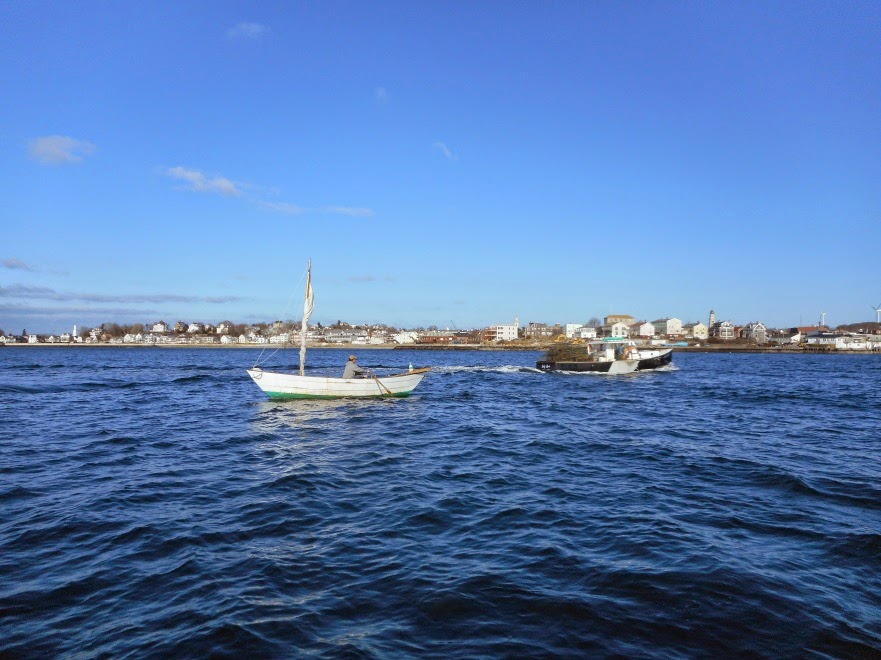
On the day after Christmas, before the Sun rises, while most of us haven’t even woken up and begun our day of nursing yesterday’s overindulgences  or heading to the Mall to exchange things we don’t need for other things we don’t need, Tom Jarvis is down at Santapaolo’s wharf in East Gloucester. He’s a true Gloucesterman, so the routine of checking his dory and gear for hauling lobster traps is more like breathing than a difficult thought process.


He lets go of the lines, rows out of Smith’s Cove and arrives at the Gloucester Maritime dock with the first rays of morning sunlight. His first order of business is to take care of his favorite girl, the only one he’s ever been able to commit to. She’s the “Resolute”, a Burnham-built Friendship Sloop with such beautiful lines you can’t gaze upon her without a double-take or a lasting, long look. The Burnham family courted Tom to buy the “Resolute” for years, knowing he’d take good care of her, they finally let him have her for a song- the cost of the new engine they put in, as Tom says, “I bought an engine with a beautiful boat around it!” He starts the engine to charge her battery and pump what little water might be in the bilge, lingering long enough for a few sips of coffee, his hand on her boom, listening to her purr.


Now it’s back in the dory, rowing out past Harbor Cove and the Fort, the back of his neck tells him the forecast for Southwest wind was accurate and dictates that he’ll row toward Stage Fort Park, using the lee of the Magnolia shore to get to his first traps set over by Norman’s Woe, the infamous rocks causing the “Wreck of the Hesperus”.
Most of the Inshore Lobstermen are putting their traps ashore for winter because the lobster have migrated to safer, deeper water and winter storms can cost thousands of dollars in damage to a lobsterman’s gear. One passing close by, starboard to starboard, with a deckload of traps, steaming in, shouts “Jarvis!” and Tom acknowledges the greeting with a respectful raising of the chin. The hands, arms, back and legs are too busy sweeping the oars and driving the dory the 3 miles windward to the first traps. This simple greeting holds countless fathoms of mutual respect, each knowing they share the many secrets that only come with Sea time.


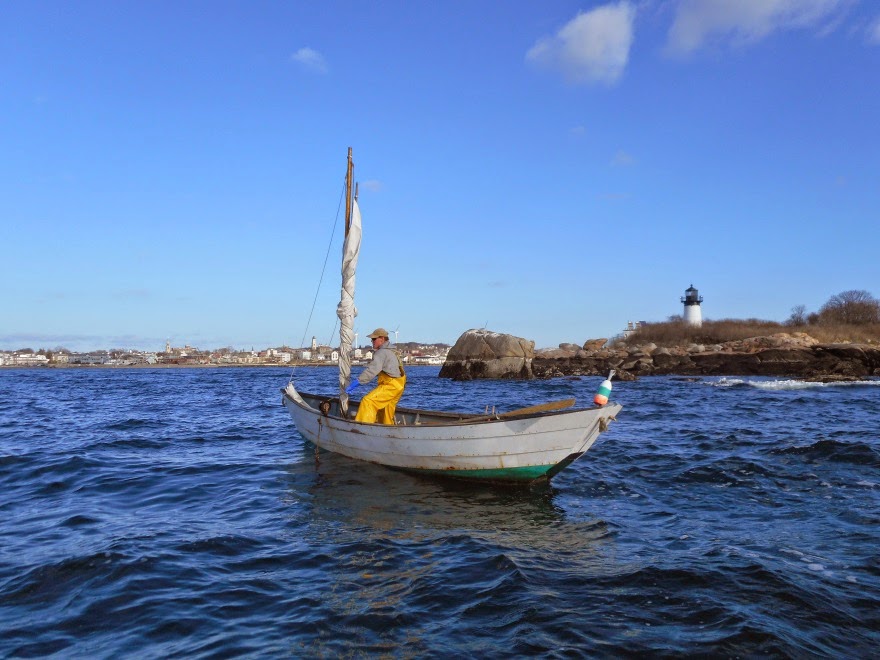
Once on his gear he quickly secures the first buoy to the dory, using it as a mooring line to hold the boat in place just long enough for him to don his boots and oilskins.  As he hauls his traps he is totally present, senses heightened by the pitch of the Sea, the squeal of the gurney and the cold salt spray spinning off of it. The Southwest wind freshens. The waves grow larger with white caps and deep troughs between. Now Mother Nature requires total awareness or she’ll take a toll. Tom embraces what she has taught him, raising his sails, she takes him ENE to Black Bess, the rocks off Joe Garland’s house on Eastern Point, where he hauls another couple of strings.

Again the sails are raised, this time the port rail to the wind as he steers NW to his gear south of Ten Pound Island. A Harbor Seal recognizes the dory and swims nearby, hoping another tasty herring will make its way into the water instead of the bait bag. And so it goes. Hauling. Setting. Trimming. Steering. Rowing. Every motion a lesson in efficiency taught by years of experience. When all is said and done he is back at his truck before noon.
The haul for the day?
Six keepers.
What???
 Six Lobsters, that’s it???
There are those that would say, “What a fool! All that work in the freezing cold for six lobsters? It’s not worth it!”
It’s not about the lobsters for Tom Jarvis, Hell, these’ll most likely end up either in his Mom’s kitchen or in a pot on the woodstove of Gino Mondello’s “Dory Shop”, feeding his fellow Gloucestermen on a Saturday afternoon.
It’s about the connections…. with the Waves, the Seal, the Lobsterman, the Sun and the Wind. 
It’s what he does.
It’s who he is.
A true Gloucesterman.
Before most people even get out of bed the day after Christmas.


Lobstering by Dory- the Day After Christmas


The Day After Christmas

By Tom Welch

On the day after Christmas, before the Sun rises, while most of us haven’t even woken up and begun our day of nursing yesterday’s overindulgences  or heading to the Mall to exchange things we don’t need for other things we don’t need, Tom Jarvis is down at Santapaolo’s wharf in East Gloucester. He’s a true Gloucesterman, so the routine of checking his dory and gear for hauling lobster traps is more like breathing than a difficult thought process.

He lets go of the lines, rows out of Smith’s Cove and arrives at the Gloucester Maritime dock with the first rays of morning sunlight. His first order of business is to take care of his favorite girl, the only one he’s ever been able to commit to. She’s the “Resolute”, a Burnham-built Friendship Sloop with such beautiful lines you can’t gaze upon her without a double-take or a lasting, long look. The Burnham family courted Tom to buy the “Resolute” for years, knowing he’d take good care of her, they finally let him have her for a song- the cost of the new engine they put in, as Tom says, “I bought an engine with a beautiful boat around it!” He starts the engine to charge her battery and pump what little water might be in the bilge, lingering long enough for a few sips of coffee, his hand on her boom, listening to her purr.


Now it’s back in the dory, rowing out past Harbor Cove and the Fort, the back of his neck tells him the forecast for Southwest wind was accurate and dictates that he’ll row toward Stage Fort Park, using the lee of the Magnolia shore to get to his first traps set over by Norman’s Woe, the infamous rocks causing the “Wreck of the Hesperus”.

Most of the Inshore Lobstermen are putting their traps ashore for winter because the lobster have migrated to safer, deeper water and winter storms can cost thousands of dollars in damage to a lobsterman’s gear. One passing close by, starboard to starboard, with a deckload of traps, steaming in, shouts “Jarvis!” and Tom acknowledges the greeting with a respectful raising of the chin. The hands, arms, back and legs are too busy sweeping the oars and driving the dory the 3 miles windward to the first traps. This simple greeting holds countless fathoms of mutual respect, each knowing they share the many secrets that only come with Sea time.


Once on his gear he quickly secures the first buoy to the dory, using it as a mooring line to hold the boat in place just long enough for him to don his boots and oilskins.  As he hauls his traps he is totally present, senses heightened by the pitch of the Sea, the squeal of the gurney and the cold salt spray spinning off of it. The Southwest wind freshens. The waves grow larger with white caps and deep troughs between. Now Mother Nature requires total awareness or she’ll take a toll. Tom embraces what she has taught him, raising his sails, she takes him ENE to Black Bess, the rocks off Joe Garland’s house on Eastern Point, where he hauls another couple of strings.


Again the sails are raised, this time the port rail to the wind as he steers NW to his gear south of Ten Pound Island. A Harbor Seal recognizes the dory and swims nearby, hoping another tasty herring will make its way into the water instead of the bait bag. And so it goes. Hauling. Setting. Trimming. Steering. Rowing. Every motion a lesson in efficiency taught by years of experience. When all is said and done he is back at his truck before noon.

The haul for the day?

Six keepers.

What???

Six Lobsters, that’s it???

There are those that would say, “What a fool! All that work in the freezing cold for six lobsters? It’s not worth it!”

It’s not about the lobsters for Tom Jarvis, Hell, these’ll most likely end up either in his Mom’s kitchen or in a pot on the woodstove of Gino Mondello’s “Dory Shop”, feeding his fellow Gloucestermen on a Saturday afternoon.

It’s about the connections…. with the Waves, the Seal, the Lobsterman, the Sun and the Wind.

It’s what he does.

It’s who he is.

A true Gloucesterman.

Before most people even get out of bed the day after Christmas.

GRATITUDE

On Thanksgiving Day 
 
Enduring Gloucester’s contributors share our gratitude
 
Gloucester Harbor  Julius Delbos (1879-1970)


“I am grateful for being so warmly embraced by my many new friends in this wonderful city.”
Bing McGilvary


“I am grateful for the sense of community Gloucester provides where it seems, it is true, everybody knows your name.  When conducting day to day activities, there is not a day that goes by where I inevitably see someone I know and exchange a greeting.”
Patti Page


“On Thanksgiving and every day, I am grateful for all the beauty that is Gloucester, from the colors of Spring to the magic Winter brings. Above all, I’m thankful for all the friends who seem to have an endless amount of joy to share.”
Laurel Tarantino

                                     photos by Laurel Tarantino


“I thought I came to Gloucester for the light and the sea, for the art and the music.  But the people I found here, tenacious and unpretentious, welcomed me into their true community and made me want to stay. This place matters to me.”   
Lois A. McNulty


“I give thanks today and every day for the privilege of living in this beautiful place, this real city, which we must never allow to be taken from us by those who would remake it in their own image.”    
Peter Anastas

Sail GHS

Sail GHS Enlivens the Harbor
by Hilary Frye, with Patti Page
                                                                                                                                                            photos by Hilary Frye

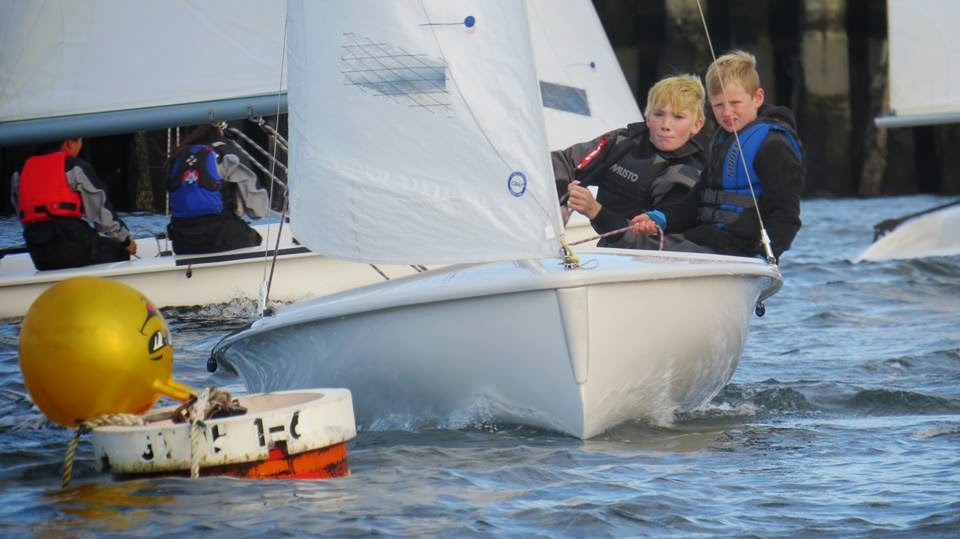
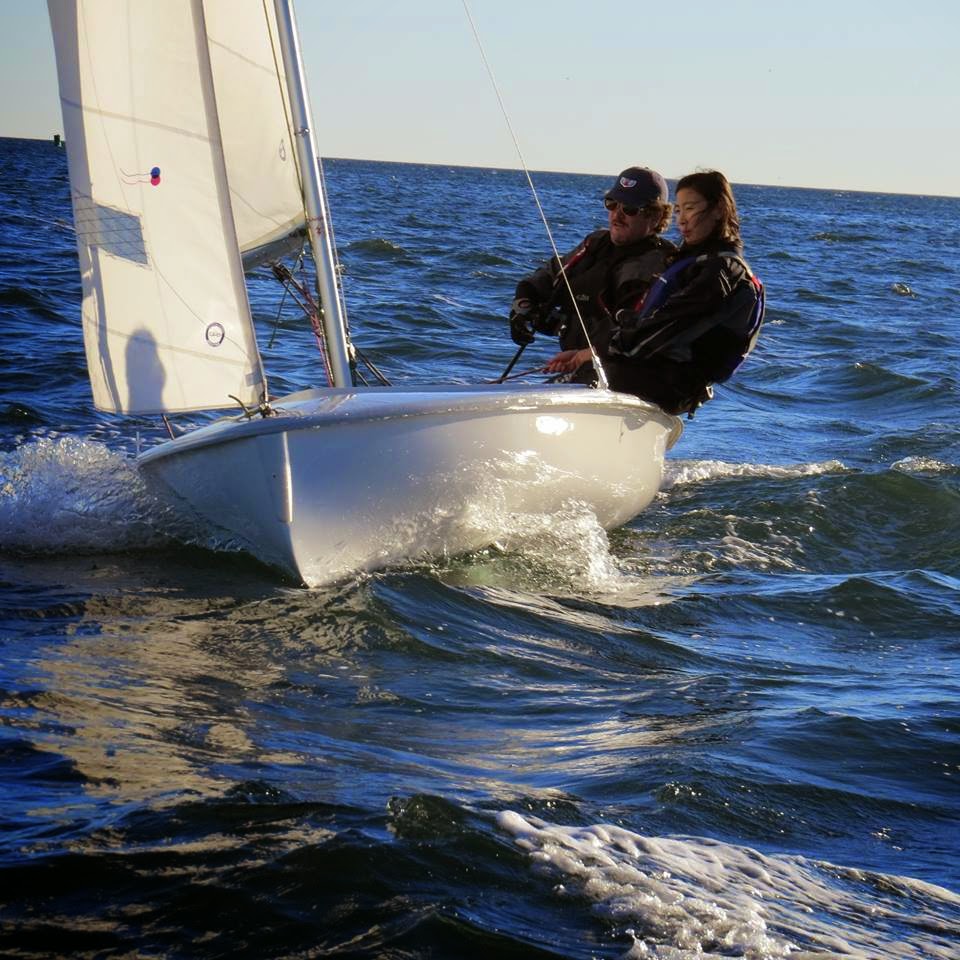
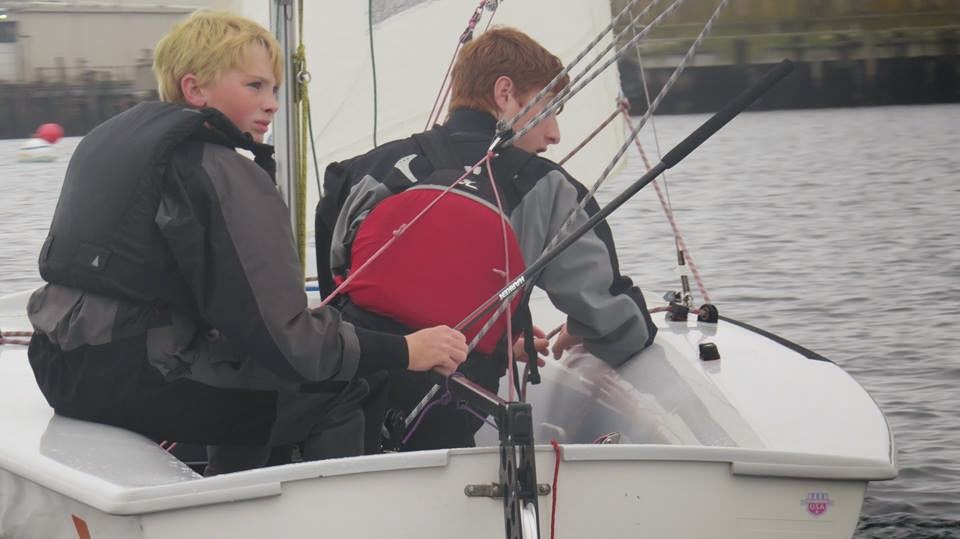
…the sky, a besmudged cauldron, leaking sudden shafts of sunlight; the water, tossing quicksilver. Like crisp white cat’s ears, the sails pop up, and the near-empty harbor dances to life.

This was the scene on Gloucester Harbor on October 30, the last day of sailing for 2014. Sail GHS will be back on the water in the middle of March.

In 2008, Patti Page introduced scholastic sailing to our city. With a harbor as beautiful as ours, she envisioned a high school sailing team as a shining asset for this historic port.
With three donated C420 sailboats, and the quiet authority and guidance of Dr. Damon Cummings, she began to build a racing team
Page engaged Guy Fiero, a canny, creative instructor, with many years of experience, as the coach. Scouring the environs of Cape Ann, she banded together a crew of intrepid high school -aged sailors who took their place as the new sailing team, Sail GHS, in the Mass Bay League racing organization.
The competitive season for scholastic sailing is early spring, when conditions are cold,  stormy and unpredictable.  Sailing is arduous at best. Page spent many an afternoon with icy winds, stinging rains, and waves breaking over the bow of her 13 foot whaler, tending her skittering flock.
By diligent fund-raising, chasing grants and soliciting donations, she equipped her team with life vests, dry suits, chase boats, insurance, league fees, and a coach, with no cost to its young members.
The Dusky foundation, ever- generous with its community enrichment efforts, endorsed the conspicuous success of the program by donating, (in conjunction with Brown’s Yacht Yard,) six brand new C420s and a fully equipped chase boat.
In 2012,  Page motivated the city to appropriate funds to replace its derelict floats at the head of the harbor with a new state-of-the-art system. The  Sail GHS racing fleet now shares the floats with the Cape Ann YMCA summer program.
With persistent nurture, Patti Page’s one-time wish was emerging as a winged reality.
Page considers Sail GHS to be the foot in the door that keeps the gate from being slammed shut on public access to our harbor. She believes that the harbor is a resource to be enjoyed by all.
Many coastal cities and towns around the country are vigorously embracing Community Boating Centers as prosperous enterprises that invigorate their waterfronts. Patti is an active proponent for just such a center, here in Gloucester.
In light of what she has accomplished with discarded or donated gear, imagine what she could make happen given actual support from the city. Give her a chance, and she just might find a way for the city to enhance the existing harbormaster’s building as a public shore-side facility. Ward Councilors would like to hear your thoughts about programs such as Sail GHS.
 Sail GHS is a competitive high school sailing program which is open to the youth of Cape Ann and beyond. Contact info: sailghs@yahoo.com  Look for Sail GHS  on facebook.

The Awesome Gloucester Foundation

The Story Behind the Awesome Gloucester Foundation
by Lois A. McNulty

(left to right)  Patty Reynolds Philbrick and Patti Ameral, representing Light Up Mattos Field, as they received $1,000 cash from Awesome Gloucester, represented by Trustee Jim Tarantino, September, 2014.

 
A small group of volunteers recently got a thousand-dollar boost in their effort to raise $100,000 to restore the lights at historic Mattos Field, thanks to the Awesome Gloucester foundation. The 20 local members of this relatively new foundation were convinced that improving the much-loved and used playing field would be one way to make Gloucester “more awesome.”
 
Awesome Gloucester has raised eyebrows in the year since it started giving away wads of cash- with no strings attached-  every month to anyone who comes up with a project that all 20 members of its board can agree will further its missions (innovation in maritime-related  industry and economy, preservation of maritime heritage and culture, community togetherness and appreciation.) 
 
What is Awesome Gloucester about?


“I guess I have a high tolerance for ambiguity,” Sal Zerilli offers, by way of explaining why he thinks The Awesome Foundation is just what Gloucester needs these days.
 
In 2012,  Zerilli had returned to his hometown of Gloucester after almost 20 years away, and he became concerned about what he perceived as divisiveness in the city’s culture. Even more so, he was concerned about his friends’ uncertainty and about growing lack of trust between people in the community.  Zerilli, an applied sociologist with a Phd from UCLA, had worked in design, communications, and innovation. He has made six documentary films, including two films about Gloucester’s most revered traditions- the Fort Neighborhood (No Pretty Prayer) and the Grand Banks Dory (Maritime Capsules.)
Having lived in Los Angeles, Seattle and Toronto before returning home with his young family, he saw firsthand how people in other places were responding creatively to similar issues in their communities .  Zerilli had a creative response to the fraught situation he found in his beloved hometown-  The Awesome Foundation – and he started talking up the idea. The Awesome Foundation, launched in Boston in 2009, has spawned  in five years 103 autonomous chapters in 14 countries.  It gives no-strings-attached, no- questions- asked mini-grants of $1,000 every month to people they believe are doing things to build community, to make the place “more awesome.” 
Within ten days of his first conversations about it, Zerilli had 20 people in Gloucester willing to commit to the ideals of The Awesome Foundation, and so a chapter began here, in late 2013.  In October 2014,  Awesome Gloucester will launch its second year.  In its first year, with little publicity but word of mouth, AG received 120 applications, and awarded $12,000 in 12 separate grants, to these projects:

November, 2013– Glosta Lobsta- promoting local, soft-shell lobster
December, 2013–  Art Haven’s Downtown Lobster -Trap  Holiday Tree 
January, 2014-Lights, Camera, Nature- getting kids outside to record the natural world 
February, 2014– Giant Chess Game – interactive, inter-generational activity for community events
March, 2014– Backyard Growers School Salad Days- involving schoolchildren in growing and eating vegetables at school
April, 2014- The Cape Ann Social Club- for mentally and emotionally challenged adults
May, 2014- Judith Sargent Murray Comes Alive!- staging a play by local writer and activist of the 1700s
June, 2014- The Phyllis A- providing a dock ramp for visitors to this restored fishing vessel
July, 2014- The Man Who Photographed the Man at the Wheel- a book of photos and remembrances of Louis Blend, from the 1920s and 30s
August, 2014- Private Freedom- support for veterans
September, 2014- The TAG Program- making the art and craft of sewing and fabric art accessible to young people 
October, 2014-  Mattos Field Rehabilitation- local playing field
November, 2014–  Bridge to Workplace- work opportunities for special needs students


“It’s a way of focusing on solutions to the problem of declining trust in community. We move beyond narrow concerns and focus instead on larger values.  This helps evolve the discourse beyond choosing sides.  We’re all about creating common ground.” Zerilli says.  “We give energy to the people who are working on the front lines of community. We trust them. We support them. Most importantly we try to realize our community ideal through action.  No matter what your own perception of what’s happening in the city, most of us can agree that we can use more cohesiveness and more trust in the community, and that’s what we’re all about.”
 
But Awesome Gloucester is not just a feel-good exercise in positive thinking. It’s a concrete method for building strong alliances within and across a divided place.
 
 
It’s one thing to say you support a person or a project you think is “good for the community,” but it’s another thing entirely to reach into your pocket and hand them $50 of your own cash with no strings attached. But that’s exactly what Awesome Gloucester trustees do month after month. Zerilli adds, “The strength of Awesome Gloucester is definitely the Trustees. Smart, dedicated, passionate people all putting their money where their mouth is. In my opinion, there might be another chapter as good as us, but there is none better.”
Who are these people? You may know more than a few of them as neighbors and friends:

Jacob Belcher
Amanda Nash
Deb Pacheco
Jim Tarantino
Greg Bover
June Cook-Madruga
Mike Diliberti
Rick Doucette
Rona Tyndall
Rich Francis
Grace Giambanco-Numerosi
Greg Jaeger
Allison Mueller
Chad Johnson
Walt Kolenda
Ann Molloy
Traci-Thayne Corbett
Sharon Lowe- official AG photographer

(left to right)    Awesome Gloucester Trustees Rona Tyndall, Rich Francis, Rick Doucette, Sal Zerilli.


Awesome Gloucester Trustee  Ann Molloy, sales manager for her family’s Gloucester business Neptune’s Harvest,  believes she gets far more out of her association with Awesome Gloucester than she gives. “It’s positive energy. It’s building up the community.  It’s good people,”  she explains.  “Not just the Awesome Gloucester board,  who are awesome, but the people who apply and come pitch their ideas. I’m always blown away by the creativity and the generosity of people. They come from all walks of life, all political and religious groups.  I thought I knew this town, growing up here, but I get surprised all the time.  People are thinking up amazing ways to make life better, in the face of all the hardships we face here. You can’t get depressed when you see this kind of thing month after month.”
 
Trustee Jim Tarantino puts it this way,  “Some people here think fishing is dead, and real estate is their hope for the future;  some people think the death of the fishing industry can and should  be prevented and the working waterfront restored.  No matter what we believe,  we can all can learn from each other. Bottom line- we all have families and homes and we all care about this place Gloucester. We’re all trying to do the right thing. Awesome Gloucester is one place where people with opposite opinions on the issues  can learn from each other and work together for the same goal.”
 
There is now an opening for an AG trustee. If you are interested,
contact AG through facebook (Awesome Gloucester) or by reaching out to Sal Zerilli at szerilli@gmil.com
 
 
Awesome Gloucester invites members of the community to attend Pitch Night, at 7 pm on the third Monday of each month, at the Gloucester House, Rogers Street,  which supports Awesome Gloucester by donating its meeting space.


Awesome Gloucester meets at La Trattoria, Middle Street, during the winter months.

Zerilli points out that “Awesome” turns on its head a traditional model of the philanthropic foundation as a board of remote wealthy donors granting money to anonymous needy people.
“this is an ongoing experiment in community philanthropy,” he adds.  “totally grassroots.”
 
As a group, Awesome Gloucester’s trustees, for example, come from all walks of life (small business owners, real estate agents, teachers, retail employees, government workers, bank employees, artists, and social and health care workers. They represent varying opinions about the changes coming over Gloucester’s fishing industry and harbor, and sometimes divergent views on the future of Gloucester .  Diversity among members of the board as well as among applicants is the goal and byword for Awesome Gloucester, and it somehow works.
Awesome Gloucester crafted its local mission with three aspects:
innovation in maritime related industry and economy,
preservation of maritime heritage and culture,
community togetherness and appreciation.
Of the 12 grants that have been awarded in Awesome Gloucester’s first year, all but two have been to projects that fit the third goal- community togetherness and appreciation.
 
Zerilli is hopeful that more of Awesome Gloucester’s grants in the coming year will support its maritime economy and maritime heritage goals. To that end, AG will launch an initiative for December of this year. For one month, AG will consider applications only from a targeted community – Gloucester High School. AG volunteers and high school staff will work with students on their ideas for initiatives, and on writing applications and pitching their projects.
“We’re posing an Awesome Challenge to GHS students in December.  Our model for the challenge comes from the world of design and innovation, and we’re optimistic about the impact our experiment will have,” Zerilli says.
If this experiment goes well, AG will choose two other public institutions later in 2015 for “targeted consideration.”