Village Facing the Sea

Anne Babson Carter

Dunes at Annisquam. 1916 John French Sloan

Dunes at Annisquam. 1916
John French Sloan

Bing1 (2)bing2 (2)

September 14, 1991/For K.D. and T.B


Anne Babson Carter is the author of an award-winning collection of poems, Strike Root, published by Four Way Books.  Her poems have appeared in The Nation, The Paris Review, Theology Today, The Christian Century, Borderlands Review, among others.  A founding member of the Guilford Poets Guild in Guilford, CT, Carter has twice been a fellow of the Yaddo Corporation.  She lives and works on Cape Ann, Massaschusetts


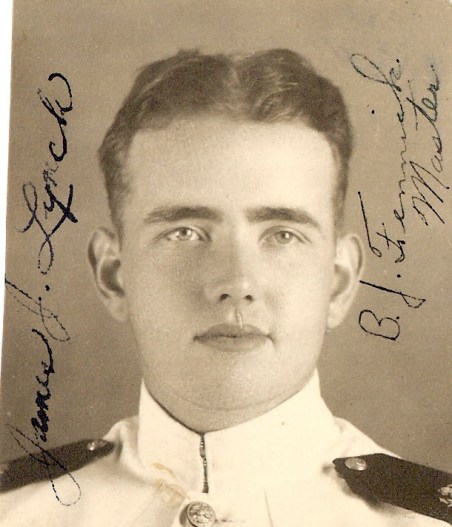
Jim Lynch: My Favorite Veteran

Justin Demetri

On a rainy Armistice Day my thoughts and prayers go out to my favorite Vet, James J. Lynch as he recovers from a serious fall…Get well my friend.

To me the most interesting man in the world is not the guy from the Dos Equis commercials; it is a 91-year-old gentleman who lives down the Fort in what many of us still call “Dutchie’s House.” For over 15 years, Jim Lynch has been more than a best friend, he’s my mentor, my Master Yoda, if you will; and along with the late great Joe Garland another set of shoulders that I stand upon. Jim has been so influential to me that it’s hard to pinpoint all that he has done. But anyone who has talked with Jim, either down the Fort playground, at the Sawyer Free Library, or even aboard the schooner ARDELLE, realizes very quickly that he has lived a life straight out of a Hollywood script. In honor of his service, here are just a few of his adventures during World War II.

As a kid Jim spent his summers aboard his family’s fishing schooners where he learned the art of navigation from his grandfather and uncles. By 1939, with German U-Boats starting their patrols, his grandfather was reluctant to have him aboard. When America joined the Allies in 1941, Jim

Jim Lynch

Jim Lynch

signed on to the Merchant Marine, and with his fishing background was made a lieutenant. He was to be a navigator on the perilous Murmansk Runs – large, poorly protected convoys to the Soviet port of Murmansk to keep the USSR in the war. Part of his training was an intensive crash-course in conversational Russian that would serve him far beyond the war years.

In May of 1942, Jim was part of a convoy on its way to Murmansk from Philadelphia. While steaming past Jan Mayen Island in the Arctic Ocean, German bombers came in almost at mast-height and bombed the ships. A direct hit sent Jim into the icy water as the ship went down.  The long day this far North allowed him to find some floating wreckage to climb upon. As he lay floating there with hypothermia beginning to take hold, he was rescued by the Soviet freighter the STARY BOLSHEVIK, heading to Murmansk with a cargo of high-octane gasoline from Texas. They threw a line and Jim had just enough energy to tie a bowline around his waist as they hauled him on deck. He was surprised to find the captain and all of the officers were women. They did not waste time as they set him up on the ship’s boiler to get his core body temperature back, while on the way to Murmansk. When Jim tells this story today he usually ends it with “it made a Christian out of me.”

Salerno

Jim’s ship was ordered to deliver mobile artillery during the landing at Salerno. The captain of this ship didn’t like Jim, one time saying, “You’re Irish, You’re a fisherman and you’re from the North….You’ll never be any good to me.” He ordered Jim to the battle bridge in the stern. By exiling him aft he saved Jim’s life. German fighter bombers swept in equipped with the latest in Nazi super weapons: Hs model remote guided rockets, the precursor to today’s cruise missiles. One of these flew right into the bridge and killed most of the bridge crew. Now it was up to Jim, highest ranking surviving officer, to run back to the ruined bridge and pull the damaged ship out of the line. I won’t describe what he found once he got there, but I have no idea how he sleeps at night…

The Raid at Bari

Jim barely survived the German raid at Bari, Italy in 1943. The Allies had ships filled with mustard gas containers in the port. The official story is that these banned weapons were being prepared in case the Nazis used chemical weapons in Yugoslavia or Greece. Jim knew what was on the ships–his ship was tied up next to them. When the German bombers flew over the ships and dropped conventional bombs, the mustard gas in the ship holds was released. Jim was once again thrown overboard from an explosion, but this time he was covered in oil, contaminated with mustard gas. Jim was mostly blind for the next three months but fared better than the 2000 military and civilians that were killed from the gas. This little known event was covered up until the late 1950’s.

Jim had many more exploits during the war, which took him to most of the major Allied ports, from Archangel to Asmara. He spent time in the Adriatic ferrying Frogmen and Partisans from Italy to Yugoslavia under German fire. It was there he met members of Italy’s exiled nobility fighting for the Allies and became life-long friends with the Duke of Colonna, the Count of Montezemolo and Venetian banking families. By the end of the war in Europe, Jim was back in the Soviet Union, where he celebrated V-E Day on the Eastern Front with Russian champagne and the thunderous singing of hundreds of Cossacks. The war was over for Europe but not for Jim. Due to the fact that Jim knew where the Germans laid mines in the Black Sea, Stalin “invited” him to stay and help with their removal. Jim didn’t return home until 1947. In the 1990’s Boris Yeltsin invited Jim and the other Murmansk Run survivors to return and they were recognized as Heroes of the Great Patriotic War.

This is only a sample of Jim’s war stories, but one thing they all have in common is his message that all he was trying to do was to stay alive: a fisherman who was just doing his duty for his country. Whoever Jim Lynch was before the war, a stronger but still honest and true version emerged from the USSR in 1947. And for those like me who have the privilege of knowing Jim, we know that his wartime exploits only set the stage for the amazing career and the wonderful family that would soon follow.

Schooner Ardelle

Here’s to you Jim!


Justin Demetri

Justin Demetri

Justin Demetri grew up “Down the Fort” in one of the many families that comprised Gloucester’s Italian fishing fleet. He spent his childhood among the fishermen, the boats and the wharves. At age 12, Justin gave the first cash donation to the newly arrived Schooner Adventure, leading to a friendship with author and historian Joseph E. Garland. This was the spark that would lead to a love of writing and an appreciation for the special place he still calls home. His interests include researching local maritime history and exploring his family’s Sicilian fishing heritage. His works on Italian history, culture and food can be found at LifeinItaly.com. Justin holds a degree in Cultural Anthropology from the University of Massachusetts/Boston and is the Director of Visitor Services for the Essex Shipbuilding Museum.

Giving Thanks

A wish to all of you from all of us at Enduring Gloucester…   may you have a Happy and Safe Thanksgiving, filled with many blessings.

“For each new morning with its light, For rest and shelter of the night, For health and food, For love and friends, For everything Thy goodness sends.” ~ Ralph Waldo Emerson

Gloucester Landscape 1919 Stuart Davis (1892-19640

Gloucester Landscape 1919
Stuart Davis (1892-1964)

Pot Luck

Laurel Tarantino

I’ve resigned myself to the fact that I will never have a formal dining room.  You know the kind I mean, a room with a long handsome table that seats ten or twenty people, with water glasses, stemmed goblets for wine, fine china and fingerbowls.  The kind of table where I would have to question, “Which fork is this, my salad fork, or is it for the main course?” A room where there are old fine art oil paintings that adorn the walls, lit by brass lamps that reflect the mastery of the artist.  Oh, and candles, how they’ll set the mood for an exquisite evening.

No, I may never know what it’s like to dine in such a formal setting, but I do know fine dining.  I’ve found a dining experience that fits into my life just perfectly, and I can’t imagine a month without one.  Pot Luck dining: I don’t know where these dinners originated, I like to think they started right here in New England.   I’m not going to “Google” them on line to learn their history, but one thing I do know, whoever came up with the concept was a genius.

I can’t remember my first, perhaps it was at the Fire Station in Lovell, Maine, where it seemed the entire town showed up to socialize.  I’m always tempted to stop at those suppers you see advertised on a hand painted board “Church Supper Tonight, All Are Welcome,” but it’s usually last minute that I see them and I was brought up never to show up empty handed.  So I smile instead for those inside enjoying their community gathering.

I have a small group that gets together to play what we call “Extreme Croquet,” mostly during the not-so-perfect weather days, hence the name “Extreme.”  One Saturday a month, at High Noon, weExtreme Croquet meet for the fun and the bragging rights of taking the win on the course.  There may be briar, knee deep grass, waist high snow, rain, or other obstacles on the course.  Always, there is friendly ribbing…   “Watch him, he cheats!  Send Him, Send Him Long.”  And always, always, there is laughter in abundance and a great variety of food in between rounds.  A quiet comes over the room as folks warm up with some of Helen’s chowder, a mound of Shepherds’ Pie, or a slice of Tracy’s extreme lemon cake.Extreme Lemon Cake

So, I may have only won bragging rights once in 20 or 30 games, but I surely come out on top each time I go, from the friendship, fresh air filled with the sounds of friend’s voices, and that wonderful, ever present “Pot Luck” meal.

Fast forward now, to a boat building shop on Harbor Loop.  The building itself is part of Gloucester’s Maritime Heritage Center.  Why they took the word “Heritage” out of the name is beyond me and a whole other story.

Anyway, when I bump into Geno he’ll say, “Hey, we’re going to be cooking this Saturday, you should come by if you can.” Or: “We’re getting together this weekend,” and the one I’m always sad to hear: “We’ve been getting together, I haven’t seen you in a while, where’ve you been?”  Life.  Why is it that life sometimes gets in the way of being somewhere we’d like to be, doing what we’d like to do?

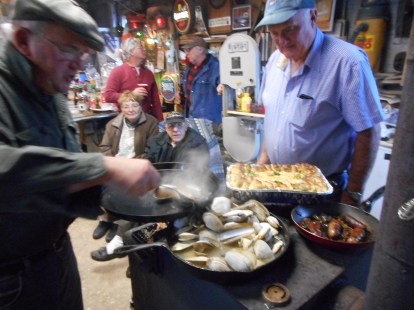
Back to the Dory Shop.  There’s usually a boat in the process of being built on any given Saturday afternoon you step through the old wood sliding door.  Hopefully, for our purpose, it’s at the stage where it’s upside down and we can use the bottom for our table.   One of my fondest memories was hearing someone yell from inside the shop “Hey Geno, we need a bigger boat,” as people kept arriving with more food.   There’s plenty of sawdust, boat building tools and warmth from the wood stove that will surely have something good cooking on it.

Cooking on the wood stove at the Dory Shop

Cooking on the wood stove at the Dory Shop

Remove the lid from the cast iron skillet and catch a fine mouth-watering aroma taking the chill out of a November day.

Tom will most likely arrive with rosy cheeks, a bucket of steamers and a few lobsters he hauled just that morning.  Someone may bring Finnan Haddie, home baked beans, a salad, sweets… Ever hear of a “Gloucester Lollipop?”  We have those too, when Joe comes in with his Mackerel on a stick and what a treat when Geno makes his fish cakes and calls from the wood stove to get ‘em while they last.  You never know what you’ll get, but a guarantee is that you will be welcomed, you will be well fed, and you’ll have such a grand time that you’ll want to return again and again.

An added bonus to Saturday afternoon’s at the Dory Shop would be the music. Someone is bound to bring an instrument or a pretty voice to entertain for a spell.  Want to dance?  Go ahead, no one judges you here.

Music at the Dory Shop

Music at the Dory Shop

Perhaps others will join you, or try and sing along. It’s okay if you don’t know the words.  Just don’t sit in the rocking chair if it’s empty. That’s Joe’s chair and he’s too much of a gentleman to tell you so.  It’s just a given for those of us who’ve been around a while.  The way I hear it, Geno started these Saturday afternoon “Pot Lucks” so he would have something fun to do with his uncle.  How wonderful for us that we benefit from these kind souls.


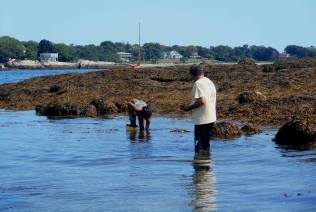
I bring you a bit away from the waterfront, to a two-car garage that houses no cars, behind Burnham’s Field.  I call these pot luck meals “Sunday Dinner at Joe’s Garage.” I have an entire photo album just for these meals.  Some of the photos include Joe gathering mussels off theGathering Mussels seaweed beds of Ten Pound Island with his daughter, to be later photographed in a pan of garlic, fresh tomatoes and wine.  Oh, and the fresh bread!

Bread is always warm at Joe's Garage

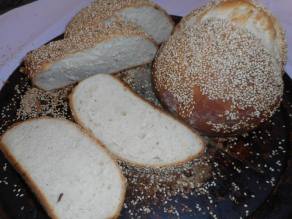
Bread is always warm at Joe’s Garage

Joe makes loaves every time.  Hot from the industrial restaurant style ovens, smothered in sesame seed, a true gift for your taste buds.  How many pictures of food can you take?  I don’t know yet, I’m still working on it.  I know for sure, there’ll be more delights coming from Sunday Dinner at Joe’s Garage.  Homemade sausage, pizzas, linguini with the clam sauce, countless photo ops.

Today I’m at another friend’s house for “Patriots Football.”  I’m among some of my dearest of friends and they all know I’m not here to watch football.  Oh, I do hope the Patriots continue with their winning streak, but it is certainly not the foremost reason for being here.  It’s the nourishment of friendship, good eats and conversations, before, during half time and after the game that feed me.  Even the dogs are happy to be invited.  Maybe someone will toss them a scrap; in the meantime, they run and play in the autumn sunshine.    This group of people take turns each time there is a one o’clock game on a Sunday.  One week it might be at Maria’s or June’s, perhaps a Harvest Meal at Lenny and Ricks, wherever it may be any particular week is the place I want to be.

I can hear cheers from the other room, the Pats must be winning.  From where I sit, we have all won for this day we’ve been given together.

There are so many ways we enjoy ourselves.  I find for me they generally involve food.  The Fort Gang feasts at different friends’ homes during St. Peter’s Fiesta, celebrating the Fourth of July with the same crew and then some in Rockport.  Bringing a dish to the Orchard Street Parade where the famous “Hat Ladies” debut their incredible work.   St. Joseph’s Feast at Auntie Emma’s, which starts before most are out of bed to make the pasta.  All memories that make forever stories to be told time and again.

So folks, if you’ve never experienced it, I highly recommend it…   call it what you will, “Pot Luck Dinner, Pot Luck Lunch, Sunday Dinner at Joe’s Garage.” Make up your own excuse, just do it.  Get together with your friends, share in the making of the meal, and eat it together, be it leaning on a porch railing or the bottom of an overturned boat.  Rain, snow, sunshine or under the stars, simply enjoy each other’s company.

If you want to “Google” the origins of Pot Luck, please let me know what you find.  I imagine they’ve been around since time began.  Surely, because of them, I dine on the best food on earth, in the finest settings, surrounded by the laughter and love of friendships old and new.

It doesn't get any better than this...


Laurel TarantinoLaurel Tarantino, writer, is happy to live in her hometown, Gloucester, with her husband, James,”Jimmy T,” daughter Marina Bella, and the family dog, Sport. She is known for “stopping to smell the roses” and loves to photograph and write about her beloved waterfront community.


Hear Her Roar

Lori Sanborn

For the first twenty-five plus years of my life, I felt more connected to the male gender. Throughout my middle school, high school, and college years I had way more male friends than female ones. Of course, I had a few girls that I trusted and could tell anything to. And one or two, who I was really close to that I would even smoke Marlboros with and cut class. But overall, at these stages of my life, I felt more comfortable around males. I was even able more readily to

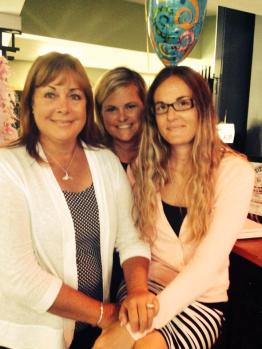
Nancy Sanborn (my Mom), Meagan Sanborn (sister) & me

Nancy Sanborn (my Mom), Meagan Sanborn (sister) & me

admire males over females. But then I turned thirty, and from that point on, my perspective had changed entirely.

During the last five years of my life, I have witnessed countless acts of unwavering courage and unbelievable strength from women in my circle of friends, women from our seaside community, and from one of the most important women in my life, my sister.

I have some badass girlfriends. Not because they ride Harleys or remain standing after pounding five shots of tequila. My friends endure. I have a friend who only cried once after being diagnosed with an aggressive type of breast cancer. When “cancer” entered my world, I was on the bathroom floor unable to move. Yet when recalling her story, she actually smiled and told me she “had two boys to raise and they needed her.” She never looked back but rather dedicated herself to being the best mother she could be. Did I mention that she was also a single mom? Badass.

Another girlfriend of mine had her world turned upside down upon hearing that her mother had been diagnosed with early onset Parkinson’s disease. Honestly, I would struggle to get out of bed if faced with such a circumstance. But in looking at my dear friend, one would never know of her struggle. She maintains a calmness and stick-to-itiveness that is admirable. She goes to work. She takes her mother to all of her doctor appointments, all while managing to hold down her own fort. She values her role as wife and mother. She doesn’t complain and is one of the most genuine women I know. Did I mention that she doesn’t drink? Badass.

Within our Gloucester community heroism is all around us. She is the woman that has the drive to start a new main street business and still raise four kids. She is the young woman that moves by herself to North Carolina to start anew.  She is the woman that can still believe in love after being lied to time and time again. She is the loyal wife of over 30 years. She is the woman that has the courage to file for divorce. She is the woman that can still raise a child after losing one.  She is the woman that can work more than one job to provide for her family. She is the woman that decides to follow her dream or face her fear.  She is the woman that runs for office. She is the woman that chooses to be a stay at home mom. She is the woman that has lost a spouse or sibling unexpectedly. She is the woman that faces a health scare of her own. She is the woman that ran the Boston Marathon. Did I mention that SHE doesn’t always roar?  Sometimes she just shows up, and that alone is enough. Badass.

My sister is one of those women who always shows up. No matter what time the hockey game is, no matter the hosting state, she is always in that rink for her sons.  And she’s probably there two hours ahead of time.  No matter how many times she has faced unfairness or less than desired

My sister, Meagan Sanborn and her son, Timmy

My sister, Meagan Sanborn and her son, Timmy

outcomes, she has pushed on. She never complains about being the sole provider, but rather has always found a way to provide. She always puts her boys first yet somehow finds a way to be there for her family and friends when they need her. She is the type of woman that shoots straight and knows just what you need and when you need it. Intuitively, she knows when to take you on a Backshore ride, grab her Macy’s card, or pour a big glass of wine. She is the woman that picked me up off that bathroom floor after I was misdiagnosed with lymphoma and spoke only this to me, “So, you’ll beat it.” She is the woman that hates hugs but can still make you feel loved and comforted.  Did I mention that she just closed on a new house for her and the boys? Badass.

It may have taken me thirty years to truly connect with the female gender. But in only five years “She” has taught me the real meaning of compassion, loyalty and above all, strength. Imagine what “She” will teach me in next twenty-five.

And this is not some feminist propaganda piece.  I could give you a thousand reasons why I love my Daddy.

~Lori Sanborn

lori sanborn

Lori Sanborn was born in Gloucester and returned to live permanently in our seaside community three years ago. She has been a public educator for 12 years, teaching eighth graders.  Lori is most proud of her role as mother to her children, Emerson and Ryder.


Gloucester Author Writes about an Endangered Bird

A Review by JoeAnn Hart

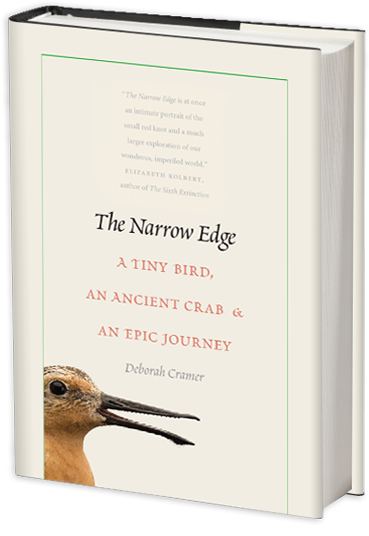
The Narrow Edge, by Deborah Cramer, Yale University Press, 2015. $28, 288 pages.  

The Narrow Edge

 “When an extinction occurs, there is no way to know which species will be the next to cling to the hands of time.”

The “narrow edge” in the title of this engaging book by Gloucester resident, Deborah Cramer, evokes the image of comedian Harold Lloyd, in the 1923 film Safety Last!, teetering on a skyscraper ledge, clinging for dear life to the hands of a clock. It is an apt metaphor for the uncertain future of the red knot (“a small sandpiper about the size of a robin and weighing about as much as a coffee cup”), which roams the sliver of sand between land and sea, a precarious place to be these days. This indefatigable bird lives for five months on desolate tidal flats at the tip of South America, then, as if possessed, travels 9,500 miles north, following the coasts of two continents, to breed in the Arctic.,

In The Narrow Edge: A Tiny Bird, an Ancient Crab, and an Epic Journey, Cramer explores this flyway by plane, kayak, helicopter, and foot, feeding on history and science as she goes, wrestling with the consequences of human interaction with the natural world. Her journey ends at a scientists’ field camp in the most northern of Canada’s territories, where the red knot lays its eggs. The birds arrive with just the feathers on their backs, while Cramer is weighted down with supplies, bulky clothes, a GPS, and the requisite twelve-gauge shotgun to ward off polar bears. It was the worst summer for shorebirds in the field camp’s history.

In her travels, Cramer often sustains herself on pilot biscuits, but the red knot needs high protein fuel and lots of it, preferably the eggs of the homely horseshoe crab. Yet this living fossil, which has survived on Earth for half a billion years, is running out of breeding grounds. The beaches on which it lays its eggs are being destroyed from over-development, rising waters, oil spills, and industrial run-off. As if the crab didn’t have enough to worry about, it is also of considerable value to humans: Aside from its historical use as fertilizer and bait, the crab’s blue blood is used to ensure the safety of intravenous medical procedures. In theory, the blood harvest should not kill the crab, or at least not many, but Cramer’s research suggests another story—and so the red knot’s fortunes rise and fall with the crab’s.

Cramer walks and talks with a wide band of scientists and naturalists who are working against the clock to save the red knot, because if this shorebird disappears, it won’t be the only one, and we cannot predict the consequences. “The foundation of food webs may not be apparent until they fray,” she writes, citing the disappearance of the passenger pigeon with the rise of Lyme disease. (Read the book to discover the connection.) When an extinction occurs, there is no way to know which species will be the next to cling to the hands of time.

—JoeAnn Hart

Orion Magazine, Sept./Oct. 2015

JoeAnn Hart

 JoeAnn Hart, a long time Gloucester resident, is the author of the novels Float and Addled.  Her review first appeared in Orion, September/October, 2015.   

Photo by Brendan Pike, Gloucester.

House Gods

                                                                                               ©Eric Schoonover

I don’t have any house gods—strictly speaking that is. But I do have four garden gods and one car god. My cars have always displayed life-sized lizards on the dashboard; small, alert and attractive creatures, they have kept me company over many thousand miles. My current reptile is a Desert Grassland Whiptail (Aspidoscelis uniparens), mild mannered with a tendency to creep over to my side of the dash where it creates a distracting reflection in the windshield. She (it’s an all-female species, reproduction by parthenogenesis) is probably fifteen years old. Her markings blend in with the dash; passengers rarely comment on her. She is on her second car just now.

Two of the garden gods are also reptiles: small snakes. (One is a baby Yellow-Bellied Water Snake (Nerodia erythrogaster), the other a MadeInChinaSnake.) They’re realistic, so realistic that visitors are often startled:  a tighter breathing, / And zero at the bone, as Miss Dickinson wrote. They make up for the innocuous Whiptail on the dashboard, and I must confess to a somewhat sadistic delight when people respond to them with alarm. They lie atop the cement that encases the two gate posts, so they are most clearly visible. They are the guards of our small urban courtyard; although, save for the startled guests, they are rather ineffectual. I struggle nightly in early summer with a prowling skunk whose malodorous body gives off such pungency that it wakes me. And then there are the cats who are most interested in the soft, cultivated soil of the flower beds that surround the slate courtyard floor.

Last are the other two garden gods. They are the oldest and made an entry into my life as a wedding present many years ago. They were (perhaps) Asian salad utensils, carved from some

house gods

house gods

exotic wood. I never liked them, and they were relegated to bottom drawers and backs of closets. (I suspect that the fate of many wedding gifts.) But then, years later, I thought to stick them in the garden ground. A lovely decorative detail hidden beneath fern fronds, lording it over a quiet herbal world. Years passed, and the fork and then the spoon rotted away, and they were once again retired, this time to a trug, along with trowels and garden gloves.

Over the years I began to develop a liking for these two, male and female. I mounted them on fiberglass rods and urethaned them. They are contemplative, coming perhaps from a Buddhistic world; Burma or Bali—but virtually universal save for their seemingly symbolic postures and attire. Their majesty exudes peace, and although I don’t think that they have much sway with the skunk or the cats, they reassure me and provide continuity to the garden over the years as it wanders, grows differently, and changes its color.

I hadn’t given this matter of house gods much thought until recently, perhaps prompted by my study of a Roman villa. I am neither a spiritual nor a superstitious person, but these familiars bring a feeling of stability that is not always present in my life. People have long touched an object on entering or leaving a house, expecting good fortune. So, too, I view these beings, these non-beings, as objects bringing good fortune.


“House Gods” one of 19 essays in Eric Schoonover’s collection, Telling Tales, to be published later this year.

Remembering Bob Stephenson by Peter Anastas, Ernest Morin & Bing McGilvray

This slideshow requires JavaScript.
PeterABobS Florence1959

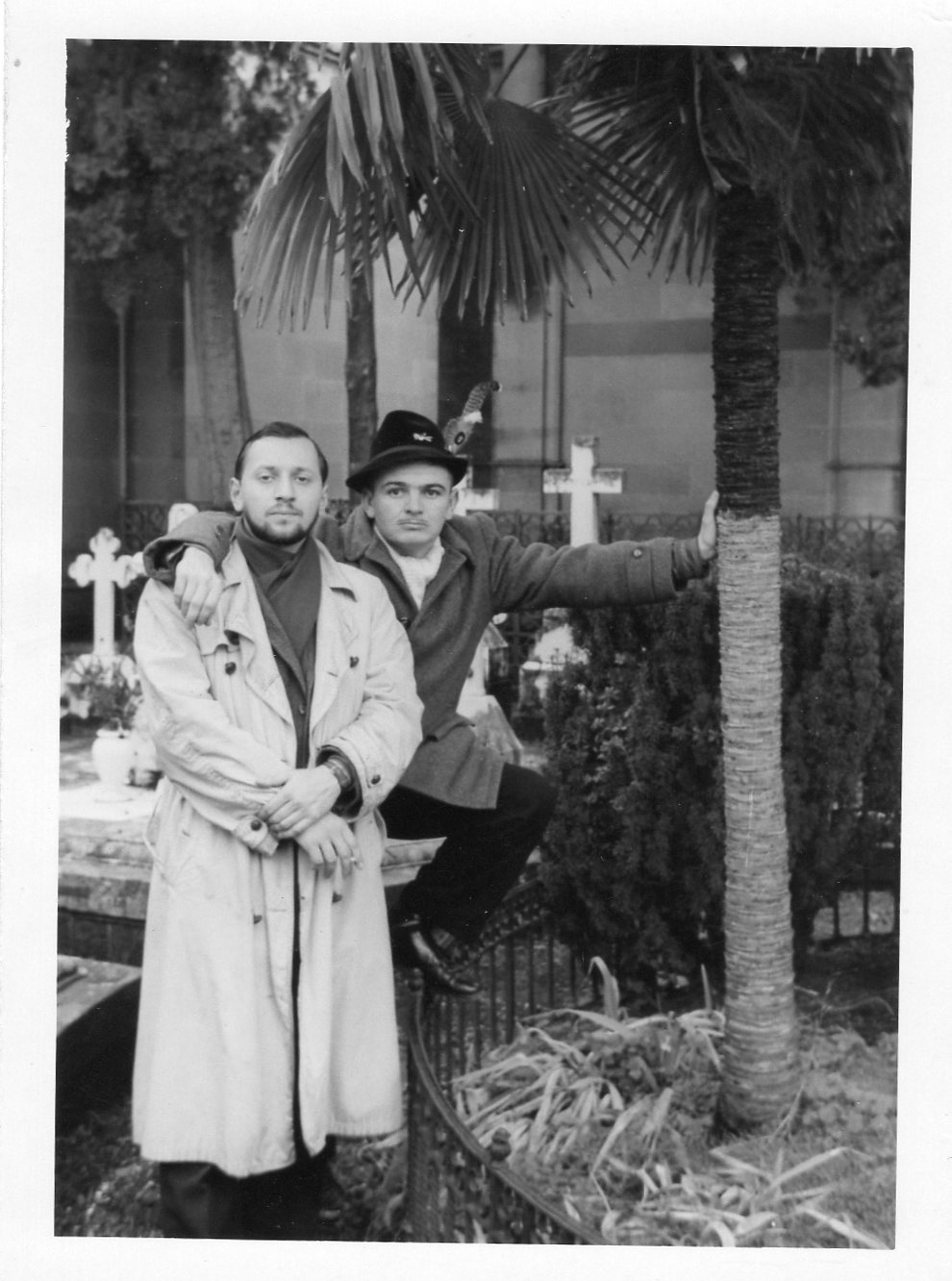
Peter Anastas and Bob Stephenson – Florence, Italy 1959

In Memoriam: Robert Douglas “Bob” Stephenson (August 21,1935 – August 9, 2015)

With the death of painter Robert Stephenson on August 9, Gloucester lost one of its most distinctive contemporary artists.  We also lost a great character, a trait that is in short supply these days.

I knew Bob from the Hovey School, where we met in Miss Courant’s fifth grade class in 1947. Even then Bob was drawing and painting constantly.  He was also a wit, who kept us laughing when we should have been concentrating on our studies.   As befits someone as creative as Bob, he was  able to turn both his art and his wit into activities that gained him academic credit.

One of our first projects together was a play we co-wrote for our unit in American history about Captain John Smith and Pocahontas, for which Bob designed the costumes, or rather, adapted them from clothing we borrowed from our mothers—today you might call it “colonial drag.”  Bob’s mother, Cora Douglas, the daughter of New England lighthouse keepers, had a house full of the most interesting artifacts, many of which she and Bob’s late father, Charles Francis Stephenson, had collected during his tours of duty in the diplomatic corps.  In fact, much of Bob’s sophistication, which made him seem so much older and more mature than the rest of us, was the consequence of the family’s having lived abroad.  I suspect these experiences may have played a role in Bob’s becoming an incredibly accomplished linguist during his military career.  It is said that he was proficient in twelve languages, including several dialects.

Once we were in Central Grammar for 7th and 8th grades, our dramatic activities did not cease.  We wrote a play about Julius Caesar, which we performed with an Italian accent, followed by a Nativity play in Yiddish inflected English.  How we got away with what today would be considered politically incorrect behavior is still a mystery to me; but those plays, and others we did together, including a British murder mystery, in which we played Sherlock Holmes and Doctor Watson with the appropriate British accents, were performed in the school auditorium in front of the entire school body.

During 7th grade Bob and I also initiated an activity that we would pursue well into high school.  We spent every Saturday walking all over Cape Ann.  Beginning with Ravenswood Park, where we explored every trail in detail, we branched out to Dogtown, which we crossed to Rockport many times.   There was not a single Gloucester neighborhood we had not traversed on foot, or any place on the waterfront that we did not come to know intimately.   One of our signal achievements was to have walked entirely around Cape Ann, beginning in downtown Gloucester and walking to Rockport, Pigeon Cove, Lanesville, Bay View, Riverdale and back to Bob’s house on Mansfield Street.

We did it in a single day, carrying water in canteens and packing lunches that our mothers had prepared for us.  There were no cellphones or public phones from which we might report our progress.  Always during these walks we observed nature carefully, gathering specimens of plants and wildflowers or marine life that we examined by microscope in the laboratory I had set up in the basement of my house on Perkins Road.

Looking back on Bob’s artistic career,  it is my belief that his minute depiction of Gloucester places and objects, his grasp of buildings, wharves, rocks, beaches, tidal eddies, surf, trees, bushes, flora and fauna originated in part from the experiences of those walks during which nothing was lost on either of us.  Our early walks resulted in a lifelong habit of my own of walking all over the city of my birth and writing about it in my weekly column for the Gloucester Times, “This Side of the Cut.”

Bob’s artistry was nurtured at Central Grammar by our art teachers, Jean Nugent in 7th grade and Edna Hodgkin’s in 8th.  Both were practicing artists, as was the city’s art supervisor Hale Anthony Johnson, who had taught us all the rudiments of art since first grade, along with the history of the visual arts on Cape Ann.

But it was at Gloucester High School, that amazing WPA modernist building we had the privilege of attending classes in during the 1950s, where Bob came under the influence of Gloucester’s greatest art teacher, the native-born painter Howard Curtis, who was head of the art department.  Comprising an entire wing of the school, the art department had state of the art equipment and the benefit of northern light, because Howard and the preceding art teacher, Muriel Spofford, had insisted to the architects that the original siting of the school be rotated to take advantage of the light itself.

It would be an understatement to say that the influence of Howard Curtis on Bob’s art was profound.  Curtis, a distinguished artist who had exhibited widely, along with painting or restoring earlier murals in city buildings, was a remarkable teacher.  Learned, articulate and engaging, he held sway in his two-room classroom-studio from before school in the morning until late in the afternoon.   In those classrooms, whose walls were hung with the finest examples of world art, you could find students, some of whom did not even study art, in deep conversation with “Mr. Curtis,” as we all respectfully called him.   The subjects were wide and diverse, from the forms of Medieval and Renaissance  painting and questions of perspective to abstract philosophical issues about the origins and fate of man.  Curtis himself was a deeply meditative spiritualist, a mystic, in some ways, as I look back on him.   This part of his nature and his teaching must clearly have had an impact on Bob’s future art, which has a profoundly spiritual dimension, influenced as well by Bob’s immersion in Buddhism, prompted by his time spent in the Far East during his military service.

Taken together, Bob’s encyclopedic knowledge of Gloucester terrain and his spiritual vision, in part the influence of Howard Curtis and in part his Eastern knowledge and practice, provide a lens through which we can view and understand the astounding production of his paintings.  Many were completed in his first studio on the top floor of Brown’s former department store, later in the studio he occupied at the Fitz Henry Lane House, and finally at his remarkable studio on Parsons Street, just off Main, a former garage, which Bob, with the help of friends, converted into a living and working space that took advantage of a marvelous view of the waterfront and wonderful light throughout the day.  It was a studio, like those of the Florentine masters, that was open to all during Bob’s working hours.  It was not unusual to find friends visiting while Bob painted, or a conversation ongoing about the state of the world, about which Bob had many opinions, pungently expressed.

Everyone has a story about Bob, and I will conclude with one of my own.

It was late in 1959.  I was living in Florence, studying Medieval literature at the university and about to begin teaching English at the International Academy.  Bob was stationed in Germany with the US Army.  He wrote to tell me that he had some leave coming and wished to visit me in Florence.  I had not seen Bob since I was in college and he was attending art school in Boston, prior to his induction into the army, so I jumped at the opportunity.  Bob was due to arrive on the Brenner Express, so I went to meet his train at the railroad station.   As I stood on the platform, I observed a group of Germans getting off the train, all of them speaking excitedly in their own language.  Bob was among them, conversing in what I later learned was perfect German.  He was also dressed in German clothing, a gray Loden jacket and a dark green Alpine hat with a feather in it.

Bob stayed in the Pensione Cordova in Via Cavour, where I had been living since early fall.  His room had a marvelous view of the Duomo from its window.  Soon Bob set about drawing everything he saw as we walked (of course) over every inch of the fabulous city that was to become my home for three years.   From his study of art history Bob was familiar with the storied buildings and monuments, and his knowledge of the art was extensive.  As we walked through the galleries of the Uffizi and the Pitti Palace, Bob paused to explain what artists like Botticelli had in mind as they concentrated on the placement of figures or the overall structure of the work.   We explored the interiors of the great cathedrals and churches, from the Duomo to San Miniato, adjacent to which was a vast cemetery which fascinated Bob (my friend Paul Hamilton, who was studying art in Florence took some pictures of us in that cemetery, one of which is posted here).

Back in the pensione, I introduced Bob to another resident, Carlo Cirelli, a young artist from Ferrara, who worked designing shoes for a local company.  When Carlo saw Bob’s drawings and watercolors of Florence he asked Bob if he would ever consider designing shoes.

“I’ll take a crack at it,” Bob said, setting to work with his pencil and watercolors he borrowed from Carlo.   We left him alone for a while, and when he said the design was done, Carlo and I went to look at it.  Instead of an elegant Italian shoe, Bob had painted what looked like a worn out work boot, brown, scuffed and with turned over heels.  Along the edge of the boot he had painted a wooden match stick, inserted between the shoe and the sole.  The match was on fire and would naturally have resulted in a “hot foot” for the wearer of the shoe.  This was Bob at his best, using art to make a point about the vanity of fancy footwear.

I did not see Bob again until his retirement from the military when we were both again living in Gloucester.  From time to time I would visit his Parsons Street studio to see what he had been up to.   When I reminded him about his visit to Florence and the shoe, his eyes twinkled.   “I wouldn’t be surprised if I’d started a fad,” he said.  “You know how clever those Italians are!”

​Peter Anastas​

___________________________________________________________________________________

The Most Original Native Artist of His Time​

by Ernest Morin​

Bob Ste​ph​enson, like F​itz Henry​ Lane​, ​ was a Gloucester boy.  He also shared with Lane a real sense of light and love of the harbor and city. I met him when he had his studio in Lane​’​s house.

Bob Stephenson Photo Courtesy of Greg Cook

Bob Stephenson
Photo Courtesy of Greg Cook

When it came to subject matter however Bob Stephenson was not a realist. His canvas would be a place to situate dream, myth, reality, symbols and spirituality. He would combine an eastern sensibility towards use of space and western techniques of painting with scenes that were both drawn from local reality and greatly fabricated to fit artistically into the Stephenson paradigm, a very original paradigm.

His skill and technique with paint was extreme, he was a master at use of glazing, applying hot near cold color of designing a series of spaces within spaces that had strong push pull, repetitive form, harmony culminating in complex compositions that were layered with meaning.

He also did this in a way that was simple and abstract at heart – in the way an Edward Hopper is real yet truly abstract.

Stephenson labored intensely over 6 or 8 canvases at a time. ​ ​They were works to be pondered, to be massaged, to be coaxed into life one nuance at a time once they were cohesive. His art wasn’t rushed; he didn’t produce product.

Continue reading

Gloucester Fishermen’s Memorial Service, August 22, 2015

Fishermen's Memorial 2015

fish mem 2 2015

From: Maximus, to Gloucester, July 19, 1957

A fisherman is not a successful man
he is not a famous man he is not a man
of power, these are the damned by God

When a man’s coffin is the sea
the whole of creation shall come to his funeral

it turns out the globe
is below, all lapis
and its blue surface golded
by what happened

this afternoon, there are eyes
in the water

the flowers
from the shore

awakened
the sea

Men are so sure they know very many things
they don’t even know night and day are one

A fisherman works without reference to
that difference.  It is possible he also

by lying there when he does lie, the jowl
to the sea, has another advantage, it is said.

‘You rectify what can be rectified,’ and when a man’s heart
cannot see this, the door of his divine intelligence is shut

Let you who paraded to the Cut today
to hold memorial services to all fishermen
who have been lost at sea. . .

not knowing what a fisherman is
instead of going straight to the Bridge

and doing no  more than–saying no more than–
in the Charybdises of the
Cut waters the flowers tear off
the wreathes

the flowers
turn
the character of the sea  The sea jumps
the fate of the flower  The drowned men are undrowned
in the eddies

of the eyes
of the flowers
opening
the sea’s eyes

Charles Olson

downloadPlease enjoy this clip from the film, Captains Courageous, which illustrates the treacherous life of the Gloucester fisherman.

The Fort Hotel is Here

glo panorama

Today we offer a letter written by Fort business owner Ann Molloy to the editor of the Gloucester Daily Times, from November 4, 2011. The perspective of time, and events which have transpired since then concerning the re-zoning of the Fort to accommodate the construction of a luxury hotel there, weights this letter with a heartbreaking realism.

Don’t Throw Gloucester “Off-Balance”

  What makes Gloucester so cool? Why do you love it here? How does it make you feel? What makes it so great?   I like that it’s real. It’s authentic. I like that it was built with hard workers, tough working class men and women. We have something special here, something different. Saltwater runs through our veins.   Tourists come here and recognize we’re different. There’s magic here. We’re as tough as our granite and as powerful as our ocean waves. Our hands are calloused and our clothes worn. We’re the finest kind…   Now I ask-  what are we becoming? Do we really want to sell out? Should people with big money from out of town be able to change our look, our feel, our very existence? They want to pretty us up,  put in a Harbor Walk for the tourists, with kiosks that say, ‘This is where the fishermen “used to” tie up, and “used to” unload their boats.” Words uttered from a Harbor Walk representative at City Hall last summer. Was it a Freudian slip?

crime scene

What is the spirit of Gloucester? Is it a grand hotel and marina down the Fort? Is that really what we want? People from out of town move here because they feel the power here and fall in love with Gloucester. What kills me is the people who move here and then try to change it.   As I think about the days ahead, it aggravates me to know I must take time away from my family and job (a marine industrial job down the Fort) to fight again, for the third time, to save the Fort from rezoning, therefore allowing a hotel. And as the mayor(Carolyn Kirk)  was quoted in the paper saying “Third time’s the charm”.  It honestly makes me sick, and at this point after about four years of fighting this, it feels like harassment.

a 3536

But now the real big bucks have arrived. The third richest man in Massachusetts (Jim Davis,) can afford to sway votes and public opinion with his cool million (half million for the naming rights, and half million for construction) for the New Balance Newell Stadium. Dollar signs in one’s eyes blurs vision sometimes.   Mr. Davis paying double and triple for property will increase all the Fort people’s taxes, by creating a false sense of property values. How many will be forced out? This is what some people want. Is it what you want? Do you want to look like Newburyport, or Newport, RI? Do you want their traffic? Why would anyone pay so much over value for this property? And talk about putting the cart before the horse, especially after rezoning failed in the last two, very recent, attempts. I sure wish he wanted to make sneakers there.   Many will say I’m living in the past. Fishing is never coming back, so I’m dreaming. We’re holding the city hostage. Please look a little deeper, before passing judgment. Look at the thriving MI (marine industrial) businesses that are down the Fort.   If this zoning goes through, it will benefit my family financially, if we wanted to sell out, but at what cost? I’d rather leave our future generations with something real, authentic and of substantial value, like my grandfather and father did for us. Showing us, with hard work and ambition, you can accomplish great things. I think that’s worth much more than selling out, and leaving them a trust fund.   The Fort is basically an industrial park, a marine- industrial park, and the people who live there deal with that daily. Do we want to put tourists and their kids down there with all the big trucks? Sounds like an accident waiting to happen. Do we really want more traffic? Our way of life as we’ve known it will no longer exist. Tourists won’t even want to come here.   So, when you’re sitting in traffic for an hour, trying to get over the bridge, will you think of this letter and say “Wow, what have we done? What have we let our town become?”   If you value what we have here, will you stand up with me and help me “Hold the Fort”, before it’s too late? It could be your neighborhood next.

Ann Molloy

Neptune’s Harvest Fertilizer

88 Commercial Street     (Down the Fort)


ann photo (2)

Ann Molloy was born and raised in Gloucester. After several years of traveling around the country and world, she settled back here and has been helping run her family business, located down the Fort and on Kondelin Road. For over 20 years, Ann has been in charge of Marketing and Sales for the Neptune’s Harvest division of Ocean Crest Seafoods, which came about as a way to fully utilize 100% of the fish, by turning the gurry (everything that’s left after you fillet a fish) into an organic fertilizer. She has a wide knowledge of organic fertilizers, and the fishing industry. She also loves to paint, write, and see live music.