Ten Pound Island

© 2016 Louise Welch

© 2016 Louise Welch

rugged with
gulls
toughened by
raw weather by
unpeopled
growth stench
rust & wash
barrels & wire
gulls protest when
we land
on the beach
poke among
shells climb to the green
so high she thinks
of snakes
does not proceed
under the gull hover
to visit the light
the rust but feels textures
in the sand with wet feet
hauls a little on the painter
keeps her head to wind

Melissa de Haan Cummings


melissa2bcummingsMelissa de Haan Cummings majored in French and English Literature at Bryn Mawr. She has published poetry in a number of journals.  She describes her interests as including, “much small boating around Cape Ann, love of Charles Olson, Hatha yoga practice since 1969.”

The Luxury Building Boom Train

Gordon Baird

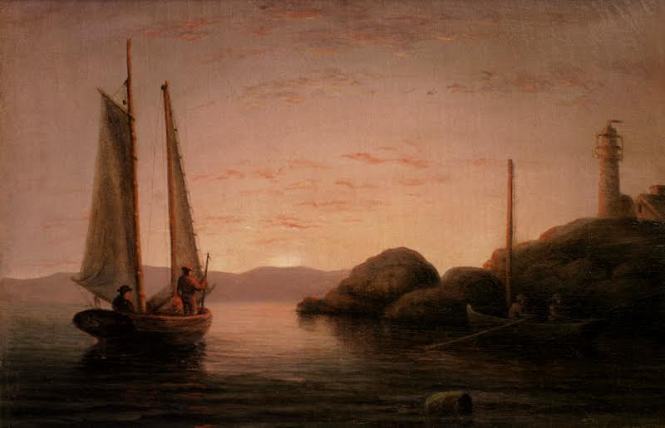
Mary Blood Mellen (1819-1886) Sunset Calm off Ten Pound Island Light, Gloucester, c. 1850s

Mary Blood Mellen (1819-1886) Sunset Calm off Ten Pound Island Light, Gloucester, c. 1850s

We’ve all recently read about the Cheryl Soones plan to build 4 houses on “the wrong side” of Atlantic Ave., i.e. the ocean side of The Back Shore. But really, why stop there?
There are a myriad of other proposals that could and should be vetted towards the great and holy objective of making money, you know, the almighty dollar, the beast of Mamon – to worship at the feet of dumptrucks full of cold, hard cash, driven up and dumped at the feet of the investors. In this era of Donald Trump, we invite readers to come up with their own ideas of other profitable building ventures in Gloucester to pump up the tax base and class up the place by bringing more of the “1%” into our ranks. Let’s start with the obvious: a full service Yacht Marina at the Lighthouse on Eastern Point. The Feds are only using the tippy-top part and the rest of it is going entirely to waste. The tower would make a heckova bar. Kick back with a Cuban cigar and a snifter of $200-a-glass brandy and watch the fish struggling their little lives away. The yachts and super yachts could tie up right alongside the actual breakwater (on the inside, of course).There would be a shuttle to the squash and paddle tennis courts at the end of the big, suddenly important Dogbar. It could be very profitable and could solve the problem of people who want to fish off the breakwater since there would no longer be room for them with the luxury cabanas and their personal bars, massage tables and big screen TV’s. And they could gaze right down the harbor to the brand new swanky health club on Ten Pound Island with its underground tramway back to Rocky neck. There would be a Trump Tower in Dogtown, as tall as the turbine windmills so as to boast the best views in the east. And just a zip trip away from the Ferrari dealership at The Man At The Wheel on the Boulevard. Hey, but what a wheel – we’d have to inport an Italian sculptor to modify the statue with an actual oversize Ferrari sterring wheel in his hands. Now that’s marketing the city!
And how have we not installed that Jet Boat Docking Terminal yet on Thatcher’s island? Another barely used asset that is just wasting it’s views and profit poptential – as The Back Shore so obviously does. That’ll all have to change. A Helipad at Stage Fort Park is a must for when VIP’s or even foreign heads of state come to town. Very welcoming and appropriate. And wouldn’t Coles Island make some classy Golf Club with all natural sand traps! Let’s not leave out Crane’s and Wingaersheek Beaches because with a wave of the rezoning wand, there’s still space for more and more houses, McMansions all. But more to the point: why couldn’t there be Luxury Apartment Towers on those beaches as well as in downtown Lanesville. We literally have to be able to “rise above” the actual zoning to get this plan to work.
Annisquam has long been itching for a sports and entertainment complex with equisitely fine dining and plenty of limo parking. I say we give it to them. That grey yacht club out there on stilts is getting too old for anyone anyway.
Gloucester itself has always felt kinda naked to me without a proper Polo Club. It can’t be sited too near Stage Fort, though, because the helicopters will spook the polo ponies. Wait, screw the Trump folks and put the Polo Club in Dogtown, far away from the noisy hoi-poloi in town. Put the Trump Tower right at the Rotary and rename the A. Piatt Andrew as the Donald J.Trump Luxury Bridge with a gold plated fence that no one will dare climb. That’ll put us on the map and we’ll get Mexico to pay for it.
Come to think of it, why are all those fish plants and smelly boats still allowed to remain downtown? They will definitely cut into our P.L.D.I. – the Potential Luxury Development Index that financial planners who make big decisions use. Come to think of it, the ocean side houses proposed for the Back Shore had a pretty strong P.L.D.I., considering just how little they paid for the lots. That’s a R.O.I. – Return on Investment – all developers can envy. Ms. Soones can set a new standard on P.L.D.I.R.O.I.
But wait! There could be a fly in the ointment for plans on our new Luxury Gloucester future. Maybe they’ll build the 4 Soones ocean side houses part Affordable Housing. After all, even non-1%-er’s want to live in the teeth of the Atlantic. Affordble housing with an ocean view! And when their houses are scattered down the length of the Back Shore, they’ll feel like the other displaced zillionaires – so that’s a bright spot when Americans feel more equal.
So send in your suggestions, ye citizens. The luxury building boom train is just getting ready to leave the station. Will you be on that train or just one of the old fashioned, stuck-in-the-mud, bleedin’ heart Back Shore protectors who think the rocks there are something special. Hah ! All you need is cash and no memory and we finally can get somewhere. Think P.L.D.I.R.O.I., people!

Gordon Baird

Gordon Baird sails, writes, sings and video edits his way through Gloucester as he has since 1950.  Musician Magazine called him co-founder, Gloucester Times calls him columnist, 3 kids call him Dad.  7 chickens, 2 goats, 2 pigs and a donkey call him breakfast, lunch and dinner.

Pimping Out Gloucester

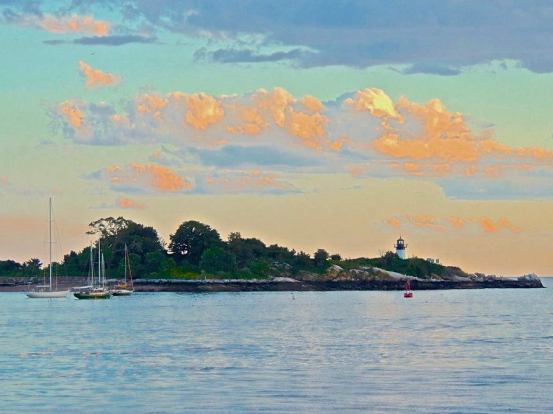
Ten Pound Island. Photo Courtesy Laurel Tarantino

Ten Pound Island.
Photo Courtesy Laurel Tarantino

February 2016

A favorite quote of mine is one by Zelda Fitzgerald (1889~1948), “Nobody has ever measured, even poets, how much a heart can hold.”  I so understand this.  Science tells us that it’s impossible to die from a broken heart.   I beg to differ; it sure feels like it sometimes, especially when you keep taking blow after blow, seems like the damage can be irreparable.

With friends, my heart fills with gladness for all that we have and share.   These same friends have my best interest at hand when I’m sad for personal reasons.  They’ll turn me around to see the positive impact I have on people that count on me and need me.  Sometimes it’s hard to be needed.

I just took another blow to the heart again Tuesday night.  I need more than my friends for repairs this time. Before I let the tragic issues of the world get the better of me and turn me into a cynical old woman that roams the streets hurrrmmping through life, I reach out to you, anyone that may be reading this.

The injury this time, for lack of a better description, “The Pimping out of Gloucester,” in particular, Ten Pound Island, with total disregard for nature and its needs.  Where do we draw the line?  When are we going to say, “You know what, enough is enough?” When every inch of it is sold off to the highest bidder?

Put before the Waterways Board Tuesday night was a proposal for a float system on Ten Pound Island.  Sounds like a good idea, right?   It would give people access to the island, a place for people to tie up their boats, a place where people could take the Shuttle service every hour.   They even talked about tying it in with other activities…   yoga, the sailing program, the arts.  To me it sounds like another idea with an amusement park like theme.  In fact, the proposal was called “Harbor Park.”

My apologies, I’m starting to sound cynical, I can feel it.  I can’t help myself, when not one member of the board asked about the environmental impact to the area.  No one brought up the fact that the island is a safe haven for hundreds of birds, birds that migrate there, nest, roost and raise their young there.

This slideshow requires JavaScript.

“Why shouldn’t everyone be allowed to enjoy the island?” has been a question on social media.  The answer to that is that everyone can.  People visit the island now by kayak, row boat, sail boat, paddle boards and small motor boats and all these folk seem to be very respectful of the area.  They seem to understand the term “Carry In, Carry Out,” without having signs posted to tell them to do so.  As it is now, the small boat traffic is about all the island can handle.  I find the people that visit truly leave the island as they found it.  If you open the area to an unlimited number of people for adventure I feel it would be incredibly hazardous to the environment.  In the 90’s there was a shuttle you could catch a ride on that left you on the beach.  During that time, my husband and I saw an increase in litter, dirty diapers strewn into the plant life that grows beyond the wall, human feces, an overflowing trash barrel that never got emptied, a neglected picnic table that usually had the aftermath of someone’s lunch on it, basically signs of an uncaring public.

I psyched myself up to go to this meeting Tuesday night and speak on behalf of the birds, as they have no voice in City Hall.  This was going to be a great feat for me, as I’m petrified of public speaking, but I was willing to sacrifice my comfort.  I was mortified when the meeting started with the Chair Person commenting, “I don’t know why all these people are here, for what issue, but I can tell you, there will be no public input.”  I had my courage and couldn’t do anything with it and I was letting the birds down.

If you’ve never visited Ten Pound Island, you may not know what a beautiful sanctuary it is for several species of birds.

Snow Egrets. Photo Courtesy Laurel Tarantino


From late April to late October, there are Snowy Egrets that adorn the treetops in such numbers that I often refer to them as Christmas ornaments.

There are Great Egrets, Black Crowned Night Herons, Crows and occasional songbirds in the trees as well.  Along the rocks you might be entertained by the sweet little Purple Sandpipers as they dab for small crustaceans while outrunning the splash of a small wave.  Common Eiders scurry down the rocks and jump in to have a swim.  Of course, there are the ever present Seagulls and Cormorants.   All these lovely creatures can be seen if you take a quiet ride around the island in a boat.

There are also birds that nest on the ground in the interior of the island.  One must be ever aware of their footing or they could very well harm the nest of a Mallard Duck sitting on her eggs.  You might destroy an entire family of Canadian Geese if you’re not being careful,

Just Hatched Canadian Goslings. Photo Credit Denise Foley

since they may not always be sitting on their eggs, you might traipse right through them without their snarling warning.  The Herring Gulls will distract your attention away from your footing to the sky as they swarm you to protect their nests, which are plentiful along the cliffs and on the ground.

I fear it will be disastrous for the birds if people are arriving every hour.  In this day of cell phones with cameras, I’m afraid that this safe haven will slowly disappear and be replaced by 54 “Likes” on Facebook, because people will have to walk through the homes of these beautiful creatures in order to get a sought after photo of the Lighthouse.  What will happen to the babies once they’re hatched?  They’re so incredibly cute, I can see someone trying to catch one, which wouldn’t be very hard to do, since they have no defense against us humans.

Juvenile Flounder. Photo Credit Laurel Tarantino

Juvenile Flounder.
Photo Credit Laurel Tarantino

What will happen to the thriving ecosystem in the water that surrounds the Island when you have a motor boat arriving several times a day, everyday of the week?  I cringe to think of it.

I’ll end this long winded rant with another quote, this time from Martin Luther King Jr. (1929-1968) “The time is always right to do what is right.”

Please help stop the giving away of Gloucester.  Believe me when I say (sadly) there are more great plans being drawn, but great for who is what needs to be asked.

***************************************

To learn more about the Audubon (IBA) Important Bird Areas, which Ten Pound Island is part of, visit the following site:

Massachusetts Audubon – Conservation

Locally, here is the link to our city offices should you like to contact them with your concerns on this or any other issue:

Gloucester, MA – Official Website


Laurel TarantinoLaurel Tarantino, writer, is happy to live in her hometown, Gloucester, with her husband, James,”Jimmy T,” daughter Marina Bella, and the family dog, Sport. She is known for “stopping to smell the roses” and loves to photograph and write about her beloved waterfront community.


There is Great Love

Hospital in Arles. 1889. Vincent van Gogh (1853-1890)

Hospital in Arles. 1889.
Vincent van Gogh (1853-1890) 

There is great love in this place of devastation
dire illness, rank injury, and near death
I watch from my room’s uncurtained door
the  Brownian movement of white coats
stethoscopes dangling, aids in blue, nurses white
incessant motion, seemingly without meaning
they look at a board I see the edge of and rush off
urgently beyond the narrow scope of my vision
I miss the action when they come to work on me
they draw the curtain that distracts me from my pain
I joke where there are no jokes, let them probe.
One more CAT scan before I rise to higher floors
but still must wait in the corridor and see the action newly.
Then I see them coming, the worried, anxious and fearful
lovers of those thrown up, wrecked here.
A soft eyed black family waiting to know for their son was shot,
Japanese crying, solitary women dreading their love’s fate,
There is great love in this place of devastation.

Kent Bowker     1/18/2016

Kent BowkerKent Bowker  started with poetry at Berkeley in the Fifties, then became a physicist working mainly in optics.  His new book of poems is Katharsis: Sifting Through a Mormon Past.  He lives in Essex, next to the Great Marshes and is treasurer of the Charles Olson Society.


Maritime Gloucester Talks: Who Owns the Ocean?

Gloucester Waterfront. Walter Curtis Yeomans (1882-1972)

Gloucester Waterfront. Walter Curtis Yeomans (1882-1972)

THURSDAY, FEBRUARY 11, 2016, 7:00 PM TO 8:30 PM

REGISTRATION : FREE EVENT. PLEASE CONSIDER MAKING A DONATION AT THE DOOR. Maritime Gloucester, Harbor Loop.
AUDIENCE: GENERAL AUDIENCE; STUDENTS ENCOURAGED
2016 Maritime Gloucester Talks kicks off with a panel discussion on the Massachusetts Ocean Plan, Balancing Interests while Managing “Ocean Sprawl” with presenters Bruce Carlisle, Director of Massachusetts Office of Coastal Zone Management and Jack Clarke, Director of Public Policy and Government Relations, Mass Audubon, Chairman of the Massachusetts Ocean Advisory Commission, as re-appointed by Governor Baker; and a Gloucester resident.
Massachusetts’ Ocean Plan is the landmark blueprint to protect and sustainably use state ocean waters, safeguard critical marine habitat and important water-dependent uses, and to set standards for new ocean-based development. This panel discussion will provide you with the background on how and why the plan was developed, explore the role of stakeholders and discuss its stresses—from sand and gravel mining to our Canadian neighbors exploring for gas and oil. Leaving plenty of time for your questions and group discussion.

Shut Up and Dance

On Saturday, March 26, 2011 my life was transformed when a 6 lb 11 ounce princess joined my world. When the midwife first placed her in my arms, my daughter rested her tiny hand against my left cheek and stared at me with large, dark brown eyes accentuated by strikingly long lashes. Her look was intense and so attentive, qualities that would only grow deeper as the years passed. It has been almost five years since Emerson Belle was born and not a day goes by where I don’t try to live like “Emmy.”

To Emmy, every day is the best day of her life.  Every chocolate milk she tastes is “the most IMG_5886delicious one ever.”  Every dress she owns is, “the most beautiful gown in the world.” Every cartoon on t.v. is “the funniest show she has ever seen.” Emmy feels everything so deeply that something is not merely good, it’s, in her words, “unbelievable.” And the compliments that this kid dishes out can make you feel like a million bucks. She won’t just say you’re pretty, she will tell you that you’re the most gorgeous woman in the entire Universe.  But times are not always glorious on Granite Street.

When Emmy is upset, “it’s the worst day of her life.”  This comes with slamming doors and loud outbursts.  But her tantrums are short-lived and she emerges from her bedroom apologetic and loving. Emmy has taught me the value of pure and raw emotion. Being vulnerable enough to share your true feelings with another is a beautiful thing, yet it becomes so rare as we age.  Society tells us that mature adults must control their emotions. Adults must not get angry and certainly must not cry.  Adults that do such things are labeled as “emotional” and deemed weak.  Label me then. To share your genuine self makes an ordinary person extraordinary. Through Emmy, I have learned that feeling things so deeply simply means that you are living completely.

Not long after Emmy’s first birthday, I discovered that I was once again pregnant.  Thrilled, I did what most newly pregnant women do, I hit the computer. I found out my estimated due date and started scanning websites for potential names. All the while, I did not feel quite right. Looking back, all the signs of a miscarriage were there, but my optimistic nature refused to pay them any mind.  I was convinced that I was having a baby boy and that Blake Ashton would make his arrival on or around December 9th.  I had no reason to think otherwise because I had such a textbook pregnancy with Emmy. But this time, I was not so lucky. Just shy of two months, I would experience the loss that accompanies a miscarriage.

I was left devastated and full of questions. How could this happen? I thought I was healthy.  Did this mean I will have problems having another child? I wanted Emmy to have a sibling. I felt tremendous guilt and deep sadness all at the same time. Did I have the right to grieve this much when others have carried and lost a baby much later in pregnancy? And what about those women who have faced multiple miscarriages. I felt so alone and it was not until I met with a midwife of Essex County that my healing process would take shape. She listened to all of my fears and questions. She let me cry long and hard and then provided invaluable comfort and guidance with her words. A baby is real the second a woman finds out she is pregnant. Give yourself permission to grieve the loss of your baby.  Your body was healthy enough to reject an unhealthy pregnancy. You will conceive again when you are ready.  It took this loss for me to learn that it’s okay for adults to talk with other adults about what hurts and to even share fears. There are some great listeners out there. Through opening up to others, I learned that I was not alone. In fact, it is estimated that as many as 1 in 4 women experience this same heartache. Time and a shocking surprise helped me to move forward but not forget. Every first week in December I think about the loss I suffered but also pay respect to the Universe for the surprise she brought me.

Not long after that meeting with the midwife, Brandon and I learned that I was once again pregnant. This time around I felt awful, but a good kind of awful. My morning sickness lasted for six months and it didn’t stop at noon. I was nauseous 24 hours a day and I couldn’t be happier about it! It meant that my body was doing what it should, creating a new life. And what a life it would create.

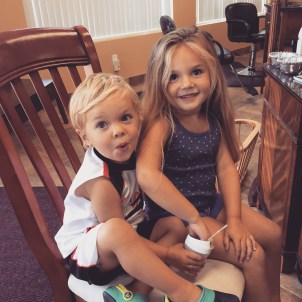
Emerson Belle and Ryder Kai Sanborn

Emerson Belle and Ryder Kai Lewis

Ryder Kai entered the world on Saturday, January 26, 2013.  This 6 lbs and 6 ounce baby boy with blonde hair and blue eyes would grow into the coolest kid I have ever met. While I know my daughter like the back of my hand, my son still surprises me constantly. A boy who marches to the beat of his own drum. A very large drum. Ryder knows what he wants and he doesn’t care if everyone else wants something different. No one is changing Ryder’s mind when he sets it on something. He is that comfortable in his own skin. You can imagine the struggles we have faced when trying to convince him to eat something besides butternut squash or chocolate. Through Ryder I have learned how important it is to stay true to your genuine self and that spontaneity can be invigorating after adhering to a schedule dominated by routine.

Ryder is a fearless child who takes risks and has the scars on his chin to prove it. He lives hard and sleeps the same way. In a few weeks, Ryder will turn 3, yet he still naps like a infant, for 2-3 hours every day. Ryd savors mischief and easily finds it countless times in any given day. The kid who appreciates the bad guy. Sher Kan, Scar, and Shredder are among his favorites. My son loves to

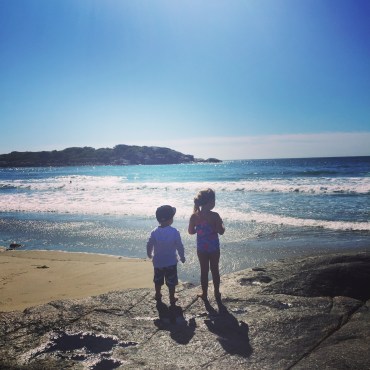
Emmy and Ryder Kai Sanborn. Good Harbor Beach .

Emmy and Ryder Kai Lewis
Good Harbor Beach .

swear and I know his favorite song is Shut Up and Dance just because he thinks he’s getting away with saying something inappropriate. Ryder has taught me not to take life too seriously. He has

helped me worry less and lighten up, even when times are tough.  He has shown our family the importance of humor; no one can make us belly laugh quite like Ryder Kai.

It is true that there is no gift like a new baby. But the best gift of all are the lessons these babies teach us as they grow up.


lori sanbornLori Sanborn was born in Gloucester and returned to live permanently in our seaside community three years ago. She has been a public educator for 12 years, teaching eighth graders.  Lori is most proud of her role as mother to her children, Emerson and Ryder.

Toward a Vision for the City’s Future

Peter Anastas

Peter Anastas and Sefatia Romeo Theken. Gloucester Mayoral Inaugration. January 1, 2016.

Peter Anastas and Sefatia Romeo Theken.
Gloucester Mayoral Inaugration.
January 1, 2016.

The American Heritage Dictionary defines inauguration as “to induct into office by a formal ceremony” or “to cause to begin, to dedicate, to consecrate.”  Our Gloucester High School Latin teachers, Josephine P. Ray and Vincent Elmer, would have taken pains to point out the Latin root “augurare,” “to presage, to foretell, to look ahead.”  This gave us the Italian “augurio,” “to wish, to be of good omen, to give one’s best wishes,” as in auguri.   So, in effect, we are here today not only to celebrate the induction of Sefatia Romeo Theken into her first full term as mayor of Gloucester, we are also gathered to look ahead, to consecrate ourselves and the city we love to a future of good omen, to wish our new mayor and her administration, our new city council and school committee—the community itself— tanti auguri for the New Year ahead and for our hoped for future.

Before I speak of that bright future we richly deserve, I’d like to look back for a moment, to pay tribute to those who have made it possible, particularly our parents and grandparents; and for Sefatia, her mother and father, Rosalia and Enzo Giambanco.  Enzo Giambanco, was president of the Board of Directors at Action, Inc., Gloucester’s antipoverty agency, when I first went to work there in 1972.  I found in Enzo not only a mentor but a person of deep compassion for the low-income families we were serving, including out-of-work fishermen, children who needed a pre-school education their parents could not afford, people who did not have health insurance, and elders who were torn between paying rent and utility bills and eating.  As an immigrant he understood what it felt like to be on the outside, whether you spoke a different language or your customs differed from those of the community.   Along with Executive Director Bill Rochford, Enzo helped to steer the agency through some of its most challenging times, while never abandoning those who depended on our services, whether it was help with fuel bills, home care, or after-school care for the children of working mothers.

I will never forget the time when, after the construction of the O’Maley middle school, the city was deciding what to do with the suddenly empty Central Grammar School with its beautiful WPA murals, where many of our parents had gone to high school and my generation had spent our 7th and 8th grade years.   Action proposed a reuse of the stately building for apartments for the elderly; but there were questions about the need for such housing and the ability of an agency like Action, which had never done bricks and mortar, to undertake such a project.  A public hearing was to be held at City Hall to determine which direction the city would move, and it was necessary to show support for the agency’s plan to create quality housing for our senior citizens.   Enzo told Bill not to worry.  And that night he arrived with 500 elders and their families, filling city hall auditorium and convincing the council of public support for the project.   The present Central Grammar Apartments not only met a crucial need in the city, it became a pioneer project in the regional movement to adapt former schools into much needed housing.

Sefatia learned these innovative and caring ways from the cradle.  She has spent her entire life helping the people of Gloucester as one of the city’s hardest working councilors and as a health care advocate and human services liaison at Addison Gilbert Hospital.  During her tenure as interim mayor, Sefatia again demonstrated her skills at reaching out to citizens across the entire social and economic spectrum of the city, listening compassionately to their concerns, hearing the ideas they shared, and making decisions in a thoughtful and intelligent manner, while relating to all of us in an open, caring and humane way.  When you are hugged by Sefatia you know she means it.

Sefatia has roots that run deeply into the community and its history.  She’s gone to school and raised a family here.  She can walk down the street and recognize everyone she meets.   She can tell you who lived on which street, who worked where, and what happened to them if they got laid off.  This kind of knowledge that comes from growing up in one place and feeling it in your blood is indispensable when it comes to understanding the needs of neighborhoods and their residents, no matter which part of the city they are located in.  A public official who is not deeply in touch with the culture of the community he or she hopes to serve is already at a disadvantage.

We need a mayor who encourages our community to engage in the kind of constructive dialogue that is the cornerstone of our democracy, a mayor who will lead us toward a more vital sense of community in education, civic responsibilities, historical awareness, fiscal prudence, economic and social self-sufficiency, and love of place.  We particularly need a mayor who understands and cares deeply about our fishing industry and the importance of our working waterfront and the innovative Blue Economy.  I believe that Sefatia will be this kind of mayor.   Just as we need to move ahead, we equally need to maintain our roots as a city of families and neighborhoods, where everyone has a place at the table and everyone’s  voice is listened to and respected.  There is a yearning all over America for the sense of place, of shared history, of belonging, that we in Gloucester are fortunate to enjoy in abundance.

Gloucester has always been a city of ethnic and economic diversity—and this diversity has been one of our greatest strengths.  We live in dangerous times and we need the peace and comfort that a community like ours affords.  It is through community that we learn together and grow together, as we help our children and grandchildren grow and prosper.

Concretely we must address the following issues as we look to the city’s future.

–We need a revised and updated Master Plan so we can best manage growth and know where to build and what to preserve.

–We must recommit ourselves to our embattled fishing industry and to the working waterfront itself, continuing our long history of adaption to change with the creation of a strong seafood innovation cluster economy and the good local jobs it will create.   We are also a great boating community and while we work to make our waterfront a more welcoming place for recreational boaters, we must not forget the importance of community boating facilities for our own residents.

–We will need to look newly at tourism and its impact on the city’s life and infrastructure (traffic, the harbor, the beaches, the land), with a special conversation about the role of a smart,  human-scale visitor-based economy, the corner stone of which should be cultural and eco-tourism.

–We need to continue our conversation around the development of a public arts policy with added discussion on the place of the arts in local life and the visitor-based sector.  Essential to the future of the city as a magnet for the arts is the development of live-work housing for local artists, who constitute a bridge between the life we all enjoy here and what we want to offer to those we welcome into our community.

–Essential also is an initiative to involve more citizens in public life, volunteering for boards and commissions.  We must especially nurture a new generation of engaged citizens: our democracy will depend on it.

–As for schools, plant is important, but what happens in the classroom is paramount.  We must transcend the tyranny of standardized testing, reasserting the primary role of the imagination, critical thinking and creativity in art, music, drama, science and the humanities.

–We must do everything to keep our city beautiful, not only for those who wish to visit but for those of us who live here year round.  The restoration of Stacy Boulevard, Gloucester’s crown jewel, is long overdue.   Dogtown is our refuge for hiking, cross country skiing, berry picking, and the exploration of nature.  Let us continue to support the work that volunteers are engaged upon in preserving this treasure and keeping Dogtown unspoiled for future generations.

What we especially need, along with careful planning to account for inevitable change, is a land ethic, a way in which we view the land and its uses beyond mere profit-taking and commercial development.  We must build what we need, but we must do it in a way that does not destroy the unique character of neighborhoods or disrupt human and natural ecologies.

We must plan regionally as well as locally, always with a sense of preserving the character and integrity of particular communities; for I believe that only those places which are sensitive to their uniqueness will survive.  Without an informed, coherent and humane vision of ourselves in relation to our environment we will not survive as a community, let alone as a planet or a species.

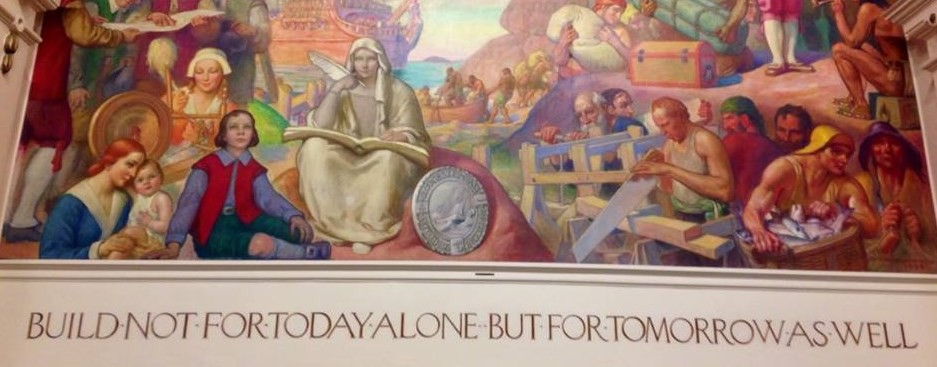
So as we inaugurate our new mayor and congratulate the city councilors and school committee members we have elected to represent us, let us re-commit ourselves to working together, to building “not only for today alone but for tomorrow as well.” If we expect it of ourselves, those who come after us will thank us for our vision, our imagination, and especially for our commitment.

Thank you e tanti auguri a` tutti for the New Year and for Gloucester’s future.

(This speech was delivered at City Hall, on January 1, 2016, at the inauguration of Sefatia Romeo Theken as Mayor of Gloucester)


Peter at Museum (1)Peter Anastas, EG editorial directoris a Gloucester native and writer. His most recent book, A Walker in the City: Elegy for Gloucester, is a selection from columns that were published in the Gloucester Daily Times.
 

ALL THAT’S LEFT: ANOTHER HOUSE BITES THE DUST

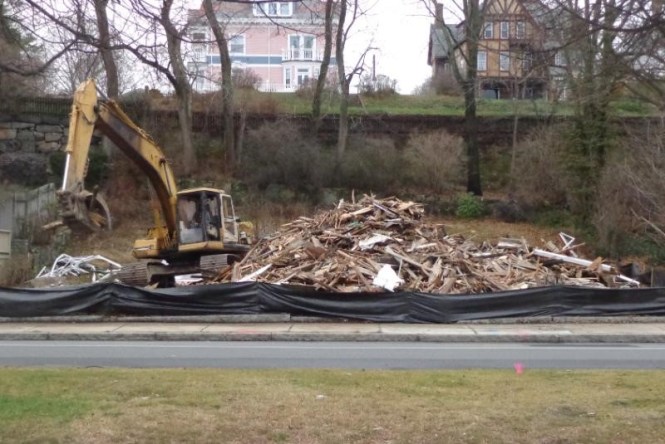
This is all that remains of what was once a nice old house at the Cut

This is all that remains of what was once a nice old house at the Cut

Back in September I wrote “The Value of a House” published in Enduring Gloucester.  At that time word had circulated around the city that two houses on the Boulevard were in danger of being demolished.  News that one of the threatened houses was the Inn at Babson Court caught the attention of the public.  There was an anguished outcry of dismay from a number of people including the Gloucester Historical Commission.

Meanwhile, the owners of a lesser known house just a few doors down the street obtained a permit to demolish and rebuild with hardly a ripple.  This house was not as old as the Inn at Babson Court but with its two big chimneys running up the back of the house supporting numerous fireplaces it actually had more integrity and more remaining original fabric than did the Inn.  Somehow it never got the attention it deserved and there was little or no reaction or opposition. Misleading was the date of 1900 from the assessors’ records.  People don’t realize that the arbitrary date of 1900 has been assigned to most old houses in Gloucester having nothing to do with the actual age.  The demolition was quickly approved by the ZBA.

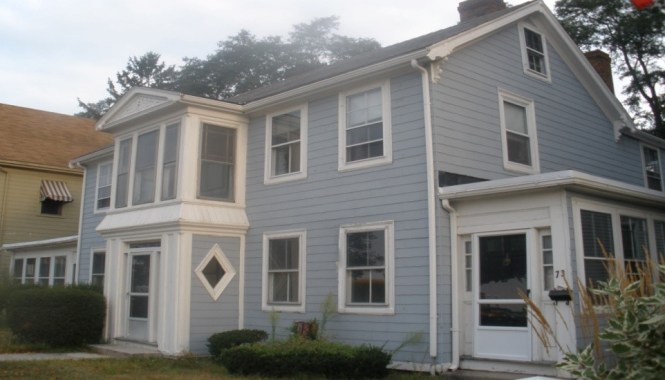
73-75 Western Avenue in recent years. Not so long ago it was an intact house.

73-75 Western Avenue in recent years. Not so long ago it was an intact house.


This is 73-75 Western Avenue in better days showing the added enclosed Victorian portico.

This is 73-75 Western Avenue in better days showing the added enclosed Victorian portico.

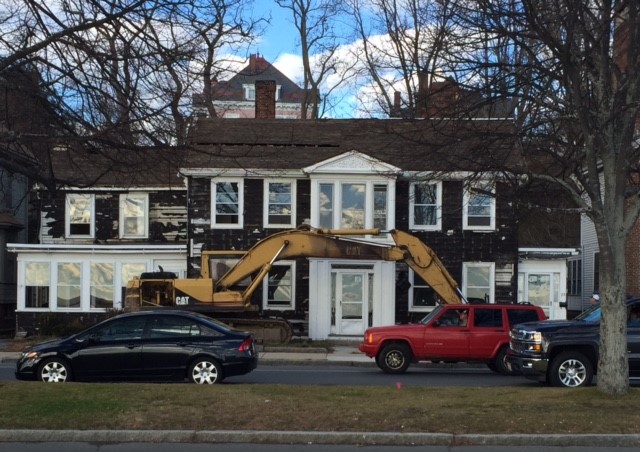
In the fall the outside of the house was stripped away.  It sat there with little happening.  A large dumpster occupied most of the  yard.  I secretly hoped the owners were having second thoughts.  But as was predictable, its brief reprieve came to an end and heavy equipment sat in the front yard, poised to wreak the inevitable destruction.

The Stripped House, December 23, 2015. Linda Amero photo.

The Stripped House, December 23, 2015. Linda Amero photo.

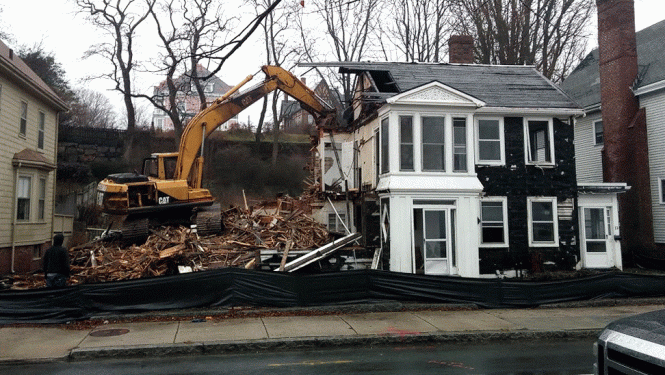
The demolition only took a few hours. Joshua Gerloff photo.

The demolition only took a few hours. Joshua Gerloff photo.

By mid afternoon I grabbed my camera and headed to the Boulevard.  All that was left was a pile of kindling.

I took several photos. The Harborview Inn right next door was festively decorated for the season looking beautiful and inviting,  sharp contrast to the pathetic pile of rubble just a very few feet from its foundation.   I hurried back to my car not caring to linger.

The Harborview Inn in sharp contrast to what is left of its long-time neighbor next door.

The Harborview Inn in sharp contrast to what is left of its long-time neighbor next door.

73-75 Western Ave in 1883 The long ell on the left is there but the large portico on the front has not yet been added. You can see the big chimneys accommodating many fireplaces behind the ridgepole, standing tall to the very end. (Corliss and Ryan photo. Property of CAM.)

73-75 Western Ave in 1883 The long ell on the left is there but the large portico on the front has not yet been added. You can see the big chimneys accommodating many fireplaces behind the ridgepole, standing tall to the very end. (Corliss and Ryan photo. Property of CAM.)

My definition of a true antique house is one with a hand hewn, handmade timber frame and fireplaces for heating and cooking.  By these standards this house was a true antique almost 200 years old.

Here is a repeat of the history of the Joseph Proctor house researched by me and previously published in Enduring Gloucester.

“The house was built on land owned by Joseph Procter, just one of a long line of Joseph Proctors.  It may not have been his homestead but certainly was the homestead of his son, Joseph Johnston Proctor, followed by Joseph Osborn Proctor.  The Procter family’s role in the history of Gloucester is huge.  They were heavily involved in the fisheries and many local organizations.  Ultimately they owned a number of houses along the Boulevard including the Inn at Babson Court as well as the stately house at 73-75 Western Avenue.   Their holdings extended up the hill toward what is now Hovey Street.

Joseph J. Procter was born in 1802 and married Eliza Ann Gilbert in 1826.  This couple had eleven children before Joseph died unexpectedly on September 2, 1848.  His death was followed by the death of a one year old son just two weeks later.  Eliza Ann lived in the house until her own death in 1887.

At this time the house was sold to Hiram Rich, a poet (1832-1901), who worked at the Cape Ann National Bank.  Hiram Rich was widely published in many periodicals including the Atlantic Monthly.  Not so long ago in the Gloucester Times John Ronan called Hiram Rich an underrated poet who was important to the City of Gloucester.”

On Wednesday December 22rd almost simultaneous to receiving the news that the house on Western Ave. was being leveled I received a call from an out–of-towner; a stranger to whom I had been referred.  After giving me his name he said, “How would you like to help save one of the oldest houses in Gloucester?” My immediate thought was, “ Here we go again! “   But, of course, the caller already had my full attention and yes I would go to bat for another old house; another piece of Gloucester history, the fabric of this place.

Two hours later I was wandering through the old house poking into the nooks and crannies of the large,  once charming  rooms of this interesting but tired  country antique from the late 18th century.  I had to acknowledge that this was not a project for the faint hearted.   Yet I’m sure most readers of Enduring Gloucester would have the same conviction as I that this house too must be saved.

I learned that some of the heirs to this property wanted to save the old landmark while other heirs did not appreciate its value and wanted it to be demolished.  Old Gloucester names such as Riggs, Haskell and Dennen are associated with the property.

It is premature to predict the outcome and too soon to talk about it publicly but when and if it is no longer confidential information and still in jeopardy you will be hearing from me.

We need demolition delay and we need it now!

There is positive news about the Inn at Babson Court.  The anticipated demolition has been CANCELLED!  The  potential owner has gone back to the drawing board and will retain the house with alterations and adjustments on the interior in order to create new spaces for today’s condo living.  With so little of the original remaining on the inside I have no problem with redesigning the interior.  I hope the developer will be sensitive to retaining an appropriate exterior.  His willingness to accommodate and still come up with viable plan for development is commendable.

There will always be houses in jeopardy in the name of progress.   Will we be ready to go to bat for them?  Will we have a demolition delay in place to at least slow down the destruction thereby gaining time to consider other alternatives?

Has this recent spate of demolitions been a wake-up call?   In 2016 will Gloucester finally say, “We’ve had enough already!”  by approving a long overdue demolition delay ordinance with a long enough delay to give it some teeth?

Now that would be a good first step in the right direction.

 Prudence Fish

Prudence Fish, of Lanesville, is a published author and expert on antique New England houses.  Read Prudence Fish’s blog, Antique Houses of Gloucester and Beyond.


GREEN WEED

"View from the Ledge" 1975. Nell Blaine (1922-1996)

“View from the Ledge” 1975.
Nell Blaine (1922-1996)

Green weed

Tawny tufts

were flowers

Mushrooms climb

a listing tree

Carpets of oak

and brown pine

needles over gray

rock and root

A light shower

accelerates the dogs

The tie to my hoodie

sways

December pansies

loving the mist

the fog horn

from the lighthouse

South easterly gusts

darken yesterday’s

northeasterly swells

suck back around

smooth and ancient

boulders by thistle

and bitter sweet

green weed

Melissa de Haan Cummings

17 December 2015

melissa2bcummingsMelissa de Haan Cummings majored in French and English Literature at Bryn Mawr. She has published poetry in a number of journals.
She describes her interests as including,“much small boating around
Cape Ann, love of Charles Olson, Hatha yoga practice since 1969.”
An Academic Christmas

by Eric Schoonover

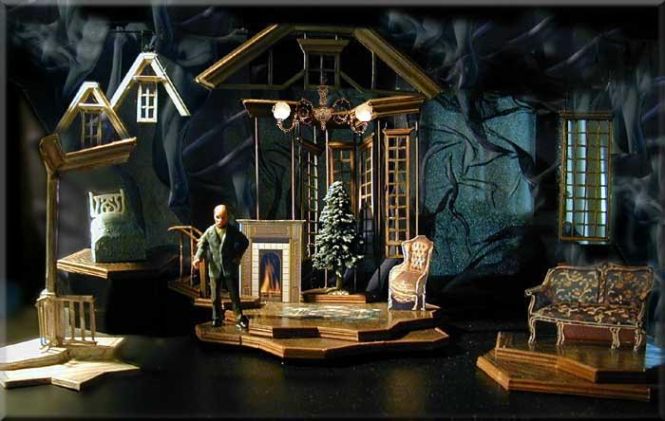
A Child's Christmas in Wales - Winter 2000 production for The National Theatre of the Deaf. The Set Design is by Richard Finkelstein. This adaptation of the work of Dylan Thomas, is by Burgess Clark, with direction by Peter Flynn

A Child’s Christmas in Wales – Winter 2000 production for The National Theatre of the Deaf. The Set Design is by Richard Finkelstein. This adaptation of the work of Dylan Thomas, is by Burgess Clark, with direction by Peter Flynn

The corgi sits next to the stack of papers. Perhaps he’ll eat some: there are essays on Melville, Whitman, even Elizabeth Bishop. Some tasty stuff, even whale meat there, but he only nickers and dreams of a Xmas-day bone.  Children race through my study, loving to slide across the wide waxed floorboards on the runner rugs, their winter surfboards, crashing into the dictionary stand holding the giant Webster’s III.  I shout. The dog looks up. The phone rings. It is the day before, long before, caller-ID, so I scrunch deeper into my great comfy chair . . . and hope.  “Dad, the phone’s for you.  Sounds like another sob story!”

Time: 9.30 a.m. 24 December, many years ago. This is the worst time in an academic’s year.

Our semesters always ended just before Xmas. Grades had to be submitted to the registrar within 78 hours after the final examination—in hand.  So, if you gave an examination on the 23rd you’d be staring at a pile of blue books on Xmas day. The computerized processing of grades was far in the distance.  Students could not discover their final grade until the New Year, when reports were sent home; we faculty posted grades on our office doors. But some students, even some of my students, couldn’t wait: they began calling before I’d even read their exams or papers. I had clearly informed them, repeatedly, that grades could be obtained only by those two methods:  the registrar or the office door. But as my son, now too an academic, observed, “Some students never listen!” a remark that seemed to apply to a few of the some 7,000 students that I have “taught” over some 40 years of my life. (Quick checking on my arithmeticing fingers informs that probably I read a grand total of some 42,000 student papers in my academic career.)

The day before Xmas can be trying, even in a non-religious household. There are commitments of gifting, of cooking, of making music, of writing letters and cards, of visiting, of entertaining, of reading Dylan Thomas. Yet for the academic, all of this must be pushed aside in favor of the exam booklet, the term paper, the graduate thesis proposal. This is the worst time in an academic’s year.

And then the reading itself, after the younger children have fled to other adventures and the door firmly shut against the delicious smells of pies and strudels and sauces for the next day. Did Mr. Adams deliberately mis-read the exam’s instructions? He’s been a tough one, frequently missing class, missing quizzes, and then arguing about grades. Do I give him the benefit of the doubt? It’s too late for a make-up, which I always allow in term. I want my students to learn the material. If they fail or do poorly in a major segment, I feel as if they should have a second chance.

So now, with grades due in a few hours, there’s no second chance. And that first paragraph lead in Daphne Cook’s term paper on Anne Sexton sounds awfully familiar—and it’s not credited. Well, other matters are, thoroughly credited. And, you know, once you say something about Sexton, everyone else seems to have said it too. This is the worst time in an academic’s year.

Hey Professor Softy, get a grip. But I can’t just now; I have to drive to the station to pick up the New Yorkers who feel a seasonal urge to be in the country in a large Victorian farmhouse fairly near the ocean.

Morning has gone, strident Xmas trumpets blast through my thickened door. “Dad, Mom wants to know whether you can . . . and now!” A sandwich, edges curling up, has been set on my desk. Thoughtful, maybe. I think of the Frost poem we studied last month:

. . . I am done with apple-picking now. / Essence of winter sleep is on the night, /. . .  I am drowsing off.  “Daddy, Henry won’t play Candyland with me!” I Drowse.

I check the pile of remaining exam booklets—constantly wishing that it will magically shrink to one, well, maybe two. It won’t. I’d like to skip that part of the course. “Dad, they’re back from the beach, and Mom says it’s time to make them cocktails.” That’s the answer. An anodyne. It’s danger? More sleep. This is the worst time in an academic’s life.

After midnight, after Santa has descended though our enormous fireplace and arranged all of the presents just so, after I have relaxed again into the depths of my Morris chair, after a blanket has been pulled up over me (thoughtful) and I might just sleep a bit more, the number of booklets has magically, it seems, reduced itself to very few. And then I think of the ending of that great story of Christmas written by the Welsh poet Dylan Thomas:  I said some words to the close . . . darkness, and then I slept.


Eric SchoonoverEric Schoonover, Professor Emeritus of American Literature and Literature of the Sea at the University of Rhode Island, now lives in a small 1735 Cape Ann cottage with his wife, a writer. Gone the corgi and the farmhouse, gone the blue books and even Candyland.   “An Academic Christmas” will appear in Schoonover’s forthcoming book, Telling Tales.