Poem by Melissa de Haan Cummings

a73de-parade2b202142bdennis2bflavin

Parade 2014 Dennis Flavin

[huge slow flakes of snow float straight down]

huge slow flakes of snow float straight down

this windless morning

thick on the trucks

Joe and Dylan walk in it

Joe rolls snowpeople balls

Dylan flops down

for snow angels

first big fall of the season

check on the snow person

O it’s half the height

of the yellow slide!

Riley sits on his knees

on the fourth sphere

Dylan heaves snowballs at him

the three take off to find more snow

flakes thin supposed

to continue all day

the little snow person

has sticks for arms and fingers

both sport Patriots helmets

Dylan runs up the hill

stops surveys the guys

runs on

flakes thicken

a tiny avalanche

slides off the triangle

shaped boat cover

my black buddy told me

her kind is lazy

shiftless and

wears loose shoes

Game on!

Stop in Beverly

for hard boiled eggs

salt coffee and a hot

chicken sandwich

What’s up with the Pats scandal?

O everybody does it

The Pats got caught

What it is is

each team gets nine balls

They give them to the ref

Fifteen minutes before the game

the ref gives them the balls

So they could both

deflate their balls!

Yah.  They do

according to what

the quarterback wants

The balls have to be

between twelve and

thirteen pounds

Of pressure?

Yah

How come it isn’t

what the receiver wants?

It’s what the quarterback wants

Cape Ann Mites

defeat Marblehead Mites

six to four

but our goal keeper

chastised by

Coach Dad

for staying inside

the crease

is sulky

as well as

frustrated by

the four goals

Grampy said

he was so so

the Marblehead goalie

was pretty good

Is so so better

than pretty good?

Grampy remains Mum

Before sunset

snow becomes rain

helmets and heads

roll off snow bodies


Melissa de Haan Cummings
24 January 2015

melissa2bcummingsMelissa de Haan Cummings majored in French and English Literature at 
Bryn Mawr. She has published poetry in a number of journals. 
 She describes her interests as including, “much small boating around Cape
 Ann, love of Charles Olson, Hatha yoga practice since 1969.”
 

Gloucester Writes the Sea

 
Gloucester Writes the Sea
Peter Anastas
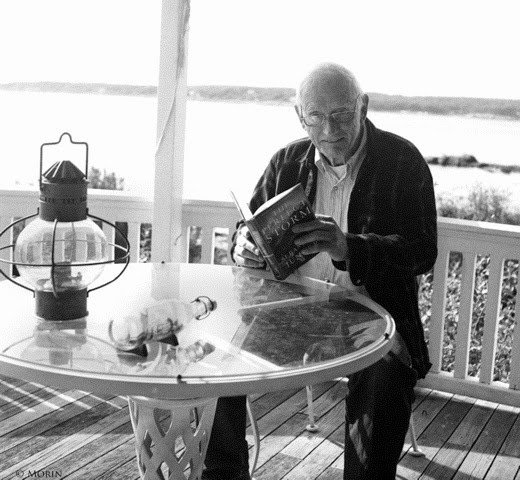
Joe Garland on his porch at Black Bess, Eastern Point, Gloucester, preparing for a visit with Sebastian Junger, 1998,
photo by Ernest Morin


Sitting out last week’s blizzard with a hot toddy and a good book, the distant roar of the Back Shore’s breakers in my ears, I began to think about the storms we’ve lived through, especially the Northeaster of 1991, known historically as The Perfect Storm.  This sent me to the bookcase for my copy of Sebastian Junger’s 1997 bestselling account of the storm and its impact on the city and our fishing families. 
I read the page proofs of The Perfect Stormin one sitting.  Replying to Junger’s publicist at W. W. Norton, who had sent them to the Book Store in Gloucester for pre-publication comment, I told her that I found the book “beautifully written.”  I said it gave “the flavor of Gloucester fishing life as lived by a segment of that community—-the bars, the drinking, the relationships formed out of bar life, the violence of that life, the losses.”  I went on to note that Junger had rendered this life “without judgment and with a precision of emotional detail.”
Eighteen years later I still feel the same way.  While the book has attracted an international readership and its ageless theme of men and women against the sea, of courage in the face of seemingly insuperable obstacles, is universal, its local focus is what still makes it memorable.
The Perfect Storm is a profoundly Gloucester book.  It tells a local story about indigenous people.  It evokes a time and a place in Gloucester’s history.  It is told with precision and candor.  And it doesn’t romanticize the maritime life or mythologize its participants.  Books about the sea often tend to do this, especially if they are fictive.  Melville’s notably did not; neither did Conrad’s or Richard Hughes’.
Closer to home, I find the stories of James B. Connolly, who wrote so prolifically about the lives of Gloucester fishermen, less easy to read than when I was younger.  In contrast, Joe Garland’s books have seemed to ripen with age, as I believe the republication of Lone Voyager in 2000 by Simon and Schuster amply demonstrates.  Connolly’s penchant for “salty” lingo over straight talk has reached the end of its shelf life, while Garland’s Yankee astringency still seems exactly right for its subject.
Yet Connolly, who wrote in The Book of the Gloucester Fishermen (1927) that he’d sailed with Gloucestermen “to the fishing banks, loafed with them ashore, sat with them in their homes,” set a standard for writing about the maritime life here that later writers had to measure up to, including Garland and Kim Bartlett, whose The Finest Kind (1977) is the best account we have of our Italian fleet.  Both succeeded, and beautifully.  As did Geoffrey Moorhouse, an English writer who moved to Gloucester in the 1970s, fished here, and produced his semi-fictional The Boat and the Town,(1979), which documents the pressures on the industry before the establishment of the 200 mile limit, while presenting Gloucester, in the author’s words, as “a paradigm of all the fishing communities in the world.”
These texts, whether he had read them or not, were the models that Sebastian Junger had to write The Perfect Stormagainst, if only in the minds of those natives who knew and lived them.
Are these books, including Junger’s, enough to create a local tradition of writing about the sea?  And is The Perfect Storm part of that company?  In each case, the author has either lived or spent significant time here.  Connolly and Garland had the deepest roots, though Bartlett worked as the Gloucester Times’ waterfront reporter and fished alongside of his subjects.  Junger lived here, too, emerging with a finer understanding of life ashore than many natives.
In 2010, John Morris, the grandson of a dory fisherman lost at sea, published what may well be the definitive history of dory fishing, Alone at Sea: Gloucester in the Age of Dorymen, 1623-1939.  Of this major contribution to Gloucester writing about the sea, Joe Garland wrote:
“John Morris is about to tell you all there is to be told about Gloucestermen and their wives and widows and fatherless kids, and ways of life, and of death by the thousands, of good times and of bad, in a masterpiece that’s been waiting for generations to be told.”
We are fortunate in Gloucester that as this community has evolved there have been people to document in gripping prose the extraordinary quality of its life, what it means, what we stand for, what we must preserve.  In Sebastian Junger’s words, “I love this town, and I really hope that the fishing industry recuperates because that’s the heart of this town.  It isn’t tourism.  It’s not light industry.  It’s fishing, and it would really be a tragedy if business by business, boat by boat, that gets chipped away.”
Junger said this in a 1998 Boston Globeinterview and his words are just as relevant today.  In fact, they speak to our condition even more powerfully.

A Gloucester Artist Speaks Out by JoAnn Castano

We are not a community afraid of change;  we are the change, in the most creative, innovative and enduring spirit. 

Over recent years I’ve watched as we become a blueprint of Salem, now like so many communities across America,  hooked on tourism and the tourists’ dollars. We’ve become followers and not innovative leaders. We were different, but soon we will not be.  Plan 2000 was promising, the Mt. Auburn Harbor Plan was promising and the public forums were also promising.   I don’t see any resemblance to those now.  So I write the following letter and offer one more push,  as I see an opportunity for change… a united change toward openness and transparency.

Greetings Mayor Theken,

First the historic blizzards of 2015 and Patriots World Championship win, you are on a roll. Congratulations on new beginnings.

I’m writing hoping you can provide me a little more insight into the procedures and issues concerning the proposed David Black sculpture.

I understand you, the Administration, will be withdrawing the request Appropriation 2015-SA-10 – $30k of free cash.   As reported in the Gloucester Daily Times, Bruce Tobey, who is leading the project, will do the fund- raising and has implied the project will be funded with private donations.

Also being implied is that there is no urgency now for a community meeting that was required and planned but cancelled due to snow.  We are told the meeting will be held in the spring.  I respectfully disagree regarding its urgency as the $30,000 appropriation was but one part of the community’s concerns.

A remaining issue is the use of Solomon Jacobs Park and the City’s negotiation with National Grid to pay for the base and installation of the sculpture.  I understand going before City Council soon is 2015.SA-19,  the Boating Infrastructure Grant (BIG) which includes the agreement with National Grid to pay for the base of the sculpture and part of the landscaping/installation.

It is not clear whether those funds can be used somewhere else. My question is this:  If approved,  does it lock in that the sculpture would have to be placed at Solomon Jacobs Park? Do you feel the public is fully aware of City plans for this site and has had the opportunity for community input?  

Am I correct to understand that in the Boating Infrastructure Grant (BIG) there is no planning opportunity for community boating and these plans have not been fully discussed with the public?  Are we building for people of Gloucester or for general tourism? If any portion of the appropriation 2015.SA-19 in the Boating Infrastructure Grant (BIG) is being negotiated or allocated to the Black Sculpture installation, I would hope a public forum will be held before a vote, or it may be stipulated that these negotiations will be withdrawn until there has been public community input.

Working together as a community we can strengthen transparency in City governance, restoring the people’s faith and trust.  The public trust, in its growing desire for knowledge and community input,  I hope will be restored in good faith.

We are not a community afraid of change; we are the change in the most creative, innovative and enduring spirit.

I am a sculptor myself with 35 years’ experience in cultural community planning and development in Salem, Newburyport, Brockton and Gloucester. Having lived and worked in an internationally renowned sculpting capital of Pietrasanta, Italy, I have had the opportunity to work and exhibit with some of the most famous and internationally known artists.  My family has been in the gallery business before and during my entire life. My uncle had been the Newbury St., Boston,  dealer of many of the artists Gloucester has historically claimed. We have a history of knowing the arts and the business of art. Gloucester has many seasoned artists and sculptors today with more experience than I in public art installations. We collectively have a wealth of education, knowledge and experience.  I understand the contemporary and educational process of bringing community assets of art into the public arena, as well as funding structures.  I worked on Plan 2000 with efforts to integrate the arts into every part of our urban planning.  We established the Committee for the Arts and spearheaded and co-founded seARTS advocating for and bringing in well over $600,000 from the Mass Cultural Council alone in the first seven years (2003-2010) of the Creative Economy initiative. Since then the funds and MCC’s financial and social investment has continued to increase other local, public and private matching funds.  Our community has worked hard, participated as a whole to strengthen our economy and enliven the livability of Gloucester.

I thank you in advance for providing  hope for stronger communication between the City government and her people. You have given us, in the short time you have held the office of Mayor, a hope to end the divide and polarization we have been enduring for too long. The arts can transcend all,  and this may be the issue that will bring us together and return the “fun” you want to bring back.

We have heard from many of the seasoned and well- respected artists who are very concerned about their future and the direction Gloucester has taken in negotiating industry and the sustainability of living and working here.  Placing art on the harbor without proper and sensitive planning with the waterfront workers,  especially during such difficult times, as outlined in the Mt. Auburn Plan commissioned by the City, is a discredit to the fishing industry and the cultural community as well as all citizens.  This is a community- wide issue and respectfully I request you lend your ear to the people.

The artists’ #1 issue today and for many years now is to have live/work space with incentives such as 1% for the arts. Cultural tourism planning vs. general tourism is paramount to who we are.  We’ve discussed this in recent years as it was brought before City Councilors in 2013 awaiting a public forum.  We are still waiting.

Thank you for continued service to the people of Gloucester.

Respectfully,

Jo-Ann Castano

Jo-Ann Castano of Gloucester ​is a sculptor, arts educator and a community arts activist and organizer.  She is the principal of Castano Design Associates/ArtsGloucest​er​. She was on the Gloucester Plan 2000 committee​, ​was a founder, past president,and acting director of the Society for the Encouragement of the Arts (seARTS) and co-founder of the Gloucester Committee for the Arts.

The Warmth of a Wood Stove by Laurel Tarantino

Loving and Leaving the Fort

A new entry from Loving and Leaving the Fort

January 2015

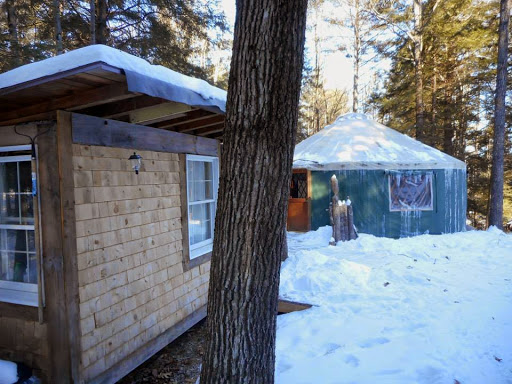
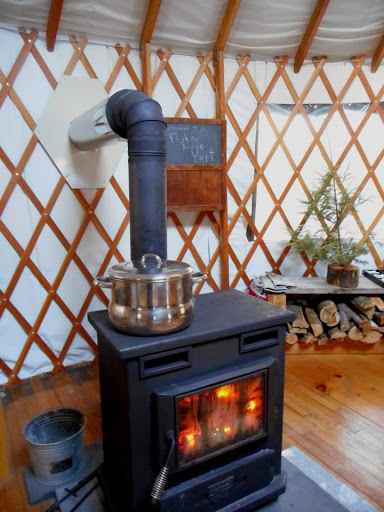
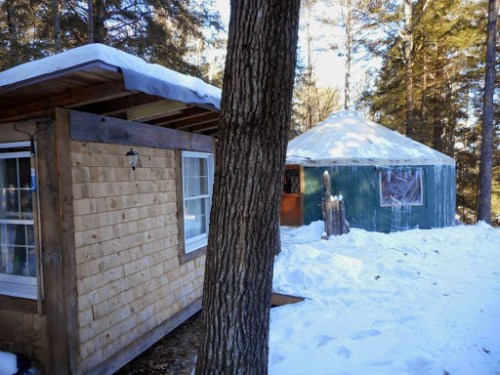
What is it about the warmth of a woodstove? I’m sitting on a very comfortable couch, my dog Sport by my side, enjoying the quiet, in a Maine Forest Yurt. It’s minus 9 degrees outside and a very toasty 78 degrees inside, and I ask that question again. What is it about the warmth of a wood stove? I can’t nail it down, but for me, there’s nothing like it.

Until I was thirty, I knew no other source of heat. I’m told when I was an infant, a sickly infant, that my folks installed a wood stove to replace a nasty furnace that blew heat up through the floor grate, along with dust particles and whatever else was lying on it. Problem solved. Oh I got sick once in a while, but nothing like before.

As I sit here now, I realize you can’t replace this all- encompassing warmth. Wool mittens drying for the next round of sledding, boots warming on top of the wood box as you shake the snow off your shoulders and hat, even the splash of snow gives an all- telling sizzle as it hits the iron and welcomes you to the warmth inside.
Loving and Leaving the Fort

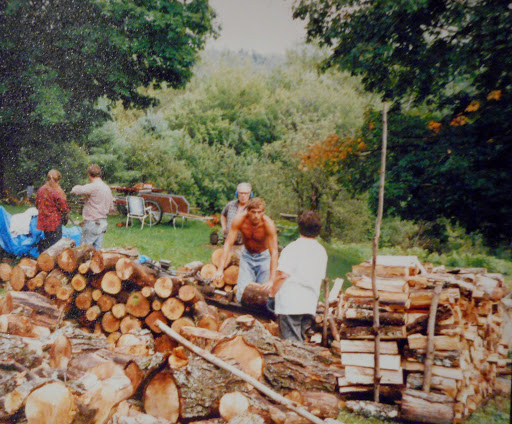
Perhaps it’s the simplicity of it, which isn’t all that simple. I can hear my mom saying, “By the time I put that piece of wood in the stove, I have it named.” I can understand why she said that, but some may not, so I’ll explain. When I was growing up we were fortunate to have 70 acres of land with hardwood, fields, wells and a brook on it up in Lovell, Maine. In late autumn, we’d fell trees, clear the branches into brush piles, cut the tree into manageable 6 to 12 foot lengths, haul them to the landing where they’d be cut into stove length, throw them into the back of the pick-up truck, drive up to the house and unload them into the dooryard where they would be split and stacked. Half a cord went onto the porch and 8 to 11 cord were stacked in the yard, bark side up so the rain would run off. If you were really lucky, you had a gas- powered wood splitter. We had both going, wood splitter and a brother who liked to split a few by hand, meaning with an axe. So, you can see how my mom could have been so familiar with each piece of wood she fed into the stove that she could have given it a name. This chore wasn’t accomplished in one day either; it took several weekends with a lot of us pitching in to help.

Loving and Leaving the FortWe had three wood stoves growing up, one in our house on Holly Street, and two in the old farmhouse in Maine. I never thought of myself as being “rich,” but my dad often said he was the richest man he knew. Years later, I realize why. It wasn’t because we had piles of money in the bank, we didn’t, or the fact that we had two homes. Our house was tiny, three boys to one bedroom, my sister and I in the other. The house in Maine was right out of the Beverly Hillbillies, before they made it to Hollywood. No, we didn’t have fancy real estate that only the well- off could afford, but our riches came from keeping those two homes running. The hearty breakfasts eaten together before hauling wood, the delicious stews or one- pot meals that kept us going ‘til suppertime, all lovingly prepared by Mom, who would be right there with us throwing a log onto the splitter once she took her apron off. Those times together were our riches.

Summertime was no different, it was still work, but it was always fun work. I can picture my dad, lying on one hip as he weeded the garden. I’d love to hear Mom and Dad bicker during planting season, she’d be putting perennials in her flower beds and Dad would say, “You can’t eat flowers, Bev.” To which she’d reply, “Food for the soul Ed, food for the soul.” Tomatoes, they were always another subject of controversy, she’d think he was planting too many, he’d think not enough, probably because it was Mom in the kitchen putting them up for winter stews. Needless to say, we had plenty of tomatoes.

When I was little-little, being the youngest of five, I can remember trying not to slip on the seaweed beds that clung to the rocks at the haul-back on the stone bridge on Goose Cove as we all filed into the dory. If it was an early low tide, Dad would row us over to Jones Creek where he’d dig clams and sea worms. I’d get to play in the warm shallows, chasing minnows and just being a kid.

Loving and Leaving the Fort

Always there were peanut butter sandwiches and boy, didn’t they taste good. Which makes me think of another question… What is it about being on the water that makes you so hungry? Is it just me, or can you eat an entire cooler full of food when you’re on the water all day?

Anyway, the tide would come up and we’d head over to the “Hummah,” our beautiful wooden boat that spent more time on dry docks in the Wheeler’s Point Boat Yard, than it did out on the water. My dad was a perfectionist when it came to painting her. This day, she’d be moored in Lobster Cove and we’d bait our hand lines with the sea worms Dad had dug up or bought earlier at Gleason’s. Remember those cardboard boxes of seaweed and worms? Can you still buy those in Gloucester? We’d always catch flounder to go with the steamers we’d have for supper. I’d silently hope I wouldn’t catch an eel, or they’d be on the menu too.

If the day was still young enough and Dad could get the Hummah’s engine to turn over and cooperate, we’d head out onto Ipswich Bay and do some trolling for mackerel. I could have cared less if we caught anything, I just loved the warm sea splash as the boat cut through the water, maybe heading towards Crane’s Beach or the Bell Buoy. I loved looking over the rail into the green depths; maybe I’d see a whale! It was always fun. I had my own rod and reel, and my line had about six rubbery worms on it, all pretty primary colors. How excited I’d get to have two fish on the line at once. They’re truly beautiful fish, our mackerel, such vibrant colors, especially in the warm summer sunshine.

Of course every day has its end. We’d head in to the mooring, tie off the boat and jump into the dory again. Then it was back to the haul-back, if I was lucky, the tide would be up high enough so I’d only have to step on the granite blocks and not have to struggle with the seaweed. If there wasn’t a lot of sun left, the “No See’ums” would eat us to frustration. We’d pile our gear into the back of the truck and head home. There we’d stand in a tiny little brook that cut through our yard and hose the salt off ourselves.

When I think back, my folks must have been exhausted. They still had the chores once we got home. Unpacking the coolers, cleaning the fish, cooking the fish and steamers, melting the butter, peeling the potatoes, slicing the beets, setting the table…doing the dishes. My brothers and sister would help, but I was the little one, I got to put my pajamas on early and fall asleep right after dinner, the contented kind of sleep of a little one, who’d just spent the entire day out in the fresh air in a place and with people she loves. I bet I slept smiling.
Classism and its Role in Gentrification by Mike Cook

After I submitted my opinion piece to “Enduring Gloucester” about gentrification’s numerous downsides, and how those downsides have  impacted coastal communities I’ve lived in and loved, from Provincetown to Portsmouth, I introduced a couple of old friends here in Provincetown to “Enduring Gloucester”.

085c1-photo2b7

Photo provided by Document/Morin

They lamented that a similar forum does not exist here.  As middle and lower income, largely  three season workers in the community’s tourism-based economy, they are finding basic survival here increasingly difficult—and very few among the more well to do “political class” that runs the town, as liberal and progressive as they all claim to be, seems to care not a whit.

By basic survival, I primarily mean the ability to find year round housing they can afford to rent or, if they are lucky enough to have bought something in years past, to earn enough money via the tourism and retail driven economy to properly maintain their homes and afford the ever escalating property taxes.

In the not quite three weeks since I have been here, I have been saddened to hear how many people I met and knew through the years, some of them Provincetown’s most interesting and creative residents, have  moved on. Some sold their homes because they did not earn enough in retail and tourism to maintain them, pay ever higher property taxes, and also put food on the table. Others  left because the constant fear of being asked to move, yet again, when a property is sold or another apartment is converted into a condo and the rent sent into the stratosphere, even in the dead of winter, has proven to be just too stressful—especially for people who have lived in and contributed to Provincetown for years and now feel as if the town, or at least the affluent newcomers who have bought up so much of the town in recent years and the political class that does their bidding, neither appreciate their contributions nor the town’s long history of being a place where all are welcome.

Conversations with my friends, sadly, confirmed my observation about Provincetown being a place that celebrates “tolerance and diversity” only so long as it is gay, affluent, and overwhelmingly white, was not as off the mark as I may have once thought.

That realization got me thinking about the gay community itself and what I have come to see as an issue no one in the community, or very few, ever think about—let alone talk about, at least  openly.

The issue I am referring to is classism and, I dare say, it is so pervasive in the gay “community” that it makes a mockery of the very notion that a gay “community” truly exists.

I  first thought about this “ism” within my own “community” on a warm summer night in 1991. My roommate, the late John Barnes, and I were driving home to 51 Fort Square from a swanky fundraiser for what was known then as the North Shore AIDS Health Project. The event was held at the elegant Annisquam home of a very affluent gay male couple.

As we were driving home on Washington Street, Johnny said to me, “You know, Mike, you fit in at the party. It’s that ‘preppy’ look of yours. But if I didn’t have AIDS and wasn’t needed as a ‘token’ for fundraising purposes, those two queens would never have invited me to a party at their house, unless it was to hook up for sex. ”

At first, I dismissed what Johnny had to say or, more accurately, I didn’t want to believe it. But in the years since John died in 1992, and as a result of the things I have seen in the ensuing years, I have to admit that, by and large, Johnny Barnes was right on the money.

But back to classism more generally.

I think it is very much in play in Gloucester today as the once solid lower and middle income communities the fishing industry nurtured find themselves in positions not unlike many people here in Provincetown.

The strength of those lower and middle income fishing industry related communities served as a bulwark against the kind of gentrification that has transformed Provincetown, Portsmouth, and Newburyport into mere  caricatures of their once authentic selves and into some of the most expensive small coastal communities in  which to live in the nation.

But today, that strength is waning; creating a vacuum  far too many of Gloucester’s already well heeled—be they politically liberal or conservative, Democrat or Republican—seem to think will be best filled by transforming Fort Square into Louisburg Square by the Sea and “Portagee” Hill into Beacon Hill by the Bay.

Last May I attended that bastion of Cape Ann liberalism’s premier event – the Democratic City Committees’ annual Sunday brunch.

I was both shocked and saddened to hear so many people who I’d long thought of as liberals like myself expressing their support for the kind of gentrification that was then exemplified by the imminent plans to tear down the Birdseye building to make way for a billionaire’s “boutique hotel”.

mike_cookMike Cook  is a long time liberal and gay rights activist who saw the uniqueness of Gloucester from the first moment he drove over the bridge during his move from Cambridge to Cape Ann in 1991 to run NUVA’s AIDS education and services programs.

Poem by Marsden Hartley

4b752-dogtown

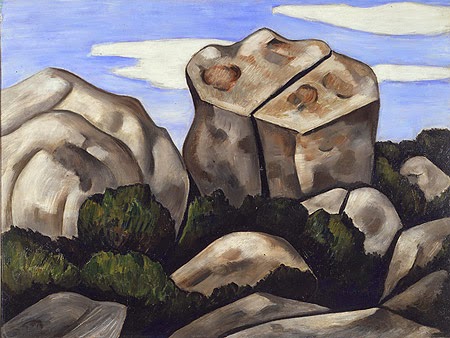
In the Morraine, Dogtown Common. Marsden Hartley, Cape Ann, 1931

This Little City

This little city in the sea
steeped in the silence of some vast amenity
of wild, perpetual, courageous things–
cast with the bounty of brave commensurate wings
that have each hour of explicit day
enfolded in a swerved embrace
the solace
of commensurate verity–
shoulders mounting everywhere to face
the crest of crude contingency of place–
gift upon the brow of flushed
thanksgiving
that makes even broken lip sing,
conscripted laughter of devout
simplicity
pouring out of their eyes that greet
the ploughing wind
as others proud of the graced returning
of their all but vanished race
give back forespoken tithes of
somehow continuity–
others basking in brisk contrariety of sun–
these the couraged men,
the fishermen.

Marsden Hartley (1904-1943) was a Maine native who painted and wrote in Gloucester during the early 1930s.
His paintings of Dogtown Common have been the subject of two exhibitions at the Cape Ann Museum.

Poem by Melissa de Haan Cummings

5fdd7-reflections

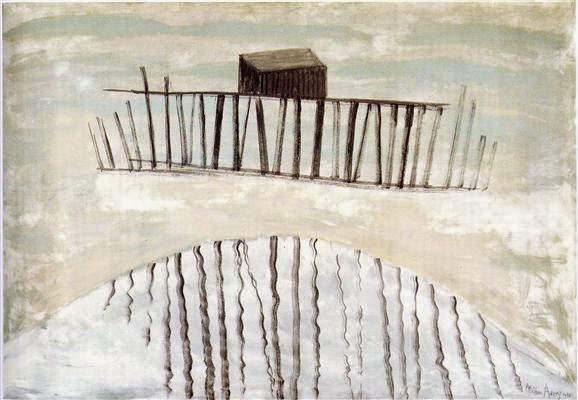
Reflections 1958. Milton Avery (1885-1965)

On the eve of my seventy-sixth birthday

on the eve of my seventy-sixth birthday
twenty degrees Fahrenheit
northeast wind fourteen nauts

for the first time in twenty-five years
I skated on Days Pond
up the street from my house
probably skated there
for the first time about forty
years ago standing with
Buddy Silva’s wife Barbara
while her Brian and my Joe
skated as five year olds do
all of us chatting

so today my seven year old grandson
warned me to be careful
as he led me across the ice
to a lovely dock
be very very careful here
that’s twenty-five carefuls
because it’s twenty five years
lace his and his brother’s skates
O you tie them just the way Dad does!
How many ways are there?
O lots of ways.
Here’s the puck!
It’s stuck in the ice!
Dylan!  Get it out!
Dylan got the puck!
O Good!
I got the puck!
There’s ice stuck to it!
Lace and tie my skates
and put one blade on the ice
Not standing on that.
Try the other.  Nope.
Turn onto my knees on the dock
grasp its corner post and then
down with a skate
Hold my hand.  O gladly.
Now bend forward
Two hands on the stick
Don’t bend too far
Are you comfortable?
I’ll let you know
Are you having fun?
I’ll let you know
I bet you’re having fun!

There’s Nana with baby Colton!
Here, Sata, give me your stick
Riley puts his and my sticks
under his arms parallel to the ice
for me to hold.  I hold happily
am glided to Nana

Are you ready to play hockey yet?
Not yet. I’m practising.
OK well this is how you go backwards
It’s called C ing.  See the marks my skate makes?
That’s a C.  Ready for the crossovers?  No.
Dylan performs one.  Hockey now
What’s that board?
We use that for a goal
The other goal is a pair of shoes
I have a big pair of shoes
You can play goal because
you won’t have to skate.
I drop my stick.  Oh-oh.
I’ll get it for you, Sata.
Thanks

After an hour the boys are cold and leave
Riley having me untie his skates
so his hands won’t get cold
although they do when they
have to squeeze a foot into a shoe
Leave the puck on the dock
Take up my skate guards
and skate them to my big boots
Put guards in boots
push both toward Nana’s
with my stick where the reeds
are frozen into the ice and
where there is an upright
two by four to sit on
able to bend where
the security of the reeds
makes a solid floor
Sit on the board and
successfully remove
skates remembering
twenty five years back
to wipe down the blades
with my green tissues
having practiced thirty minutes more
very slow and o so pleased to have
met the challenge as turning thirty
I jogged around Walden Pond
turning sixty I leapt from a boulder
at Cambridge Beach onto Danger Rock
where my father rescued me from
the outgoing tide when I was
probably five or six

Then I took a two and a half hour
woods walk with Marge
delighted to have warm
and functional feet
nothing adverse but a tired back

Sata!  Did you have a good time?


Melissa de Haan Cummings

melissa2bcummingsMelissa de Haan Cummings majored in French and English Literature at 
Bryn Mawr. She has published poetry in a number of journals. 
 She describes her interests as including, “much small boating around Cape
 Ann, love of Charles Olson, Hatha yoga practice since 1969.”
 

From Over the Bridge, At Least For Now by Mike Cook

Well, this winter did not turn out the way I expected.

Had anyone told me when I gave up my rental share in a house in Gloucester to spend the winter working in southwest Florida that I would be writing this from Provincetown, well, let’s just say not even I would have believed them.

But the fates, a lost wallet, and right wing bumper stickers all played a role in my winding up on a northbound  Greyhound bus, one cannot fly without a photo id these days, not really knowing where I was going to land.

As to the bumper stickers, I had no idea what a bastion of right wing, fundamentalist Christian, Tea Party Republicanism much of southwest Florida, even right along the coast, is. But I do now.

The bus ride was actually an intriguing experience. It got me back in touch with just what a vast and varied land the United States of America remains.

Pulling into the Greyhound terminal in NYC at 1:00 AM on a frigid night, with a three hour lay over ahead of me, was an experience I won’t soon forget. The sitting area was full of homeless people desperate to get in from the cold. To say that it was street theater taken to a disturbing extreme is an understatement of equally disturbing extremes.

I sat, writing in my journal, wondering “How can it be that in the richest nation on earth, people who, through no fault of their own, find life unmanageable can be relegated to an impoverished netherworld that is, truly, beyond Dickensian?”

After that experience, the deep woods of North Truro, where I first stayed upon my arrival on the Outer Cape, were a welcome respite from  the ugly realities of the world we all know exists but far too few of us want to talk about, let alone do anything about.

So, here I am settled into Provincetown with plans to return to Gloucester in April.

I have ample time on my hands to contemplate the meaning of this most recent adventure of mine and what might come after.

As I stroll the deserted streets of Provincetown, I find myself wondering if the  nouveau riche, bourgeois bohemian, gentrification, albeit of a largely gay variety, that has transformed this once magical place into little more than an expensive summer resort that celebrates diversity so long as it is rich, gay, and overwhelmingly white, is what awaits Gloucester.

Of course, the dynamics will not be exactly the same. But Gloucester, like Provincetown, Portsmouth, and Newburyport, with its beautiful coastal geography, is, with the decline of the blue collar/middle class fishing economy, being targeted by the same well to do bourgeois bohemian types who have so changed Provincetown, Portsmouth, and Newburyport in recent decades.

Provincetown, like Newburyport and Portsmouth, now ranks among the most expensive small coastal communities in the nation in which to live.

The working class, whether it be the gay men and lesbians  who waited on tables and tended bar,  the struggling artists and writers, or the locally born Portuguese who harvested the sea, are largely gone.

Year round housing that can be called even remotely affordable is all but impossible to find. As a result, many of the workers in the summer tourism season who wait on tables, tend bar, prepare the food in restaurants, and  change the sheets in $300 a night guesthouses are college students from eastern Europe and Jamaicans who live in dormitory style housing provided them by their employers to whom those employees then pay rent.

I don’t know what, if anything, can be done to stop, or even temper, the gentrification that is bearing down on Gloucester, but surely pointing out some of the downsides to that gentrification, many of which are abundantly visible in places like Provincetown, Newburyport, and Portsmouth, might be a means of getting people to think carefully before they embark down a road that could bring changes to Gloucester that are only in the interests of a select few as opposed to the hard working many.

mike_cookMike Cook  Long time liberal and gay rights activist who saw the uniqueness of Gloucester from the first moment he drove over the bridge during his move from Cambridge to Cape Ann in 1991 to run NUVA’s AIDS education and services programs.

But then I realized liberals are not a monolithic, like thinking group of people, especially when you are talking about  “liberal laborers” and  “limousine liberals”.

Ah well, I hope this rambling of mine gets people thinking about the role classism plays, not just in what is happening in Gloucester, but throughout the nation as a whole – before it really is too late to do anything about it.

Choosing Home, Gloucester, Massachusetts by Laurel Tarantino

A new entry from Loving and Leaving the Fort

January 15, 2015

Wow, January 2015! Where does time go? One moment you’re 17, carefree, playing in the surf at Good Harbor Beach, all sunshine and waves. The next thing you know, the cold Winter winds have awakened you and you realize you’re 50 something, wondering… “Have I packed enough life in those years?” I like to think I have, with lots more to come. Good and bad, easy and hard, so long as they balance out, better yet, with the good and easy outweighing the junk stuff.

Last I wrote, I was in the White Mountains, it was the 80s. I was in my 20s. Then, WHAM, I got my heart broken, or rather, I allowed it to break. I tried sticking around the Whites, I got myself a gorgeous place overlooking the Saco River and Cathedral Ledge. As wonderful as it was, with dear friends helping me to carry on, it just wasn’t going to happen for me. I needed and wanted out. I didn’t want what had been a place filled with wonderful memories to turn into bitterness.

What next? I called my brother down in Bay View, tears in my voice… “I want to come home.” His reply, “Come on then.” So there I was, thirty years old, never married, no home, no kids, running back to Gloucester to live with my brother, his wife and their three kids. “What a loser!” Well, that’s what I thought at the time. I was fortunate to have someone to let me in and it turned out to be a great place to re-start and get on with my next decade.

I had little ones to buy Christmas gifts for… (holidays are always tough when you feel alone). I had my own room with a separate entrance, a place at the table to eat dinner in the company of family. When my heart started aching and tears welled up, my brother would grab his oars, say “Come on,” and we’d jump in his dory tied to a haul back in Lobster Cove, and row out into Ipswich Bay. Sometimes we wouldn’t stop til we hit Hodgkin’s Cove. It was exhilarating, the healing had begun.

Loving and Leaving the Fort

Heading out into Ipswich Bay

I met a friend at one of the two jobs I was working. We hit it off right from the start. We were soon jet-setting all around in my faithful old Volvo. We were pretty fancy, us two; dinner in Marblehead, the next weekend Newburyport, off to the ski slopes in Maine. We could go where ever we wanted, do what ever we dreamed up, so long as we made it to work on Monday. Fun, fun times, but I needed to move on from play dates with my friend and living with my brother, after all, I was supposedly an adult now.

Loving and Leaving the FortEnter, Stage Left: In walks more good Karma. I’m having lunch over in East Gloucester with my mom, when I see and old friend across the room… Crushing bear hugs, “Haven’t seen you in years.” “What are you up to?” All led to me renting an amazing place on Goose Cove. Talk about being at the right place at the right time!

Goose Cove, back to my roots, where I used to catch baby eels off the dock, cupped gently in my bare hands. Here I was, 20 years later, hanging out on the rocks in my backyard, watching Snowy Egrets, Blue Herons, Green Herons and ducks while having my morning coffee. If the tide was up, an occasional pair of Swans would paddle over, looking for a treat. Such a magical place.

So, life was getting rosier all the time. Oh I still had my “Woe is me,” moments, missing friends, a cool job and my dog that I left behind in the mountains. Leaving my dog behind was the worst of it, but the best thing for her. I could never explain that I was letting her keep her fields and forests, in exchange for not having to live on a leash and as a shut in while I went to work. As she adjusted to life without me, I’d begun to settle into my old stomping grounds.

Sunrise, blue herons, coffee. Goose Cove

It’s hard picking up pieces of yourself and starting over again, but I was doing a great job of it. It helped that I was in familiar surroundings. Funny, how you miss the simple things. I used to worry that I wouldn’t have anyone to wave to on my way to work. Little by little, that came back too. It may not have been my friend Donnie in his Camino, driving down a road in Bartlett, but I’d see Fred in his pick-up truck on the stone bridge in Annisquam. Little by little, I’d bump into folks that I hadn’t seen in ten years. Oh, we wouldn’t begin again where we left off, friends can become acquaintances after a good amount of time. They’ve married their high school sweetheart, moved into a house of their own, had kids… it wasn’t like I could knock on a neighbors door and ask if Mindy could come out and play. Remember, I’m an adult at this point.

What I figured out was that Gloucester had its own way of welcoming me back. If I embraced and appreciated all she had to offer, she took me back, with open arms.

Swans stopping by for a treat. Goose Cove

Poem by Rufus Collinson

3a772-sea2bsmoke

Ten Pound Island, Gloucester Harbor by Laurel Tarantino January, 2015

Sea Smoke

We awaken in the cold this morning

to find that the sea has become enchanted

and is rising to the sky.

Gulls shine all prismy within the mist

and ultimately lift up too,

wings becoming light.

Everything is rising.

Even on the hardest day,

there is transformation.

 ~ Rufus Collinson


Ruthanne (Rufus) Collinson has lived and loved in Gloucester all of her life. She worked for 25 years as Director of Publications for Project Adventure and served as Gloucester’s poet laureate for four years  (2009-2013).