Giving Thanks

A wish to all of you from all of us at Enduring Gloucester…   may you have a Happy and Safe Thanksgiving, filled with many blessings.

“For each new morning with its light, For rest and shelter of the night, For health and food, For love and friends, For everything Thy goodness sends.” ~ Ralph Waldo Emerson

Gloucester Landscape 1919 Stuart Davis (1892-19640

Gloucester Landscape 1919
Stuart Davis (1892-1964)

Pot Luck

Laurel Tarantino

I’ve resigned myself to the fact that I will never have a formal dining room.  You know the kind I mean, a room with a long handsome table that seats ten or twenty people, with water glasses, stemmed goblets for wine, fine china and fingerbowls.  The kind of table where I would have to question, “Which fork is this, my salad fork, or is it for the main course?” A room where there are old fine art oil paintings that adorn the walls, lit by brass lamps that reflect the mastery of the artist.  Oh, and candles, how they’ll set the mood for an exquisite evening.

No, I may never know what it’s like to dine in such a formal setting, but I do know fine dining.  I’ve found a dining experience that fits into my life just perfectly, and I can’t imagine a month without one.  Pot Luck dining: I don’t know where these dinners originated, I like to think they started right here in New England.   I’m not going to “Google” them on line to learn their history, but one thing I do know, whoever came up with the concept was a genius.

I can’t remember my first, perhaps it was at the Fire Station in Lovell, Maine, where it seemed the entire town showed up to socialize.  I’m always tempted to stop at those suppers you see advertised on a hand painted board “Church Supper Tonight, All Are Welcome,” but it’s usually last minute that I see them and I was brought up never to show up empty handed.  So I smile instead for those inside enjoying their community gathering.

I have a small group that gets together to play what we call “Extreme Croquet,” mostly during the not-so-perfect weather days, hence the name “Extreme.”  One Saturday a month, at High Noon, weExtreme Croquet meet for the fun and the bragging rights of taking the win on the course.  There may be briar, knee deep grass, waist high snow, rain, or other obstacles on the course.  Always, there is friendly ribbing…   “Watch him, he cheats!  Send Him, Send Him Long.”  And always, always, there is laughter in abundance and a great variety of food in between rounds.  A quiet comes over the room as folks warm up with some of Helen’s chowder, a mound of Shepherds’ Pie, or a slice of Tracy’s extreme lemon cake.Extreme Lemon Cake

So, I may have only won bragging rights once in 20 or 30 games, but I surely come out on top each time I go, from the friendship, fresh air filled with the sounds of friend’s voices, and that wonderful, ever present “Pot Luck” meal.

Fast forward now, to a boat building shop on Harbor Loop.  The building itself is part of Gloucester’s Maritime Heritage Center.  Why they took the word “Heritage” out of the name is beyond me and a whole other story.

Anyway, when I bump into Geno he’ll say, “Hey, we’re going to be cooking this Saturday, you should come by if you can.” Or: “We’re getting together this weekend,” and the one I’m always sad to hear: “We’ve been getting together, I haven’t seen you in a while, where’ve you been?”  Life.  Why is it that life sometimes gets in the way of being somewhere we’d like to be, doing what we’d like to do?

Back to the Dory Shop.  There’s usually a boat in the process of being built on any given Saturday afternoon you step through the old wood sliding door.  Hopefully, for our purpose, it’s at the stage where it’s upside down and we can use the bottom for our table.   One of my fondest memories was hearing someone yell from inside the shop “Hey Geno, we need a bigger boat,” as people kept arriving with more food.   There’s plenty of sawdust, boat building tools and warmth from the wood stove that will surely have something good cooking on it.
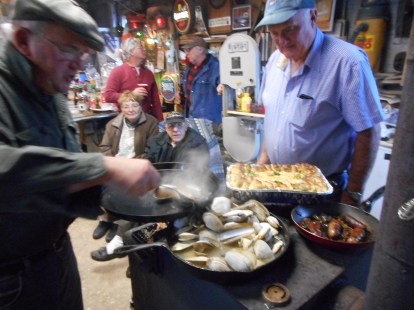
Cooking on the wood stove at the Dory Shop

Cooking on the wood stove at the Dory Shop

Remove the lid from the cast iron skillet and catch a fine mouth-watering aroma taking the chill out of a November day.

Tom will most likely arrive with rosy cheeks, a bucket of steamers and a few lobsters he hauled just that morning.  Someone may bring Finnan Haddie, home baked beans, a salad, sweets… Ever hear of a “Gloucester Lollipop?”  We have those too, when Joe comes in with his Mackerel on a stick and what a treat when Geno makes his fish cakes and calls from the wood stove to get ‘em while they last.  You never know what you’ll get, but a guarantee is that you will be welcomed, you will be well fed, and you’ll have such a grand time that you’ll want to return again and again.

An added bonus to Saturday afternoon’s at the Dory Shop would be the music. Someone is bound to bring an instrument or a pretty voice to entertain for a spell.  Want to dance?  Go ahead, no one judges you here.

Music at the Dory Shop

Music at the Dory Shop

Perhaps others will join you, or try and sing along. It’s okay if you don’t know the words.  Just don’t sit in the rocking chair if it’s empty. That’s Joe’s chair and he’s too much of a gentleman to tell you so.  It’s just a given for those of us who’ve been around a while.  The way I hear it, Geno started these Saturday afternoon “Pot Lucks” so he would have something fun to do with his uncle.  How wonderful for us that we benefit from these kind souls.


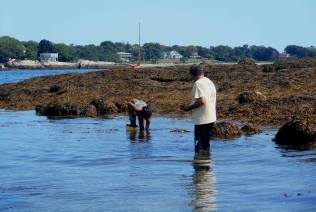
I bring you a bit away from the waterfront, to a two-car garage that houses no cars, behind Burnham’s Field.  I call these pot luck meals “Sunday Dinner at Joe’s Garage.” I have an entire photo album just for these meals.  Some of the photos include Joe gathering mussels off theGathering Mussels seaweed beds of Ten Pound Island with his daughter, to be later photographed in a pan of garlic, fresh tomatoes and wine.  Oh, and the fresh bread!
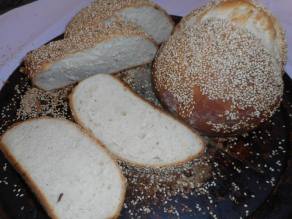
Bread is always warm at Joe's Garage

Bread is always warm at Joe’s Garage

Joe makes loaves every time.  Hot from the industrial restaurant style ovens, smothered in sesame seed, a true gift for your taste buds.  How many pictures of food can you take?  I don’t know yet, I’m still working on it.  I know for sure, there’ll be more delights coming from Sunday Dinner at Joe’s Garage.  Homemade sausage, pizzas, linguini with the clam sauce, countless photo ops.

Today I’m at another friend’s house for “Patriots Football.”  I’m among some of my dearest of friends and they all know I’m not here to watch football.  Oh, I do hope the Patriots continue with their winning streak, but it is certainly not the foremost reason for being here.  It’s the nourishment of friendship, good eats and conversations, before, during half time and after the game that feed me.  Even the dogs are happy to be invited.  Maybe someone will toss them a scrap; in the meantime, they run and play in the autumn sunshine.    This group of people take turns each time there is a one o’clock game on a Sunday.  One week it might be at Maria’s or June’s, perhaps a Harvest Meal at Lenny and Ricks, wherever it may be any particular week is the place I want to be.

I can hear cheers from the other room, the Pats must be winning.  From where I sit, we have all won for this day we’ve been given together.

There are so many ways we enjoy ourselves.  I find for me they generally involve food.  The Fort Gang feasts at different friends’ homes during St. Peter’s Fiesta, celebrating the Fourth of July with the same crew and then some in Rockport.  Bringing a dish to the Orchard Street Parade where the famous “Hat Ladies” debut their incredible work.   St. Joseph’s Feast at Auntie Emma’s, which starts before most are out of bed to make the pasta.  All memories that make forever stories to be told time and again.

So folks, if you’ve never experienced it, I highly recommend it…   call it what you will, “Pot Luck Dinner, Pot Luck Lunch, Sunday Dinner at Joe’s Garage.” Make up your own excuse, just do it.  Get together with your friends, share in the making of the meal, and eat it together, be it leaning on a porch railing or the bottom of an overturned boat.  Rain, snow, sunshine or under the stars, simply enjoy each other’s company.

If you want to “Google” the origins of Pot Luck, please let me know what you find.  I imagine they’ve been around since time began.  Surely, because of them, I dine on the best food on earth, in the finest settings, surrounded by the laughter and love of friendships old and new.

It doesn't get any better than this...


Laurel TarantinoLaurel Tarantino, writer, is happy to live in her hometown, Gloucester, with her husband, James,”Jimmy T,” daughter Marina Bella, and the family dog, Sport. She is known for “stopping to smell the roses” and loves to photograph and write about her beloved waterfront community.


Hear Her Roar

Lori Sanborn

For the first twenty-five plus years of my life, I felt more connected to the male gender. Throughout my middle school, high school, and college years I had way more male friends than female ones. Of course, I had a few girls that I trusted and could tell anything to. And one or two, who I was really close to that I would even smoke Marlboros with and cut class. But overall, at these stages of my life, I felt more comfortable around males. I was even able more readily to

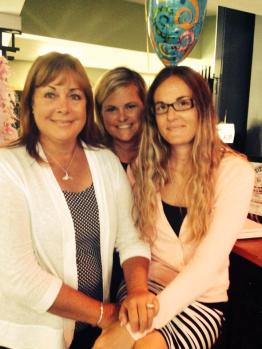
Nancy Sanborn (my Mom), Meagan Sanborn (sister) & me

Nancy Sanborn (my Mom), Meagan Sanborn (sister) & me

admire males over females. But then I turned thirty, and from that point on, my perspective had changed entirely.

During the last five years of my life, I have witnessed countless acts of unwavering courage and unbelievable strength from women in my circle of friends, women from our seaside community, and from one of the most important women in my life, my sister.

I have some badass girlfriends. Not because they ride Harleys or remain standing after pounding five shots of tequila. My friends endure. I have a friend who only cried once after being diagnosed with an aggressive type of breast cancer. When “cancer” entered my world, I was on the bathroom floor unable to move. Yet when recalling her story, she actually smiled and told me she “had two boys to raise and they needed her.” She never looked back but rather dedicated herself to being the best mother she could be. Did I mention that she was also a single mom? Badass.

Another girlfriend of mine had her world turned upside down upon hearing that her mother had been diagnosed with early onset Parkinson’s disease. Honestly, I would struggle to get out of bed if faced with such a circumstance. But in looking at my dear friend, one would never know of her struggle. She maintains a calmness and stick-to-itiveness that is admirable. She goes to work. She takes her mother to all of her doctor appointments, all while managing to hold down her own fort. She values her role as wife and mother. She doesn’t complain and is one of the most genuine women I know. Did I mention that she doesn’t drink? Badass.

Within our Gloucester community heroism is all around us. She is the woman that has the drive to start a new main street business and still raise four kids. She is the young woman that moves by herself to North Carolina to start anew.  She is the woman that can still believe in love after being lied to time and time again. She is the loyal wife of over 30 years. She is the woman that has the courage to file for divorce. She is the woman that can still raise a child after losing one.  She is the woman that can work more than one job to provide for her family. She is the woman that decides to follow her dream or face her fear.  She is the woman that runs for office. She is the woman that chooses to be a stay at home mom. She is the woman that has lost a spouse or sibling unexpectedly. She is the woman that faces a health scare of her own. She is the woman that ran the Boston Marathon. Did I mention that SHE doesn’t always roar?  Sometimes she just shows up, and that alone is enough. Badass.

My sister is one of those women who always shows up. No matter what time the hockey game is, no matter the hosting state, she is always in that rink for her sons.  And she’s probably there two hours ahead of time.  No matter how many times she has faced unfairness or less than desired

My sister, Meagan Sanborn and her son, Timmy

My sister, Meagan Sanborn and her son, Timmy

outcomes, she has pushed on. She never complains about being the sole provider, but rather has always found a way to provide. She always puts her boys first yet somehow finds a way to be there for her family and friends when they need her. She is the type of woman that shoots straight and knows just what you need and when you need it. Intuitively, she knows when to take you on a Backshore ride, grab her Macy’s card, or pour a big glass of wine. She is the woman that picked me up off that bathroom floor after I was misdiagnosed with lymphoma and spoke only this to me, “So, you’ll beat it.” She is the woman that hates hugs but can still make you feel loved and comforted.  Did I mention that she just closed on a new house for her and the boys? Badass.

It may have taken me thirty years to truly connect with the female gender. But in only five years “She” has taught me the real meaning of compassion, loyalty and above all, strength. Imagine what “She” will teach me in next twenty-five.

And this is not some feminist propaganda piece.  I could give you a thousand reasons why I love my Daddy.

~Lori Sanborn

lori sanborn

Lori Sanborn was born in Gloucester and returned to live permanently in our seaside community three years ago. She has been a public educator for 12 years, teaching eighth graders.  Lori is most proud of her role as mother to her children, Emerson and Ryder.


Gloucester Author Writes about an Endangered Bird

A Review by JoeAnn Hart

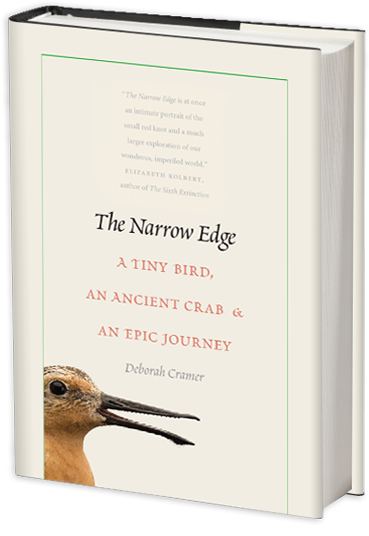
The Narrow Edge, by Deborah Cramer, Yale University Press, 2015. $28, 288 pages.  

The Narrow Edge

 “When an extinction occurs, there is no way to know which species will be the next to cling to the hands of time.”

The “narrow edge” in the title of this engaging book by Gloucester resident, Deborah Cramer, evokes the image of comedian Harold Lloyd, in the 1923 film Safety Last!, teetering on a skyscraper ledge, clinging for dear life to the hands of a clock. It is an apt metaphor for the uncertain future of the red knot (“a small sandpiper about the size of a robin and weighing about as much as a coffee cup”), which roams the sliver of sand between land and sea, a precarious place to be these days. This indefatigable bird lives for five months on desolate tidal flats at the tip of South America, then, as if possessed, travels 9,500 miles north, following the coasts of two continents, to breed in the Arctic.,

In The Narrow Edge: A Tiny Bird, an Ancient Crab, and an Epic Journey, Cramer explores this flyway by plane, kayak, helicopter, and foot, feeding on history and science as she goes, wrestling with the consequences of human interaction with the natural world. Her journey ends at a scientists’ field camp in the most northern of Canada’s territories, where the red knot lays its eggs. The birds arrive with just the feathers on their backs, while Cramer is weighted down with supplies, bulky clothes, a GPS, and the requisite twelve-gauge shotgun to ward off polar bears. It was the worst summer for shorebirds in the field camp’s history.

In her travels, Cramer often sustains herself on pilot biscuits, but the red knot needs high protein fuel and lots of it, preferably the eggs of the homely horseshoe crab. Yet this living fossil, which has survived on Earth for half a billion years, is running out of breeding grounds. The beaches on which it lays its eggs are being destroyed from over-development, rising waters, oil spills, and industrial run-off. As if the crab didn’t have enough to worry about, it is also of considerable value to humans: Aside from its historical use as fertilizer and bait, the crab’s blue blood is used to ensure the safety of intravenous medical procedures. In theory, the blood harvest should not kill the crab, or at least not many, but Cramer’s research suggests another story—and so the red knot’s fortunes rise and fall with the crab’s.

Cramer walks and talks with a wide band of scientists and naturalists who are working against the clock to save the red knot, because if this shorebird disappears, it won’t be the only one, and we cannot predict the consequences. “The foundation of food webs may not be apparent until they fray,” she writes, citing the disappearance of the passenger pigeon with the rise of Lyme disease. (Read the book to discover the connection.) When an extinction occurs, there is no way to know which species will be the next to cling to the hands of time.

—JoeAnn Hart

Orion Magazine, Sept./Oct. 2015

JoeAnn Hart

 JoeAnn Hart, a long time Gloucester resident, is the author of the novels Float and Addled.  Her review first appeared in Orion, September/October, 2015.   

Photo by Brendan Pike, Gloucester.

Sophie the Bull (1928—2015)


copyright Document / Morin 2010

copyright Document / Morin 2010

I walked to the wake at Greeley’s Funeral. Same set-up as all the Sicilian wakes.  Carlo’s—the Captain who counted on Sophie’s gang to unload his F/V  Holy Family’s trips of fresh fish,  at Empire, or Star Fisheries., usually, all those years… Mary’s—Carlo’s wife, who described fishing as “one hell of a  stinkin’ way to make a living”  and now Sophie the Bull,  their Boss Lumper.  I look around.  Who do I know?  The audience chairs, full, lined up in back. Who’s left? Sign-in,  scan the family photos, pass the casket on the right. Should I kneel at the casket, like the woman, crossing herself, before me? Sophie—laid out, in a  neat  dark, suit, tie, blue rosary beads on  delicate gold chain twined just so, in the fingers of his big hands, folded.  Still  rust “tanned”, but what’s THIS?!  WHITE hair! Last time I saw him, a few years’ back,  in the passenger seat of his car,  his wife driving, outside Giovanni’s for a haircut, his hair was still jet black.  As always.  He seemed to remember me. Then moving toward the reception line of relatives, daughters? Nieces?  Didn’t know, any,  but needed to ask for the son. There, they pointed. End of the line. I turned to him. Kind of recognizable. Forty or so years does make a difference…. I could still picture his teenaged, handsome face under the mask of his current age. ”Are you the one who was lumpin’ with your Dad the time you got the Red Fish spine stuck through your boot and he got down on his hands and knees and pulled it out with his teeth?” I asked. “I dunno, long time ago…” he answered.  Made eye contact, tho’ and it stuck, I hope.

And I’m still looking down, in memory,  from the Hatchway,  seeing his Dad,  scrambling, forking , loading my bushels,  gliding up and down the aluminum ladder I placed  down into the hatchway of  the Fish hold for them.  I’d see Sophie, then, lithe, in jeans, boots, carrying his modified, short tined  pitchfork,  wearing a brown paper bag, rolled to fit his head, protecting it from the gurry-fish slime drip below. Sophie was elegant,  and economical—no wasted effort–in all his moves.  And attuned to his crew’s. You had to be, to fit into  the routine of “the lumpin’ racket”, as he called it. As he did, expertly.  Despite his deprecation, of their sense of  their own peculiar qualifications, ie: “Strong back and very small brain…” Sophie The Bull was the epitome of DUENDE—fluid, elegant, graceful, balletic, even.  Not a ounce of fat on his sinuous, frame—like the  braided steel cables that towed, or dragged the net, coiled tight  on the winch. “Indian Muscles.” “How do you think he got the name “BULL”?! How else to make a living whose wages depended on moving vast  TONNAGE of slippery, iced fish from the confinement of narrow fish holds’ pens to bushel containers, hoisted by rope, and winch through hatch,  guided by the hatchman, steadily, to the Dumper  up on the dock as fast and efficiently as possible, as part, usually, of a perfectly choreographed team?  The faster the better. The WEIGHT was the object—as much, or little, as the hold held for that trip. If the trip was small, or a “broker”, maybe it could be handled by one lumper, and the hatchman and winchman from the boat’s crew.

Big trips kept every one busy.  Starting at dawn.  Straddling and forking fish into the bushels, sending them up as fast as possible, so you might have time to catch another boat.  Sophie’s crew were tight, and trustworthy, too. The Boston lumpers, not so much. Rumor had it that in Boston—the guys tried  to kill each other off for a chance to break in. Watching “Cowboy”— the infamous Boss Lumper,  on Atlantic Wharf —swathed in his Leopard skin poncho, standing defiantly astride the edge of the dock, dumping, swearing a Blue Streak,  you had to believe it. Cowboy, face flattened, punchy, would fling the empty bushels back AT the hatch man (me!) from long practice dodging the empties, and curses, heaved back at him. Carlo, the Captain, and I, even developed certain hand signals, to indicate that the Boston lumpers down the hold had “round and firm and fully packed “ the last bushels with  selected “money fish” for themselves.  Thievin’..! But the Gloucester Empire and Star Wharves’  lumpers  were “kinder and gentler”.  And trustworthy.  And funny.

The work itself was esteemed and rewarded for what it was. HARD. They BROKE THEIR ASSES!  And other body parts.  As Kenny, Sophie’s other partner, shyly disclosed. “I broke my back, and was back lumpin’ right after the surgery.” Kelly, Sophie’s Uncle and third partner, told me of having “cherries”—mysterious calluses that were surgically removed, for medical research, from his, and other lumpers’ knees. “From kneeling on, and forking’ the iced fish, packed in the holds…” Their hands, were deformed, too, from gripping the pitchforks, bushels,  and penboards, and often “artha-rittik..”. It was painful work, and compensated by good, well-earned, enviable pay, if you broke in, and survived it. Everyone knew, and excused whatever their predictable, “excesses”—“self- medication”, the horses—Rockingham Park…Vegas!  Nothing, no scuttlebutt, on Kenny though.  Nothing  on Sophie, either.  He lived to 87, predeceased by Kenny, who also had his own lobster boat,   and Kelly, who’d secured his own personal “legend” as a gill net fisherman, and  “everything” on the waterfront.

As I left Greeley’s, it all came back, ghostly, with a great melancholy. Walking back home, I realized we’re all in their wake. Sophie, his crew, their “racket”, their brutal work, the industry itself they served, are awash, sinking, or sunk,  like The Holy Family—burned and sunk.  By  mistake.  Years ago. Men whose lives were sustained, nobly, by  brute labor that stressed, strained and broke their bodies, but provided security and sanctity for them, their families and  the working waterfront of The Most Famous Fishing City by the Sea, “A helluva stinkin’ way to make a living”?! Or icons and avatars, attesting to our indigenous ingenuity and resilience?

I wonder. How many workers can now claim nicknames or any  resolute identity that attest to the style of their physical work skills’ excellence, worth, and competence? Identities bestowed by the esteem of their peers?  Whose work literally fed us, and ensured our survival?  Our own current work lives, jobs, and identities are relatively diminished by such AWESOME men. Our “lives of quiet desperation”, as Thoreau admonished.  Men, like Sophie The Bull, in whose wake we and our City, follow. To  what purpose? To what end?  I wish to Hell…

Peter Parsons


Peter Parsons is a Gloucester native and Social Worker, who has fished out-of-Gloucester and lives in town. He is co-author with Peter Anastas of When Gloucester Was Gloucester: Toward an Oral History of the City.

Nightcap Poem from Kent Bowker

barghazi

The Virgin Spring. © Gabrielle Barzaghi


Breakfast at Lobsta Land


On the sunlit side away from the marsh another scene

harsh in comparison as an endless stream of cars

impinge the ear and sight at the entrance to the bridge

gateway to Gloucester narrow to impede the hoard stream

but it doesn’t quite work the way it used to do

when everyone worked in the town, or went fishing.


The marsh view seems fixed, season and tidal modulation

from year to year comforting knowable and unchanging.

Not so on the highway, a little denser and faster every year.

fishing slowly dying, tourists coming, commuters, in and out.

On one side the beauty, on the other the sign of change

destruction of the unique you don’t see; it’s incremental,

one old building down, one condo built

iconic reminders of the old slower ways replaced.


The once upon a time of amiable ways, backyard conversations

the regularity of a walking postman who might be a great poet,

when we all knew each other, the artist could be your plumber.

Few now accompany St Peter on festival days.

Our memories short get used to the erosive growth

hardly notice what it does as the town, marsh and shore

irretrievably change, we don’t see the loss.


Kent Bowker 10/6/2015

Nightcap poem # 96


Kent Bowker

Kent Bowker  started with poetry at Berkeley in the Fifties, then became a physicist working mainly in optics.  His new book of poems is Katharsis: Sifting Through a Mormon Past.  He lives in Essex, next to the Great Marshes and is treasurer of the Charles Olson Society.

Tear It Down or Save It- A Tale of Two Cities

pru 2


Leading by Example

We accept the fact that Gloucester is America’s oldest seaport but it is easy to take this distinction somewhat for granted.  In addition Gloucester has a rich history in the art world.  The list of painters who came to Gloucester, drawn by the scenery and the special light, is a who’s who in art. Throw into the mix the history of the granite industry, the uniquely ethnic neighborhoods and last, but not least, the architecture.

What are we doing to respect and preserve our eroding collection of old buildings?  Not enough!

We do not have a much needed demolition delay that would slow down the demolition of old buildings with a shot at saving them even if it’s a long shot.  In the most historic and oldest towns in eastern Massachusetts most have long since embraced this tool.  Gloucester has rejected this process several times since the late 80s.

There is a small historic district including part of Middle Street, Pleasant Street and the West End of Main Street.   Those who buy property in this area are aware of the restriction imposed upon the district.  If the guidelines for an historic district bother a potential buyer and they find the rules too restrictive, perhaps they should invest in another neighborhood.  If a buyer does purchase in this neighborhood they enter into the deal with eyes wide open.  However, it is almost inevitable that sooner or later there will be changes that a new owner might like to make to the property and a good chance that the changes will be contrary to basic preservation guidelines.  Unless there is a serious hardship the commission involved must stand their ground and uphold the preservation guidelines.

Just last week it was shocking to see what appeared would be the total demolition of a stately house on Pleasant Street in progress.  Known locally as the Blatchford house it is located in the historic district.

pru- 1

This dignified house in recent days. Known as the Blatchford House, it is on Pleasant Street, on the same block as City Hall.


This extensive demolition to the building was allowed to happen legally because the façade and the gable ends were preserved saving the streetscape but the back of the house is gone and the interior is gutted.  All of the approvals are in order.  But it sure looks like serious demolition to me!

pru 2

The house has no back and the interior is gutted.


At the present time two antique houses on the Boulevard are threatened with demolition,  with no way other than perhaps public pressure to prevent the action that will permanently alter this scenic stretch of roadway overlooking our beautiful harbor.  The Man at the Wheel is an iconic feature of this neighborhood.   (Please see story in Gloucester Daily times here:  http://www.gloucestertimes.com/news/local_news/western-avenue-inn-plan-draws-worry/article_b70bf423-ff06-5e44-95ee-ec2b2d9fdca2.html )

Switching gears, let’s talk about the City of Peabody.  Peabody?  Of all the town and cities on the North Shore what’s historic about Peabody?

The City of Peabody was separated from Danvers and was the scene of leather workers and tanneries.  The tanneries are mostly gone and although that city is proud of its history few would compare it to Gloucester on any level.  It is the city of malls, old factories, busy highways and a central square that is sometimes under water.  Above all it doesn’t have a harbor and any comparison to Gloucester, Le Beauport, would seem to be ludicrous.

Although Peabody doesn’t have much going for it compared to Gloucester,  in one respect it has Gloucester beat hands down!  Here’s why.

In the late 1890s J. B. Thomas built a house for his grandson.  He spared nothing to create a beautiful house smack dab in the middle of the city on the corner of Main Street and Washington Street.  It also had a fabulous carriage house in the rear not to mention an enormous and beautiful beech tree in the front.

pru 3

The J. B. Thomas-O’Shea house in Peabody


The Thomas family lived in the house for 15 or 20 years before selling it to the O’Sheas.  It then became known as the O’Shea house until sold around 1970 and converted into a furniture store.  After the furniture store owners retired the house was sold to a social agency.

In recent years the house has fallen on hard times and was foreclosed.  Bank owned, it was available for sale.

In a scenario that is far too familiar,  a developer from our own City of Gloucester eyed this high visibility site for redevelopment and negotiated to purchase it.  He made it known that his intent was to demolish the old house. He was so taken with the site he had not initially looked at its wonderful interior. This is when the story takes a remarkable turn.

Unlike Gloucester, this community, Peabody, has a demolition delay ordinance and has had one since 1986, almost thirty years.  It was invoked in an attempt to save the O’Shea house.  But when the City realized that the delay was not long enough to be effective the city council boldly extended the ordinance from 90 days to one year, 365 days, to buy more time; a lease on life for the old house in question.

The trend is for longer delay periods as towns where demolition delay has been tested understand that in order to be effective, longer delays must be enacted and are addressing this finding.  (Meanwhile, remember, Gloucester doesn’t even have a demolition delay ordinance, still rolling out the red carpet for developers who care little for the historical value of the properties they would demolish.)

Determined not to lose this historic house, the City of Peabody, led by the mayor and supported by the Peabody City Council, made a second bold move.  They announced they would take the house by eminent domain!  The house will be saved and it will be interesting to see what happens next.  The City can potentially recover their fair market value purchase price and will have the option to sell it with preservation covenants or easements to protect it into the future.  That is what anyone caring about the house hopes will happen.

Perhaps eminent domain is a tool that Gloucester should invoke from time to time when a historic building is in jeopardy.  How is it that Peabody can take such a decisive step while Gloucester languishes, totally vulnerable with no demolition delay and only a tiny historic district?

Who would think that Peabody would have the foresight and courage to act so decisively?  Why is Gloucester so indifferent?

Is it because Peabody has so much less to save that they are galvanized in making such a bold move?

Regardless of what motivated them,  I say “Kudos to Peabody”.  May they lead by example!


Pru's photo for book (2)


Prudence Fish, of Lanesville, is a published author and expert on antique New England houses.

Read Prudence Fish’s blog, Antique Houses of Gloucester and Beyond.

Please see this related story from the Gloucester Daily Times:

Private residence proposed for the ocean side of the Back Shore

http://www.gloucestertimes.com/news/local_news/why-would-someone-want-to-do-that-berkshires-architect-hopes/article_9e06cdcf-6f1a-53b6-9d81-2f0e249071ac.html


Heroic Voyagers to Niles Pond

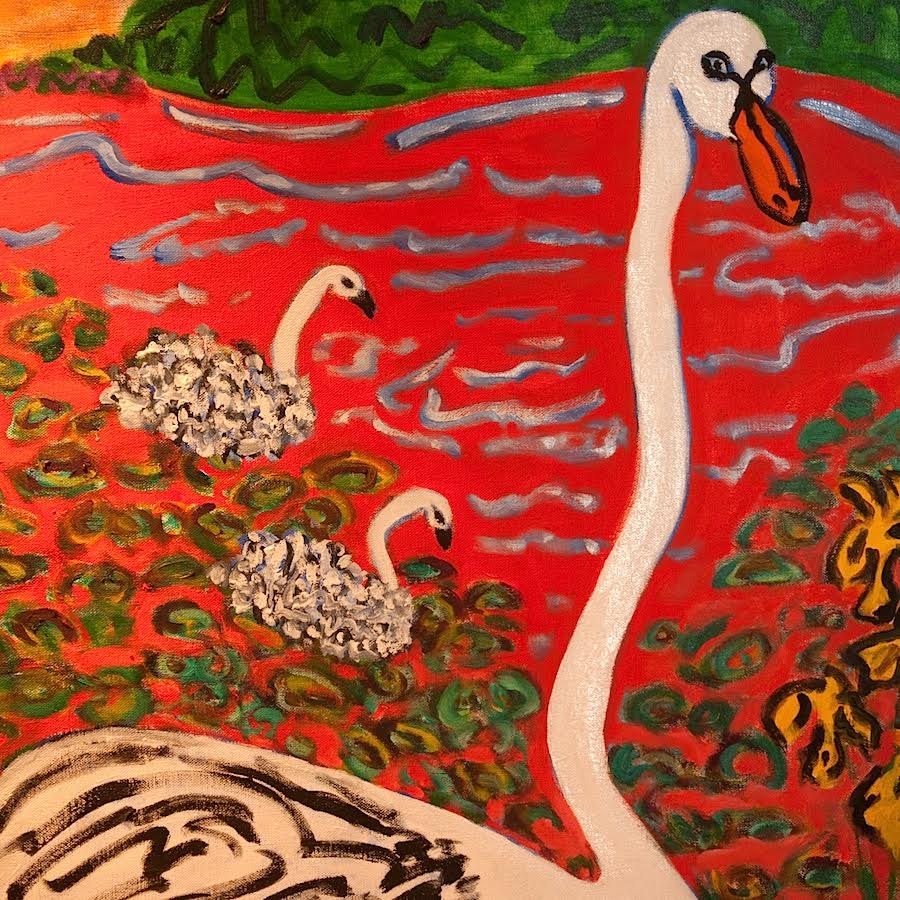
john sullivan swans

Swan Family (detail) John Sullivan, Gloucester, 2015

The swans glide across the pond as a family all dressed in white. The two chaperone three fluff balls. The swan woman who wants to guard the young like their parents do tells me their incredible story.

Born not long ago in pond by Pebble Beach they traveled miles across the open Atlantic before coming to Brace Cove and Niles Pond. Just getting the cygnets across the sea of angry waves was puzzling till I learned they climb on the parents’ backs and ride safely there.  Nature has a way. The journey from Cove Beach dividing mass of salt and fresh water to pond must have been easy compared to ocean voyage. They appeared secure but I have heard the coyote calls in the brush, seen the snapping turtles as they laid eggs, and watched hawks soar round.

I too keep a weather eye on the cygnets as I walk by the pond seeing how vigilant the parents are as they stare at me. I could watch the stamping of feet on shallow bottom of pond to raise food but do not move close.  The large wings open aggressively. These wings powerful enough to raise a large swan into flight can also be a weapon to avoid.
My short vigils did not help this family. Whether by predator of nature or disease all three were lost outside my view. The parents, staid, in the pond,  more removed than when they had young.  Heroic voyagers across the ocean to a safe harbor that proved anything but a pond of growth and joy.
John Sullivan

john sullivan (2)John Sullivan “I was born and raised in Maine, got a degree in chemistry before setting anchor in Gloucester some twenty five odd years ago. Got to know town by running two plants on fish pier.”

New Poetry from Melissa deHaan Cummings

patti sullivan solstice

Solstice, 2013, Patti Sullivan, Gloucester (Courtesy Trident Gallery, Gloucester)


WHIPPED CREAM


A shadow could be
dark and flat 
could be a root
A light spot 
could be sand
or ledge
Watch for rocks
hidden in the grass

Two feet of smooth rock
upright
Put the bike in low
pedal as fast as
trust

You were trying 
to have no man
And you got two!
Full moon
Somebody spilled glue
on the rug
A guy?
Whaddya think!
They rushed for
a wet sponge
Nah!  Need solvent 

Didja have a dog before?
O yah
I got him off Margie Jewell
Thirteen pounds 
Thirteen years
He had heart failure
Quick?
I spent twenty five hundred
Cardiologist Woburn Everything
At some point you have to let go
Like people
Remember Dr Babson?
Six dollars
Yah I used to let the dogs out
Remember he had them cages
in the back
I lived there
Once Brutus was gone
I said to my wife
You gotta get another one
Jax don't let me out of his sight
You're lucky 

BANG!
Was that a gun?
Fish tote

How's the boy?
Is he changing?
He has learned
to scream louder
and if he's loud enough
I take him home 
where he wants to be

Grandma's first rule is
That's their problem 
I trust them
It doesn't matter
whether you trust them or not
It has occurred to me
that there's a whole world
out there with millions of people 
who don't need my help
I'm taking my whipped cream
and going home!
So long as you leave your ball!


Melissa de Haan Cummings
27 August 2015

74bdd-melissa2bcummingsMelissa de Haan Cummings majored in French and English Literature at 
Bryn Mawr. She has published poetry in a number of journals. 
 She describes her interests as including, “much small boating around Cape
 Ann, love of Charles Olson, Hatha yoga practice since 1969."
Dogtown College-The Learning Endures

by Martin Ray


My recent reminiscences on Dogtown College stemmed from recollections of a field tutorial on Tree Identification that I enjoyed under the auspices of the College, back in the early days of my landscape gardening career about 1979. Currently I am engaged in discoveries of natural and social history  that I present in a blog series  Notes from Halibut Point    http://halibutpointnotes.blogspot.com/.

The idea for this endeavor came to me after seeing Cape Ann Museum’s 2013 retrospective on Marsden Hartley that combined his writings and paintings of Dogtown. I thought, I know a nearby place to get to know and share….Halibut Point.  My weekly blog series in this place, Halibut Point, now numbers over one hundred.  I  would like to share this post from the blog, April 23, 2015, on the topic of Dogtown College:


Dogtown College


In the last posting I remarked on taking an eye-opening class through Dogtown College. Three Board members of the group have helped me this week to recall its flavor and direction: Peter Anastas, Nancy Goodman, and my (now) wife Kay,  who was treasurer.


Besides Tree Identification I remember participating in Natural History with Ivy LeMon – “the butterfly lady” – and Life Drawing at Jane Robbins’ Thousand Hands Gallery in East Gloucester Square. The cost was $24 for 8 sessions.

. . .

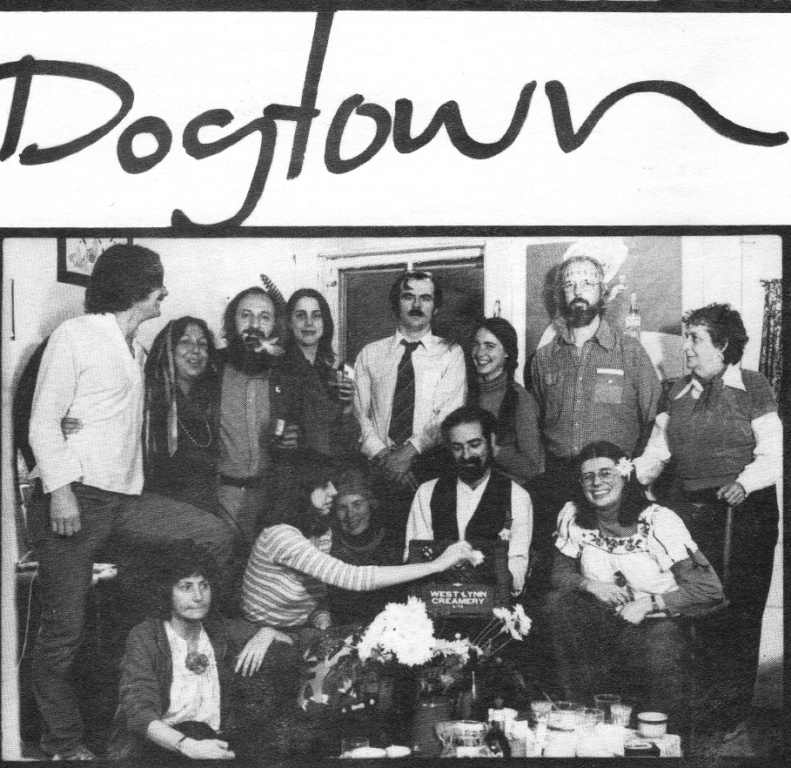
Dogtown College shimmered and pulsed on Cape Ann for a few years, beginning in 1979. It drew on many of the same community strengths, aspirations, and talents that energized other innovations of the period, such as the Cape Ann Cooperative School, the Food Coop, and the Gloucester Folklife Festival. All these expressed themes from the Sixties rooted in American arts and enterprise. They resolved to reach for the best and not wait for established institutions.

dogtown 1

Steve Heims Alicia Quintano photo

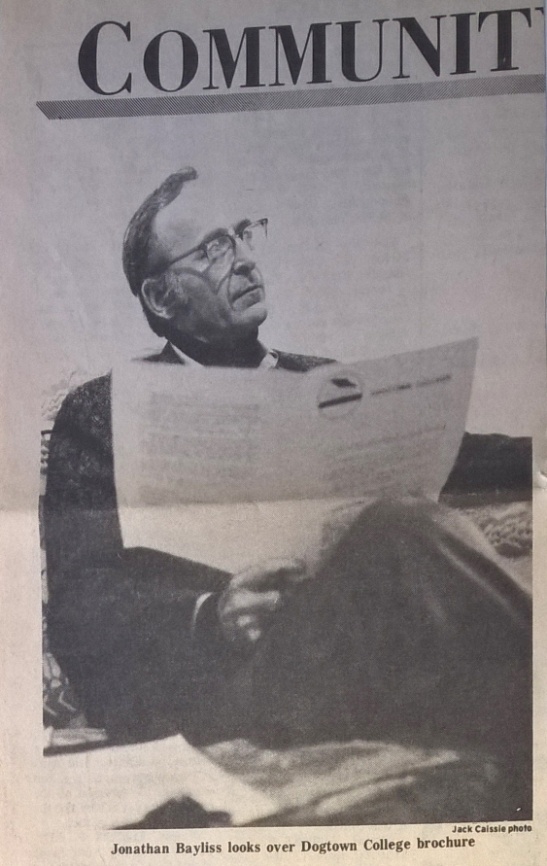
Physicist Steve Heims resided here then, pondering a more rewarding teaching environment than he customarily found as a college professor. He explored possibilities with his friend Jonathan Bayliss, a corporate and government administrator with deep literary interests. The conversation drew on discussions that Jonathan had had with Charles Olson and Peter Anastas on creating free universities based on Olson’s years as rector of Black Mountain College. Olson imagined a local center of learning called Dogtown College, the geographic and mythic Dogtown from which Maximus emerged in his epic poem, Dogtown the protean core of Cape Ann.


Dogtown College: a word-pairing delicious with ironies.

dogtown 2

Gloucester Daily Times, April 4, 1979 Courtesy of Catherine Bayliss


Mention of Steve Heims’ name these days invariably brings an affectionate response. Nancy Goodman recalls a brilliant man who “introduced me to the concept that advances in technology aren’t without consequences….I think of Steve as the visionary, more than the person to carry things out.”


A core of organizers got to work. Says Peter Anastas, “We never expected that we’d have a bricks-and-mortar operation. It was going to be like the free universities of the Sixties that were kind of floating, that never had physical locations. Josh Brackett jumped in. He was a terrific organizer. The first thing Josh did was put together a curriculum as a newsletter. We had a public meeting, a sign-up. Dozens and dozens of people came. It was amazing. People wanted to learn, and they wanted to teach.”


dogtown 3

Josh Brackett standing, second from right. Cover photo of literary publication, courtesy of Peter Anastas


Nancy Goodman brought “a faith in people’s natural curiosity and desire to learn, if they’re given a rich environment to explore.” She had met Josh in the Clamshell Alliance opposing the Seabrook nuclear power plant. “Josh was the playful one, compared to Jonathan who was intellectual and very sincere. Josh was able to see the humor in things. He didn’t take it quite as seriously, though he was equally passionate.”


Peter Anastas: We felt that there were incredible resources in Gloucester. Why go out of town when you had somebody like Steve Heims, a theoretical physicist who worked at the highest levels of physics, to sit down with people, explain to us particle physics and relativity? People loved it. Jonathan Bayliss had been reading Melville for 25 years. He had been yearning to share everything he was thinking about. He’d been Leo Alper’s mayoral assistant. He gave a course on City government. I wanted to teach writing.

dogtown 5

Peter Anastas North Shore Magazine, May 19, 1979 Sawyer Free Library files


I had an incredible experience working with all these folks who were interested in writing. The course I taught – but I didn’t really teach it, I was a facilitator – we called it The Writing Voice. The attempt was to have people find their own voice on the page. Almost everyone who was involved in it came through saying they learned something about themselves and about writing.


At other times we had seminars on Jack Kerouac and Henry David Thoreau. Joe Garland was involved, talking about Gloucester history.


Coming from the academic world, we really had to learn a new way of being. I had been in graduate school where the professor was king. His opinions were the received opinions. In Dogtown we opened ourselves to being challenged, and it was a terrific learning experience.


Writing seminar


We did a twenty-four-hour Charles Olson marathon at Hartley Ferguson’s apartment. We read Olson at different times. We left the apartment to go out and actually look at places in Gloucester that he had written about. People were exhausted, but they came away saying they had an understanding of Olson they’d never had before.


We got a lot of support from the newspaper. The newspaper seemed to be very interested in what we were doing. The kinds of people who became involved went beyond the arts, or writing. A lot of folks came and took courses who were never involved in the artistic community.


We raised money by having dinners, in the basement of the Unitarian-Universalist church. Chris Barton did the cooking. A wonderful person. She was running a vegetarian restaurant, The Garden of Eatin’. She cooked these enormous dinners. People would come and pay a  small amount. We would have entertainment. It was a way to keep the community alive.


Eventually it wound down. We knew it was time. We knew we’d done what we set out to do. Like a lot of post-Sixties kinds of enterprises, the attempt wasn’t to try to create something to last forever. The attempt was to bring people together. When people felt the time had come to move on to something else, that’s what we did. And that’s how it ended. 


MHR at Halibut Point (2)

 Martin Ray, of Lanesville, is the creator of the blog Notes From Halibut Point. 

http://halibutpointnotes.blogspot.com/