Ten Ideas for Gloucester’s Future

stephenson unnamed

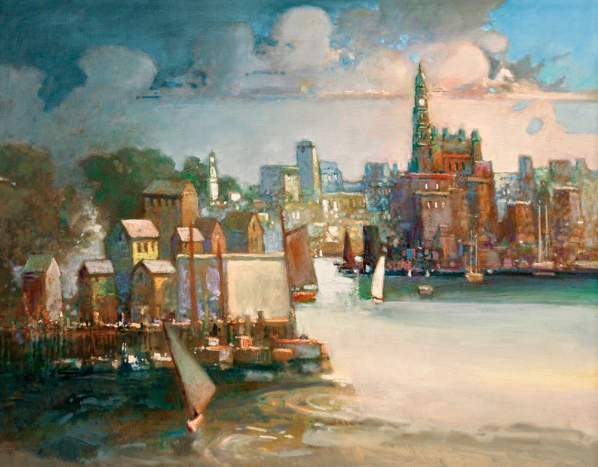
Gloucester Harbor by Bob Stephenson (b. 1936 )

Gloucester:  Some thoughts as we look to the future

Peter Anastas

April 20, 2015


  1. It is essential that we revisit, revise and update the city’s Master Plan, now fourteen years out of date, encouraging the widest possible citizen involvement.  We must also identify neighborhoods, historic properties, ancient streets and by-ways, “magical places” that resonate in local memory and should be preserved, as essential facets of the legendary character of the city, which not only draws visitors but enhances the quality of life for local citizens. (The planning process must also take into account the importance of preserving Gloucester’s Civic Center, including the retention of administrative offices and meeting spaces at City Hall, as central to the life of the community, along with a vital Downtown, where residents and visitors can meet, shop, walk, talk, eat and enjoy an intimate “village square” atmosphere.)  This process must be conducted in public and out in the open, not by committee or behind closed doors.
  2. We must complete restoration of Stacy Boulevard, the city’s “crown jewel, both the seawall and the boulevard itself; also Stage Fort Park.  The city should be especially careful about renting our public park out for events that cause environmental and aesthetic damage, with concomitant costs to taxpayers.
  3. We should endeavor to develop the I-4, C-2 parcel in a careful and patient way that is consistent with the Harbor Plan and that will create economic return and contribute to the city’s marine-industrial-research needs, (marine-industrial research with a focus on sustainability and organic and non-polluting outcomes,) while also creating well-paying jobs with benefits, not seasonal work.
  4. Since the city appears to have given up on the renovation of Fuller School for academic use, we should work to bring the property back online for economic development.  There should be maximum economic return for the city from the sale and adaptive re-use of the building and use of adjoining property.   Of utmost necessity is the development of an assisted living facility, either at the Fuller site or at Gloucester Crossing.
  5. Continued efforts to preserve Dogtown Common as conservation land and a resource for passive recreation are also essential.  Dogtown is a natural asset that few communities possess, a wilderness in the heart of Cape Ann.  As civilization become more complex and stressful, places like Dogtown., where residents and visitors can walk, hike, ski in winter, pick berries, study nature and hunt in season, will be more necessary.   The city administration and council must work to reinvigorate the mayor’s Dogtown Advisory Committee to oversee the Dogtown Management Plan and also work with the Gloucester Lyceum sponsored group that has been organized to raise consciousness about the value of preserving Dogtown, and is conducting important educational programs to that end.  City ordinances that prohibit off-road vehicles of all kinds from Dogtown must be enforced.
  6. It is essential to revise the city’s arts policy requiring more citizen input into decisions that affect public art and the enhancement of artistic life in Gloucester.  A must is the creation of affordable housing or live-work space for artists, if we are to continue to have a vital artistic community. 
  7. Art should not be considered merely as another draw for tourists.  We must separate art and tourism by embracing the production of art as an indigenous economic and aesthetic activity grounded in the life of the city, its history, its industries, and its natural beauty.  Cultural districts tend to privilege one section of the community over another and should be re-thought if not abolished.  What should immediately be abolished is the inane renaming of Gloucester’s downtown as “Harbortown.”  Gloucester is a real place, not a Disney fantasy.
  8. Instead, we should work to enhance a human-scale, high quality tourism, inviting visitors to come and stay for longer periods of time (not the ephemeral day-trip tourism of bus trips and cruise ships).  More importantly, we must understand that a community exists primarily for those who live in it, not for those who might visit or wish to exploit its resources.   Creating the highest quality of life for residents, including excellent public education, affordable housing, real jobs with benefits not seasonal employment, retail and professional resources and opportunities, a clean, healthy environment, and a sense of belonging and well-being, of inclusion, will ultimately foster the kind of community that others will want to visit or even to live in.
  9. It will be essential to support non-profit cultural organizations like the Cape Ann Museum, the Rocky Neck Cultural Center, Gloucester Maritime and the Gloucester Writers Center.  These organizations and their activities represent an important part of the social, economic and cultural fabric of the city, drawing many people to the community year-round, people who eat in local restaurants and patronize local businesses.
  10.  Finally, but most important of all, the working waterfront must remain as the centerpiece of the city’s marine-industrial, economic, social and cultural life.  The city must support all efforts to support and revitalize the fishing and ancillary industries, while restoring necessary infrastructure.   To abandon the working waterfront to non-marine uses would essentially undermine the life-blood of the city and foreclose our future.

Cultural Districts, Tourism and Art

Cultural Districts, Tourism and Art
February 12, 2015

Peter Anastas

2f910-photo2b14

Photo provided by Document / Morin

Gloucester is now the first city in Massachusetts to have two cultural districts, with all the national and international recognition that implies, and with multiple doors open to new opportunities. The name for this new cultural district is the Gloucester Harbortown Cultural District.

 All cultural districts are very special areas within municipalities and focal points of pride and collaboration.  They possess an absolute “it” quality for arts & culture and sense of place.

–Massachusetts Cultural Council

0fd4b-stuart2bdavis2bnets

Landscape with Drying Sails, 1931-32. Stuart Davis (1894-1964)

I don’t trust “cultural districts” or the thinking behind them. I believe they are just another scheme to sell out communities under the guise of supporting the arts. In Gloucester, the arts have become a way of attracting tourists, not enhancing the quality of local life for people who live here, much less supporting those who make art and need spaces to work and live in.

Cultural districts are a form of ghettoizing communities, separating the arts from other indigenous activities, mostly in the service of tourism. Monies are appropriated for the cultural districts but not for the good of the community as a whole. Case in point: Gloucester’s crown jewel, Stacy Boulevard, was allowed to languish in disrepair while money was appropriated for the Harbor Walk, which trivialized our history, and for the painted crosswalks that clashed with our redbrick, Colonial and Federal period architecture and ultimately washed away. Now comes the proposed David Black sculpture, sterile and technocratic, imposed on the city with no real process for citizen input. What’s worse is that in creating the downtown cultural district the name of the city was changed from Gloucester to Harbortown, the ultimate in trivialization and banalization.

Gloucester has a history of art richer than that of most communities.  We also have a long tradition of tourism.  The two should not be incompatible. We cannot and must not separate working Gloucester, which includes fishing and the industrial waterfront, from our indigenous arts, which are largely inspired and nurtured by our working port and the people it sustains. Artists like Winslow Homer and John Sloan, to give two of many possible examples, did not come here as tourists, they came to live among the people and render our life in art for the world to experience and enjoy. Our own local artists are trying to do the same thing today and we must make every effort to see that they have affordable housing and places to work, and, above all, to make Gloucester affordable to them and to natives who live and work here. A sustainable, authentic community, where people live and work in comfort, not a community that has given itself over to tourism, is the basis for a sound local economy. It is also that authenticity–real people, living real lives, in a real place–which makes visitors want to come here to experience the working landscape and the arts which it has generated.

But there is another issue that lies beneath the surface of the controversy surrounding the proposed Black sculpture.  It’s not merely about its potential location, who will pay for it, why and how it was chosen, or whether we want it at all.  The deeper question is one of public policy, specifically the lack of public input, not only having to do with the Black sculpture, or the vanishing crosswalks, but the way our democracy functions in Gloucester.  More and more, citizens feel they have been shut out of the decisions that affect their lives, not just about art or tourism, but about the kind of community we all want to live in.  At the core of this concern is not merely that people do not feel listened to or consulted, or that forums, when offered, are structured to limit citizen participation.  It is the lack of planning that leaves the community vulnerable to outside influences, rather than placing crucial decisions in the hands of citizens, buttressed by a viable Master Plan that has been crafted after the widest possible citizen involvement.  Gloucester’s Master Plan is out of date by fourteen years.  Not only is this a breach of public policy, it is a deliberate foreshortening of the future of our city and the lives of every one of us who live here.


2.  Further Thoughts on Cultural Districts
February 19, 2015

“There is simply ourselves and where we are has a particularity which we’d better use because that’s about all we got…the literal essence and exactitude of your own.  I mean the streets you live on, or the clothes you wear, or the color of your own hair.”

~ Charles Olson

e324d-rn

Evening Rocky Neck, John Sloan, 1871-1951

When I was coming of age on Rocky Neck during the 1950s, I did not think of myself as living in a “cultural district,” any more than we believed downtown Gloucester, where you could buy anything from a pair of socks to a coping saw, would one day be branded “Harbortown.”

Rocky Neck was a diverse neighborhood, many of whose residents were fishermen, or worked on the waterfront cutting and packing fish, or at the various freezers on the State Pier.  Some worked at the Rocky Neck Marine Railways at the end of the Neck, caulking, painting and repairing ships, or at the Tarr and Wonson Paint Company on Horton Street, where the internationally recognized copper bottom ship’s paint had been invented and continued to be refined and produced—the company even employed a full-time chemist.   There were residents who had jobs at the telephone company or in the city’s various machine shops and retail stores.  Two school teachers lived on the Neck, along with the owner of a marina, a postal worker and one year-round painter, Emile Gruppe.  Like in the rest of the city, there was a sense of community on Rocky Neck, which was connected by the bus line to downtown Gloucester and greater Cape Ann; just as the city was connected by train to Boston and the rest of the nation.

In the summertime there were art galleries, restaurants and antique and gifts shops.  The Rockaway Hotel, a family-owned hotel whose guests arrived in June and left on Labor Day, harked back to a more genteel era of summer life in East Gloucester.  In the summer, Rocky Neck also drew artists and art students from all over the country, and even from Europe.  They came because of the affordable rents for studios or single rooms and for the sense of community they found.  They also came, as John Sloan and Stuart Davis had come beginning in 1914, because of the proximity to the subjects they were drawn to paint—marine life, the working waterfront; ships, rocks, ocean; the beauty and density of 18th and 19th century houses crowded together on the Neck and up along Mt. Pleasant Avenue, and the people themselves, largely of Yankee heritage, with an admixture of Italian and Portuguese immigrant families, or Greeks, like my own.

Rocky Neck during my teenage years, was a melting pot of artists and craftspeople of various ethnicities and geographical backgrounds.   You could hear Hungarian spoken on the deck of my father’s luncheonette, and there were two New York City school teachers, who came each summer to stay in the rooms that local residents rented out, who spoke to each other in Yiddish.  Painters conversed in the languages of their countries of origins—Italian, German, Swedish, French—and at night there was a veritable “passeggiata” on Rocky Neck Avenue as natives, summer people and tourists mingled.  Then, suddenly, the day after Labor Day, it was all over.  Except for a few stragglers, artists mostly, who knew that the light was fantastic in early fall, or that once things had quieted down, they could do their best work, “the Island had been turned back to the Indians,” as my neighbors used to comment.

Though referred to as an art colony, Rocky Neck was much more than a place where artists came to work in a congenial, affordable environment, such as Bearskin Neck in Rockport had once been, or Provincetown, Ogunquit in Maine or Mohegan Island.

Artists were drawn to these places because of their great natural beauty and also because of the affordable housing, the congenial summer life of parties, and nights of talk among colleagues, which nurtured the art they would return to in the morning.  Renowned artists like Albert Alcalay and Umberto Romano came to teach art as well as to paint, and gallery owners from the large cities opened summer annexes, so that these places also became nurturing places of art.  Organizations like the Rocky Neck Art Group,  the North Shore Arts Association and the Cape Ann Society of Modern Artists grew organically from the lives and needs of artists; they were not imposed on the community by government entities, using public funds, with the ultimate agenda of promoting tourism.

There were tourists, to be sure, and even some day-trippers, but most people came to stay longer than a day or two, or a week.  Visitors were integrated into the community more than they are today, arriving, as many now do, on bus tours or in cruise ships and quickly spirited way on a bus to Salem, or allowed a chaperoned morning or afternoon in Gloucester, given the Harbor Walk’s virtual history of the country’s oldest seaport, told where to eat or shop, or directed to the Crow’s Nest, which they remember from the film of The Perfect Storm, except that the film did not show the real tavern, only a Hollywood mock-up on the waterfront, where the original venue is not located.

What I’m trying to indicate here is that not only Rocky Neck but the entire city, in its ethnic diversity and authenticity as a working seaport, its history as a place where artists came to live and work, eventually becoming part of the community, was, in effect, already a cultural district of great richness and did not need the tourist hype of designation or branding.  What I am also trying to make clear is that once you impose these designations, this branding and commodification, on a place like Gloucester for the sole purpose of promoting it in the tourist economy, you have already begun to cheapen and degrade it, to turn its citizens into extras in a movie about a place that is no longer real but is, tragically, a simulacrum of its former reality.

3.  Gloucester vs Harbortown
March 2, 2015
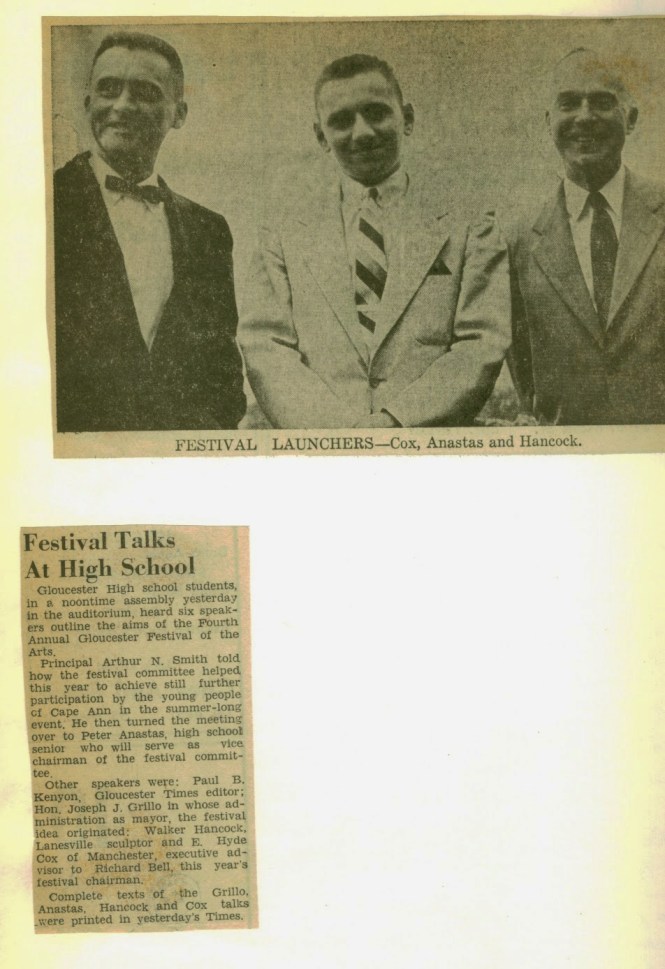
3cf3d-anastas2c2bcox2band2bhancock

Peter Anastas, with writer Hyde Cox and sculptor Walker Hancock, members of the Steering Committee for the Cape Ann Festival of the Arts, Gloucester High School. 1955

As to Harbortown, it’s purely a label for a condo development scheme, having nothing to do with Art or Culture by word choice; that’s obvious. The truth is there is no artist space to rent at any price. There is certainly none that is artist-affordable. As to artists, none are moving to Harbortown or establishing themselves in cultural districts here. Just like the fishing, it is of our past more than present or future. The reasons most artists came here to work no longer exist sans the quality of light; however, what that light now shines upon, aside from nature, isn’t inspiring or compelling to the current generations of artists. The economic inequality will only increase that phenomenon. This is no longer a city where an artist can be left to be one. A bohemian life isn’t possible here without a fat trust fund and Trustafarians don’t typically create meaningful works of art. They live in places like Harbortown for the pose.  

–Ernest Morin

One cannot look critically at the deleterious impact of government funded and imposed “cultural districts” on a community like Gloucester without first considering the city’s long history of indigenous art and its role in nurturing the work of artists whose reputations were based on living in Gloucester or coming here to work.   Let me speak first from my own experience.

My understanding of art did not begin when we moved to Rocky Neck in June of 1951, though Rocky Neck with its rich mix of artists and marine industry, constituted a new world for my younger brother Tom and me.  I was actually introduced to art in the first grade at Hovey School by the school department’s remarkable art supervisor and teacher, Hale Anthony, later known to us after her marriage as Mrs. Johnson.  When we first graders initially encountered Hale Anthony, who came once a week to teach us how to draw and paint and to introduce us to art history, especially to the art that was being created around on Cape Ann, it was 1943 and I was six years old.

83fd7-hale2banthony2b2

Local artists, including my own elementary school art teacher, Hale Anthony Johnson, delivering their paintings to the high school for the Cape Ann Festival of the Arts exhibition, 1955


I remember Hale Anthony as having an olive complexion and glossy dark hair.  She dressed beautifully—“very artistically,” as our envious mothers put it—in colorful clothing, much of which she designed and made herself .  We were always excited when our teachers announced that today would be the day that Mrs. Johnson was coming to do art with us because she was a lively teacher, who led us in a series of projects such as creating tiger swallowtail and monarch butterflies whose wings we would cut out of plywood or thin pine, paint with bright yellows, rust browns and blacks and glue together at ninety degree angles (their antennae made of black-stained pipe cleaners) to make them look as if they were actually in flight. Once the paint was dry, we proudly took our butterflies home, where they remained objects of pride and delight.

At Central Grammar our art teachers were Jean Nugent in seventh grade and Edna Hodgkins in eighth grade.  Both were professional artists themselves, excellent painters and designers whose classrooms, hung with our drawings and paintings, always looked more like art galleries.  At Gloucester High School who could ever forget studying art with the legendary painter Howard Curtis?  Not only did one receive a thorough grounding in the history of art and its materials, one also had the pleasure of knowing a gifted teacher and mentor, who connected local art history to the world’s.  One must also remember that when the new high school was being designed in the late 1930s, the building itself was sited to take advantage of the northern light so that its extensive art studios could receive its benefit.  Gloucester thought that much of art while around us the Great Depression was still raging!

So it was not without some background in art that I arrived on Rocky Neck in June of 1951.   My art education continued during the summer of 1952, when the first Cape Ann Festival of the Arts was launched.  Initiated by the son of a fisherman, Joseph Grillo, the city’s first Italian-American mayor, who had been an English teacher at Gloucester High School, the festival was the largest and most panoramic celebration of local art ever mounted.  It included exhibits of painting, sculpture, ceramics, crafts and weaving, along with musical, literary and dramatic events.  James B. Connolly, Olympic champion and author of several highly regarded books about Gloucester fishermen, spoke at a ceremony during which his contribution to the city’s history was honored (Edo Hansen painted his portrait).  The Gloucester Story by local playwright and plumber Clayton P. Stockbridge won the first Cape Ann Drama Festival Award, a cup donated by famed playwright and Annisquam summer resident Russell Crouse.  Vibrant with local dialect and set aboard a Gloucester fishing vessel, the play was staged at the Gloucester School of the Little Theater on Rocky Neck.  The Festival, which continued until 1962, became a summer tradition, drawing international crowds, while introducing natives to the richness of Cape Ann’s artistic heritage.

The Festival was an indigenous event, planned and funded locally.  A steering committee of local residents, including artists, representatives of the business and professional communities, and students, organized the dozens of events, performances and exhibitions, with the support of the mayor’s office.  There were no state or federal grants; and though the events drew people from everywhere, they were intended primarily for the benefit of the residents of Cape Ann and generously supported by local businesses.  Artists organized their own events, including lectures and demonstration, and they participated jointly in mounting a massive show of art in the gymnasium at Gloucester High School, where one could experience examples of the entire range of art that was being created locally.

Art in Gloucester was as indigenous as fishing or any other industry.  Just as we were given a thorough grounding in art in school, by simply living here we were equally able to experience the art that was being created locally.  We were able to hear artists talking about what they did, on the street, in coffee shops or in their own studios.  One did not have to leave Cape Ann to receive a comprehensive education in the making of art—painting, sculpture, theater, poetry—and its appreciation.

I do not believe for one minute that the creation of “cultural districts”—in effect, the partitioning of an organic community into ghettos, where one activity is privileged over another—could ever compare to what I have described as an indigenously created and supported culture, in which the arts are integrated into daily life as they were during the time I was nurtured, not only by art itself but by growing up in a multi-lingual, multi-ethnic city like Gloucester.  We must continue this tradition.  We need no help from outside.  We could do it here, all of us working together—artists, citizens, public officials—because communities exist primarily for those who live in them, not for those who would impose their will or their economic, social or cultural agendas on us.
Anastas and Buckles : Two Generations, Two Perspectives


POSTPONED UNTIL SPRING 
BECAUSE OF SNOW AND PARKING ISSUES

‘Two generations, Two Perspectives’ 

Writers Center event features authors age 28, 77


BY GAIL MCCARTHY 

Two writers representing two generations of Gloucester natives a half century apart will talk about their recent work at an event at the Gloucester Writers Center.

The program is titled “Two Generations, Two Perspectives, TwoGloucesterWriters” featuring Casey Buckles, 28, and Peter Anastas, 77, both of whom will read from their novels about Gloucester on Wednesday Feb. 18 at 7:30 p.m.

Buckles’ book is titled “Plain of Ghosts,” while Anastas will read from his novel-in-progress “Nostalgia.” 


Casey Buckles, 28, will read from his novel about Gloucester during a program titled “Two Generations, Two Perspectives, Two Gloucester Writers” on Wednesday at 7:30 p.m. at the Gloucester Writers Center. 


Peter Anastas, 77, will read from his novel about Gloucester during a program titled “Two Generations, Two Perspectives, Two Gloucester Writers” on Wednesday at 7:30 p.m. at the Gloucester Writers Center. 


For starters, Anastas grew up in the nation’s oldest seaport when it had a thriving fishing industry that employed thousands of residents working at sea and in the shore-related businesses. 

Downsizing industry 

Buckles, on the other hand, grew up at a time when fishing was greatly downsized with the onslaught of government regulations, and when local drug abuse made recurrent headlines as it continues to do so today. His generation is also the first to compete in a global marketplace that’s seen U.S. jobs vanish overseas where the labor market is cheaper. 

A lifelong writer and columnist, Anastas holds degrees in English from Bowdoin College and Tufts University. He also studied Medieval Literature at the University of Florence, Italy. 

Commenting on the value of the young writer’s work coming as it does from his experience growing up in the heart of Gloucester, Anastas noted: ”The city has been the subject of a great deal of poetry and prose, of history and fiction; yet until the recent publication of Casey Buckles’ novel, ‘Plain of Ghosts,’ we have not had an account of what it feels like to come of age at this very moment in a community in dramatic transition.” 

’Locally crafted’ 

Buckle’s novel, he further noted, should be experienced as a “locally crafted and produced work of art.” 

The novel tells the story about the struggles of its main character, Noah, and his friends, as they attempt to make lives for themselves after high school, and while they may dance and drink in local bars and clubs, they are searching for deeper connections of love, companionship and the meaning of community, explained Anastas. 

”For Casey, the bleakness comes from the fact that he is looking at the lives of his generation in Gloucester. What do they have for work? What is in store for them if they stay here? In many ways Casey is a poet,” said Anastas. 

Buckles said this book grew out of years of note taking when he was attending school at the University of Massachusetts, Boston. 

”It was a lot of reflection that turned into what the book is now,” said Buckles, who studied philosophy, anthropology and English. 

Seaport issues 

In addition to Buckles’ reading, Anastas will read from his own work in progress, which is described as a post mortem investigation of how the city came to be what it is today. Anastas has cherished his life in Gloucester, though he too has critical views about the issues that face the seaport today. 

Anastas asked Buckles about what he sees as the future in Gloucester for his generation. 

”The world didn’t end when the Bird’s Eye fell, so there is still a future. Will it include my generation or any type of working waterfront? That will be easier to answer in retrospect,” wrote Buckles in response. “…For those who are here, spread over its 41.5 square miles, for however we live to survive, there is a future in this city.” 

Gail McCarthy can be reached at 978-675-2706, or via email at. 

Gloucester Writes the Sea

 
Gloucester Writes the Sea
Peter Anastas
Joe Garland on his porch at Black Bess, Eastern Point, Gloucester, preparing for a visit with Sebastian Junger, 1998,
photo by Ernest Morin


Sitting out last week’s blizzard with a hot toddy and a good book, the distant roar of the Back Shore’s breakers in my ears, I began to think about the storms we’ve lived through, especially the Northeaster of 1991, known historically as The Perfect Storm.  This sent me to the bookcase for my copy of Sebastian Junger’s 1997 bestselling account of the storm and its impact on the city and our fishing families. 
I read the page proofs of The Perfect Stormin one sitting.  Replying to Junger’s publicist at W. W. Norton, who had sent them to the Book Store in Gloucester for pre-publication comment, I told her that I found the book “beautifully written.”  I said it gave “the flavor of Gloucester fishing life as lived by a segment of that community—-the bars, the drinking, the relationships formed out of bar life, the violence of that life, the losses.”  I went on to note that Junger had rendered this life “without judgment and with a precision of emotional detail.”
Eighteen years later I still feel the same way.  While the book has attracted an international readership and its ageless theme of men and women against the sea, of courage in the face of seemingly insuperable obstacles, is universal, its local focus is what still makes it memorable.
The Perfect Storm is a profoundly Gloucester book.  It tells a local story about indigenous people.  It evokes a time and a place in Gloucester’s history.  It is told with precision and candor.  And it doesn’t romanticize the maritime life or mythologize its participants.  Books about the sea often tend to do this, especially if they are fictive.  Melville’s notably did not; neither did Conrad’s or Richard Hughes’.
Closer to home, I find the stories of James B. Connolly, who wrote so prolifically about the lives of Gloucester fishermen, less easy to read than when I was younger.  In contrast, Joe Garland’s books have seemed to ripen with age, as I believe the republication of Lone Voyager in 2000 by Simon and Schuster amply demonstrates.  Connolly’s penchant for “salty” lingo over straight talk has reached the end of its shelf life, while Garland’s Yankee astringency still seems exactly right for its subject.
Yet Connolly, who wrote in The Book of the Gloucester Fishermen (1927) that he’d sailed with Gloucestermen “to the fishing banks, loafed with them ashore, sat with them in their homes,” set a standard for writing about the maritime life here that later writers had to measure up to, including Garland and Kim Bartlett, whose The Finest Kind (1977) is the best account we have of our Italian fleet.  Both succeeded, and beautifully.  As did Geoffrey Moorhouse, an English writer who moved to Gloucester in the 1970s, fished here, and produced his semi-fictional The Boat and the Town,(1979), which documents the pressures on the industry before the establishment of the 200 mile limit, while presenting Gloucester, in the author’s words, as “a paradigm of all the fishing communities in the world.”
These texts, whether he had read them or not, were the models that Sebastian Junger had to write The Perfect Stormagainst, if only in the minds of those natives who knew and lived them.
Are these books, including Junger’s, enough to create a local tradition of writing about the sea?  And is The Perfect Storm part of that company?  In each case, the author has either lived or spent significant time here.  Connolly and Garland had the deepest roots, though Bartlett worked as the Gloucester Times’ waterfront reporter and fished alongside of his subjects.  Junger lived here, too, emerging with a finer understanding of life ashore than many natives.
In 2010, John Morris, the grandson of a dory fisherman lost at sea, published what may well be the definitive history of dory fishing, Alone at Sea: Gloucester in the Age of Dorymen, 1623-1939.  Of this major contribution to Gloucester writing about the sea, Joe Garland wrote:
“John Morris is about to tell you all there is to be told about Gloucestermen and their wives and widows and fatherless kids, and ways of life, and of death by the thousands, of good times and of bad, in a masterpiece that’s been waiting for generations to be told.”
We are fortunate in Gloucester that as this community has evolved there have been people to document in gripping prose the extraordinary quality of its life, what it means, what we stand for, what we must preserve.  In Sebastian Junger’s words, “I love this town, and I really hope that the fishing industry recuperates because that’s the heart of this town.  It isn’t tourism.  It’s not light industry.  It’s fishing, and it would really be a tragedy if business by business, boat by boat, that gets chipped away.”
Junger said this in a 1998 Boston Globeinterview and his words are just as relevant today.  In fact, they speak to our condition even more powerfully.

Olson is Gone, But We Are Here

Charles Olson’s Call to Activism

Peter Anastas  


I hate those who take away

and do not have as good to

offer.

I hate them.  I hate the carelessness.


–Charles Olson

“A Scream to the Editor”

December 3, 1965


Beginning in the late 1950s and lasting for nearly a decade, the bulldozers of Urban Renewal tore through Gloucester’s 300-year-old waterfront, leveling sail lofts and net and twine manufacturers, driving ship’s chandlers and carpenters out of their shops on Duncan Street and working people from homes and tenements clustered around the Fitz Henry Lane house on Ivy Court.  The Frank E. Davis fish company headquarters on Rogers Street, long thought indestructible, was knocked down, and 18th and 19th century buildings of considerable historic and architectural value in the city’s West End were also demolished.

Urban renewal in progress, Gloucester 1966  Photo by Mark Power
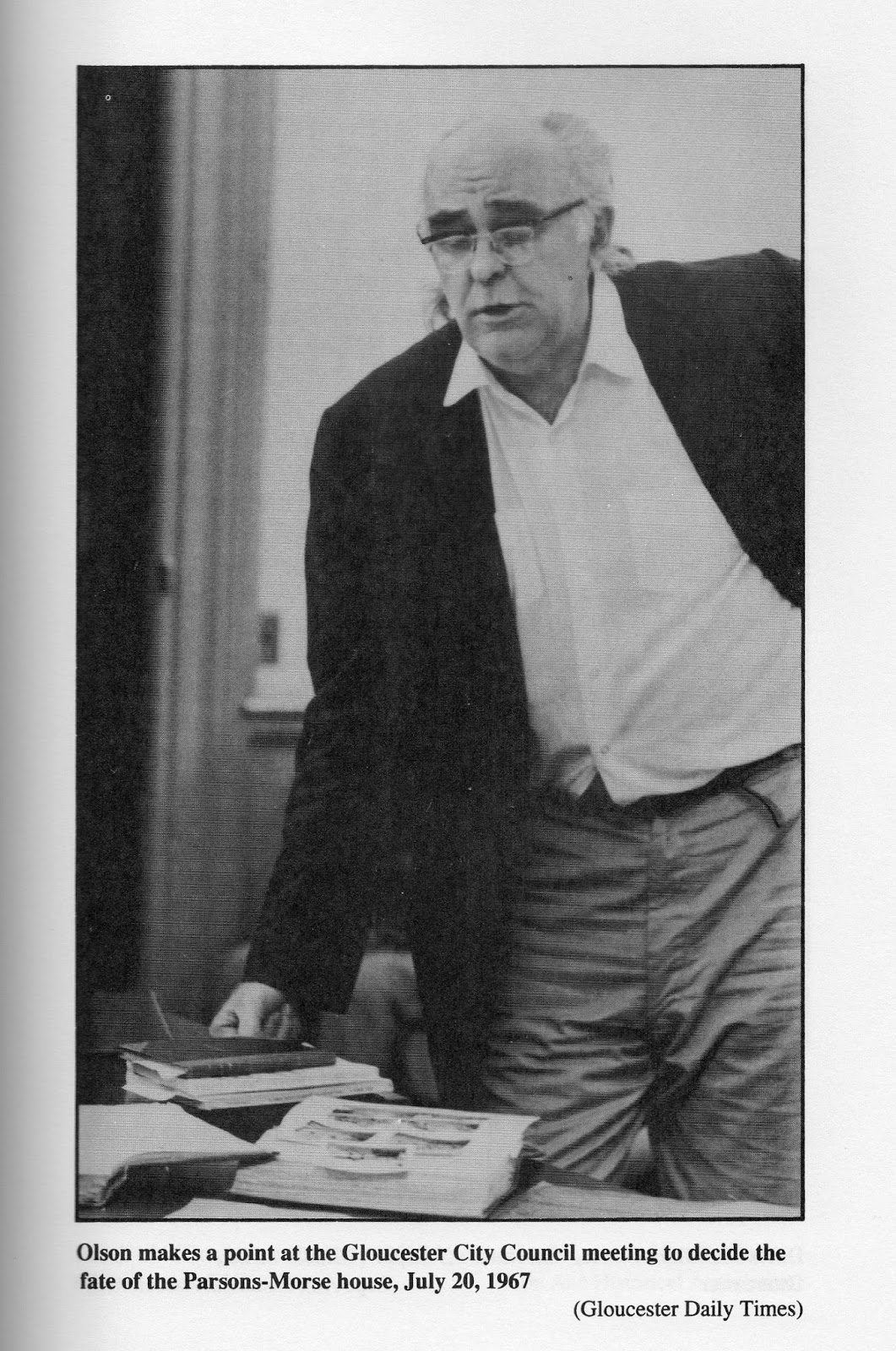
Only one person spoke against what had been sold to the city as a panacea for our post-war economic woes.  That lone voice was Charles Olson’s.  Known even then, in the early 1960s, as one of the century’s most important poets, Olson, who had worked in Washington under FDR, saw clearly the implications of yet another government “revitalization” program.  In letter upon letter to the editor of the Gloucester Daily Times, he called Urban Renewal “renewal by destruction,” warning the city that it was “ours to lose” if we did not stop “this renewing without reviewing,” as he characterized it.


Even when they bothered to read Olson’s passionately hortatory letters, many subscribers to Gloucester’s only newspaper thought that the nearly seven foot poet, who walked around town with a Yucatan Indian blanket wrapped around his overcoat to keep his massive frame warm, was crazy.  Enraged that the Solomon Davis house on Middle Street, Gloucester’s last surviving Greek revival dwelling, was torn down by the YMCA for a basketball court that was never built, Olson composed what he called “A Scream to the Editor.”  “Oh city of mediocrity and cheap ambition,” he charged in a letter that comprised the entire editorial page on December 3, 1965, “destroying its own shoulders, its own back, greedy present persons stood upon.”  Olson’s imprecation would have incredible reverberations into the present.
Yet during those years of destruction and loss in Gloucester, Charles Olson was practically alone in speaking out.  He took the brunt of criticism from Urban Renewal’s advocates and those who were benefiting financially from a program that effectively displaced most of the families who lived along the city’s waterfront (Urban Renewal quickly became a euphemism for “relocating the poor”), leaving the Fitz Henry Lane house, built in the 1850s by the eminent Gloucester “Luminist” painter, the lone survivor of the kind of downtown wreckage that had been resisted by nearby Newburyport and Portsmouth, New Hampshire.  Ironically, while those two cities have suffered more gentrification than Gloucester, they have also retained their traditional redbrick architecture and the intimate quality of their inner city neighborhoods.

Inspired by Olson’s example, a good deal of local activism since the early 1970s has been based on the preservation of a sense of place, a way of being in the world, an understanding that each place we live in has its own unique characteristics.  Place, as Olson taught, is not only where we live, but also where we get our bearings from.  Place is who we are and how we feel about ourselves, how we’re anchored in the world.  Place is our very identity, “the geography of our being,” as Olson put it.  And if we lose place, or undermine its character, whittle it away year after year through inappropriate development—chopping up neighborhoods, driving people away from the houses they were born or grew up in—we destroy the basis of our lives, if not our very identities.


Charles Olson and retired fisherman Lou Douglas talk at the kitchen table of Olson’s 28 Fort Square house
As the Australian philosopher and ecopsychologist Glenn Albrecht, has written, “People have heart’s ease when they’re on their own country.  If you force them off that country, if you take them away from their land, they feel the loss of heart’s ease as a kind of vertigo, a disintegration of their whole life.”  In a 2004 essay (quoted in a New York Times Magazine article of January 27, 2010, “Is There an Ecological Unconscious?”), Albrecht coined a term to describe the condition he called “solastalgia,” a combination of the Latin word solacium (comfort) and the Greek root –algia (pain), which he defined as “the pain experienced when there is recognition that the place where one resides and that one loves is under immediate assault . . . a form of homesickness one gets when one is still at ‘home.’”  Olson not only understood this condition, but he warned of its consequences in his letters and poems, thereby anticipating today’s ecopsychology  movement.

Place is topography, the look and feel of the land, the mapping of streets in a town, the complex of neighborhoods; what has been built by humans or has evolved from nature.  A sense of place also includes knowing the history of where we live—who inhabited it before we did and how they impressed themselves and their culture on the land.  Place includes our personal and collective history as we live daily in a given town, city or region.  Place concerns the life forms we cohabit with, indeed all the biota of our environment.  Place is also symbol and myth; for a single town or city, the history of its founding and growth, as Thoreau believed, can be viewed as an archetype for the origin and evolution of all places on the earth.


Charles Olson on the porch of his house at Fort Square
Considering Olson’s example, it is the responsibility of writers and artists—indeed, of all citizens— to help those who inhabit a community to understand what forces have shaped that place, what impact its history and indigenous industry have had on its character and identity, and what must be done to preserve that identity while fostering orderly economic growth and social cohesion.  For Olson, Gloucester was a Polis, referring to the ancient Greek concept of a self-contained and self-governing body of citizens, a place of great cultural and linguistic diversity. Even given the depth of its history,  no place can stand still.  Like their inhabitants, places themselves are in continual evolution.   The many committed citizens, both individuals and groups like the Gloucester Fishermen’s Wives, who have joined forces over the years to sustain our working waterfront and the integrity of our Polis, understand this.  We have never advocated for “no growth,” nor have we opposed every development proposal, as some have charged.  Rather, we have supported growth that we felt was sustainable and had the least deleterious impact on existing architectural and social structures in the community and on the surrounding natural environment, which comprises an essential dimension of place, indeed sustaining us all—the air we breathe and the water we drink, the woods and watershed areas that are so nourishing to us in actual as well as aesthetic ways, our natural ponds, and the ocean itself.

The longer Olson lived in his adopted city, interacting daily with its citizens, the more local the politics of this old New Dealer became.  “I am a ward/ and precinct/ man myself,” Olson wrote in The Maximus Poems, “and hate/universalization” (his term for what would soon be known as “globalization.”).  He had the ability to peel back the layers of time in a locale, a neighborhood, a single house even, a patch of forest, a moraine landscape, to reveal the depths and dimensions of its history. Consequently, Olson helped many of us to recognize that Gloucester was not merely the oldest fishing port in America and, as such, an archetypal place of human activity; but rather that it was a living, breathing city of 28,000 interconnected inhabitants.  He also helped us to comprehend that Gloucester was a continually evolving ecosphere, and that an understanding of the rich and complex ecology of one’s home town and the woods and fields that surround it led to an understanding of the natural history, geography and ecology of what Olson called “an actual earth of value.”


 Olson and Kerouac biographer Ann Charters walking on Stacy Boulevard

Olson encouraged citizens to study the history of their birthplace, their region and, indeed, the nation itself, as he had, through an examination of primary documents.  Court papers, land transactions in probate, property line surveys, wills and testaments and Quarterly Court records of civil litigation were, for Olson, the ur-texts of history, and as significant as the land itself for reading the passage of human habitation in given places.  Maps told him more than chronological histories; though when it came to the narrative he said he found more significance in town histories, written by local historians, than in the dominant works of academic scholarship.

His theory of “saturation”—that you concentrated on one place, one writer, one topic until you had absolutely exhausted it for yourself and therefore prepared yourself henceforth to take on any subject—has proved to be immensely helpful to many of us in approaching not only the study of Gloucester, but also of larger topics in literature or history.

Olson also demonstrated that by living in a book-filled $28-dollar-a-month cold-water walkup at 28 Fort Square, on Gloucester’s waterfront, one did not need to possess material wealth in order to pursue a rewarding life.  Olson counterposed himself and his ideas against the consumerist culture that was growing around us (“in the midst of plenty/walk/as close to/bare”), noting once, in the pages of the Gloucester Daily Times: “One has to have the strength of a goat, and ultimately smell as bad, to live in the immediate progress of this country.”

But Olson’s letters and poems to the editor are not mere criticism or jeremiad.  They contain a wealth of historical, practical and ecological information and insight.  Long before ecology became a household word and “environmentalists” were armed with wetlands protection measures, Olson, who had been a close reader of Carl Sauer’s ecological geography, was speaking out against the filling of tidelands and productive marshes.  He defined ecology, in one letter, in terms of “creation as part of one’s own being,” while alluding to the impact of topology on the quality of one’s aliveness to the landscape, so that one could understand that to erase the land of its original forms and contours, either natural or man-made, would be to live a debased personal life on it.  Furthermore, he showed how, if one is ignorant of one’s own history, one’s future is already circumscribed, if not blighted.  And finally, he insisted in one visually stunning evocation after another—of the West End’s brick and granite architecture, the pristine marshes of Essex Avenue, the mist-shrouded banks of Mill Pond—that even though much of the city was “invisible” to her citizens as a result of the daily habit of living here and taking her extraordinary beauty for granted, the destruction of even a portion of that beauty (“the brightness which sparkles still for me, a heron, some red-winged blackbirds, several hornets sweeping down the run of that small raised path”) would constitute immeasurable loss, not only for those living now, but for “persons unknown to us in the future, who will never know what they have lost because easy contemporary ideas and persons dominate the land.”

      Olson on Dogtown with poet Diane diPrima
Taken together, Olson’s letters and poems constitute a handbook for living in Gloucester in concert with her history and natural ecology.  They are a call to be awakened to the morning’s light as it illuminates the “rosy red” facades of 19th century Main Street, the curve of roadways on a winter’s night, roads that follow still older, indeed aboriginal and animal paths across Cape Ann.  They are a reminder, as Thoreau insisted, that no matter where we go on the face of the earth, someone has been there before us.

Deeply and specifically, Olson’s letters are a plea that we citizens recommit ourselves to our original stewardship of the land and sea, to be held in common for human use and sustenance, not to be exploited for individual profit or gain.  They are an indictment of unplanned growth and development, which was beginning to occur in Gloucester during the 1950s and 60s.  They speak of unnecessary change, which brings with it resentment and anger at the loss of familiar landmarks.  They speak against arbitrary decisions of government to build this or destroy that, decisions which do not include those who will be affected.  And they make clear, again and again, that the loss or disregard of specific local knowledge—of the land, the sea, the people, their histories and customs—leads only to a historyless future, in which Gloucester, one of the primary cities of the earth for Olson, will become “indistinguishable from/ the USA
Olson’s ghostly figure overlooks the Birdseye building before demolition.
Finally, it was Olson’s activism against Urban Renewal, against the loss of Gloucester’s historic architecture, against the filling of wetlands and all the “erosions of place,” as he called them, that helped to inspire a burgeoning grass-roots advocacy on behalf of the fishing industry and the working waterfront, the preservation of Dogtown Common, now a public conservation trust, and against overdevelopment and gentrification.  For in the end, this activism— citizens acting singly or in concert on their constitutional right to make their voices heard— is about the preservation of place, not only as an idea or ideal but as a real, living, breathing community: as home and biosphere.  Even as I write, Olson’s own neighborhood, the Fort section of Gloucester’s waterfront, where marine industries and residents have co-existed harmoniously for over a century, is about to undergo dramatic change.  Ground has just been broken for the development of a 96-guest-room boutique hotel, said to include “an executive suite, a bridal suite, meeting rooms with state of the art audio visual equipment and two lavish ballrooms,” at the site where Clarence Birdseye invented his “flash-freezing” method for the preservation of fish.  With the City’s Master Plan out of date by fourteen years, this project was undertaken in a virtual planning vacuum.  Such an unconscionable lapse in planning has allowed developers to define the city and map its future, rather than the citizens themselves, creating conflict where consensus is crucial.


Like every community, Gloucester has needed the voices of citizens like Olson to remind us who we are and what we mean, both to ourselves and the world, because living here, caught up in the stresses of daily life, our home place often recedes from our awareness.  As a consequence, many of us who were born or have settled here have taken Gloucester for granted.  Walking the streets daily, knowing each other, working together, even arguing together, we have been given an enormous gift, the gift of community and of the ocean that surrounds and sustains us.  Even if we do not fish ourselves or our families did not follow the sea, living in Gloucester, here at the ocean’s margins, we all follow the sea; and as the waterfront, which is the very heart and soul of Gloucester, stands or falls, so do we all.  This is not romanticism; it’s not a nostalgic yearning for the past, as some have argued—it’s not obstructionism.  It’s who we are and what we care mostly deeply about.  If we lose or abandon our sense of place, allowing Gloucester, or any other significant community where people make their  lives, to become like so many American towns or cities who’ve lost or abandoned their identities, or been gentrified out of existence, we will lose ourselves and everything else that matters about our lives here.  As Olson warned in a letter to the Gloucester Daily Times:

Lose love

if you who live here

have not eyes to wish

for that which gone cannot

be brought back ever then

again.  You shall not even miss

what you have lost.  You’ll only

yourself be bereft

in ignorance of what

you haven’t even known.