Art is Here!

OLYMPUS DIGITAL CAMERA

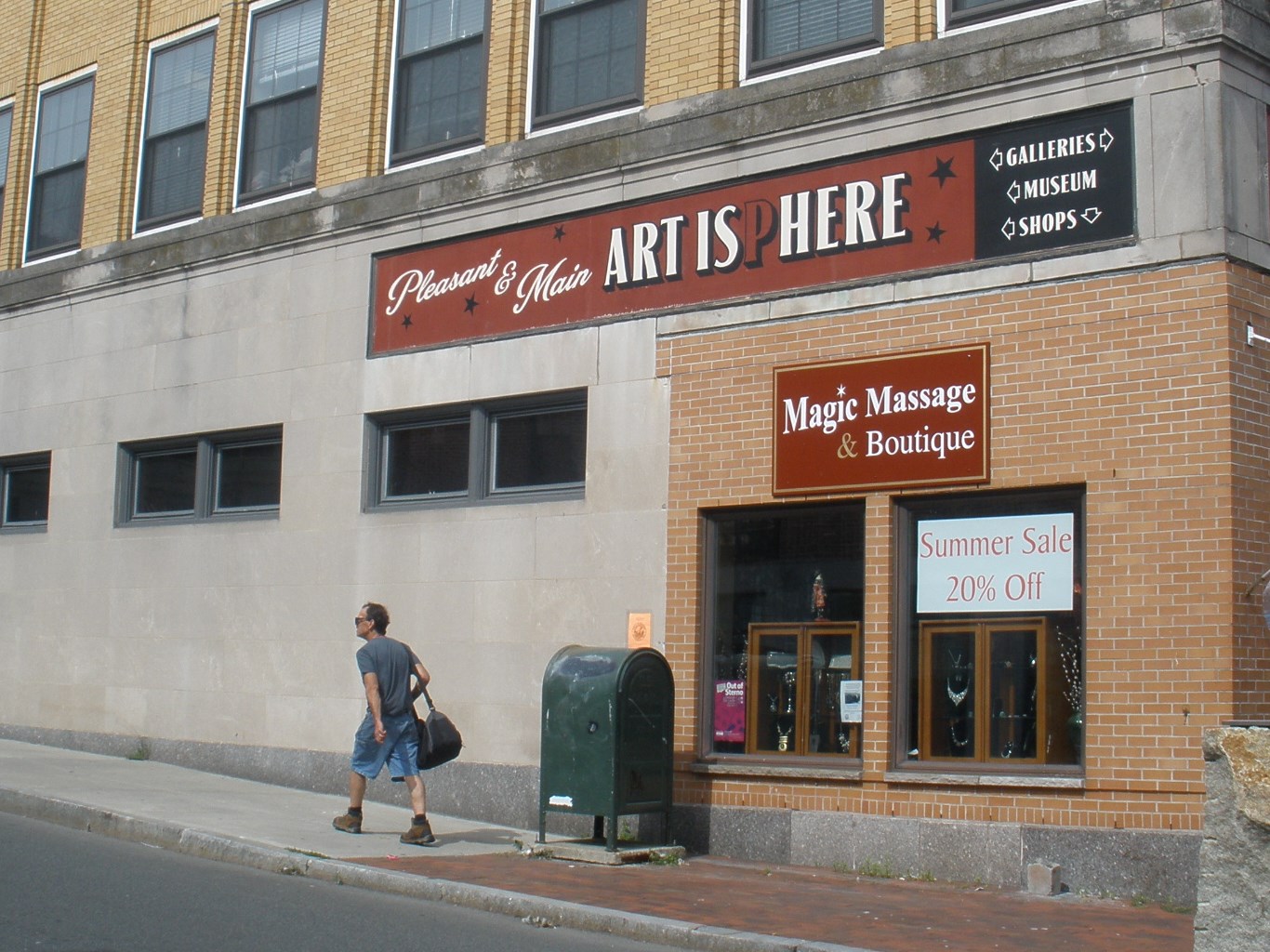
Art is Here sign being painted on the wall at the corner of Pleasant and Main Streets

OLYMPUS DIGITAL CAMERA

Tricia O’Neill

Gloucester’s Tricia O’Neill is the founder of Signs Unique. She and her company have been painting murals, trucks, windows and wooden signs for 30 years from Dublin to Boston and all over Cape Ann. (See some of her work here.) This sign points the way to a newly- designated art enclave in the first block of Pleasant Street,  Artisphere.

OLYMPUS DIGITAL CAMERA

New Poem by Robert Gibbons


image

FOLLY COVE, GLOUCESTER. Sharon Casavant


On the Afternoon in the Aftermath of the Root Canal up in Lewiston

The root of the matter is crucial.

Even in as simple thing as a tooth.

Or that of the World Tree, roots reaching

deep in the realm of the underground. Heart

of the matter of language with its dirt, & clean

stones. Cistern of language I felt today, when down

by the waterfront the wind in the waves was more like weave

of a text, knowing that underneath ocean life teemed: cormorant,

seal, crab, & fish, right down to the floor of seaweed. Stood a while

taking it all in, reading the vast World, when the tanker, Leopard Moon

out of Singapore cast added daytime light on pages turning stars in the harbor.


Robert Gibbons

Robert Gibbons, a former Gloucester resident, is the author of nine books of poetry. In 2013, in addition to completing a Trilogy of prose poems with Nine Point Publishing,  he published Olson/Still: Crossroad, a brief study concerning the similarities in approach to art by Olson in words, and Clyfford Still in paint.


Fisherman’s Statue Was Never Controversial!

April 10, 2015

Letter to the Editor of the Gloucester Daily Times:

1177767855

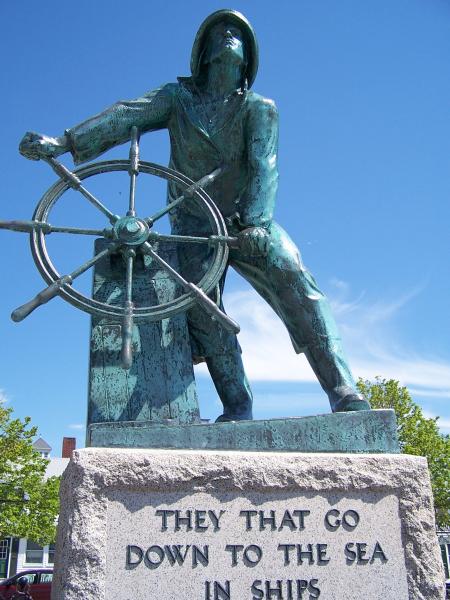
Today’s Editorial, City’s arts policy must define room for public input, leads off with the insinuation that every new work of public art is always met with some degree of negativity, followed by this statement: “Indeed, reports indicate that some local folks didn’t immediately warm even to sculptor Leonard Craske’s 1923 Man at the Wheel…” What reports are you citing here? Whatever the source, this is absolutely untrue.

Curiously, just the day before, I saw the same misstatement (on a local Facebook page)… only this time, it was a quote from none other than Bruce Tobey who, as noted in your editorial, is spearheading the drive to place the controversial David Black sculpture in Solomon Jacobs Park. As a former mayor of Gloucester, Mr. Tobey should have a firmer grasp of his city’s history, or at least check his facts before making false assertions. However, this is just another example, like the continually cancelled public hearings, of how our elected representatives have been dismissive of any input from concerned citizens.

The problem is not David Black, an artist of considerable talent, world renown and a graduate of Gloucester High School, although he moved away long ago. His gift to the city is quite generous and I’m sure sincere. High Seas, the sculpture in question, is a  large, wildly abstract piece. Whether you like it, or not, is obviously a matter of taste. Personally, I’m a fan. It is the placement of this colossal work in compact Solomon Jacobs Park that is the problem. Far from there being a unanimous consensus, this issue has resulted in considerable public outcry, especially on many highly active social media sites.  Mr. Tobey, Mr. McGeary, Ms. Cox and Mayor Romeo Theken are well aware of these numerous, impassioned, online voices. Now it remains to be seen how they will respond to them.

Just to clarify how wrong the aforementioned comparison is, Craske’s now iconic Fisherman’s Memorial Statue had a very clear purpose from conception to completion: to honor the brave local men who risked their lives and would continue to do so, by going to sea to provide Gloucester with its economic lifeblood, a thriving fishing industry. It was a most fitting tribute, applauded by all, for Gloucester’s Tercentenary Celebration in 1923, when the first model was unveiled. Empowered and inspired, Craske continued to work intimately with a committee of 60 including the Master Mariners. He even went on a fishing trip to the Grand Banks on the schooner Elizabeth Noonan to have as much authenticity in his finished work as possible. The exact positioning, wherein the fisherman faces out to sea, was also carefully considered. All these facts and much more can be easily accessed in the archives of the Cape Ann Museum, if facts are what you are interested in.

However, I’m afraid Mr. Tobey is no more interested in facts than he is in public scrutiny. Let me close with the words of the late author, historian and GDT columnist Joe Garland ~ “Beware those who would use Gloucester for their own ends.”

Bing McGilvray

Gloucester MA

J. Jeffrey Grant’s Gloucester

“My favorite sketching ground is Gloucester…” J. Jeffrey Grant

J. Jeffrey Grant (1883 ~ 1960)

After the death of both his parents, Grant left his native Scotland, ultimately establishing himself in Chicago as one of the city’s most important and prolific artists. Still, something in him longed for the seaside life he had loved as a boy.

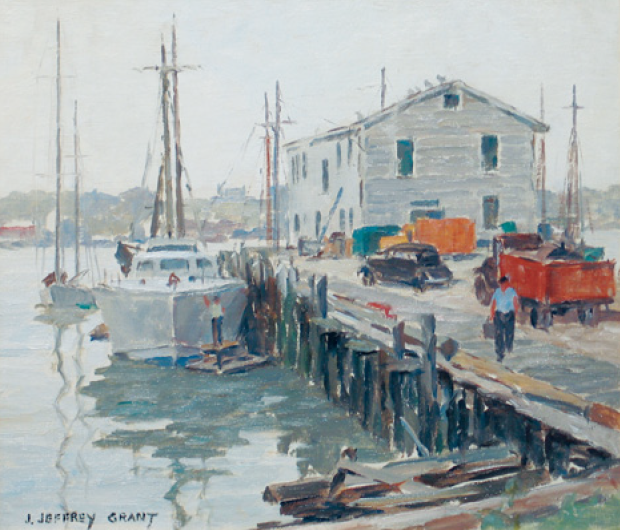
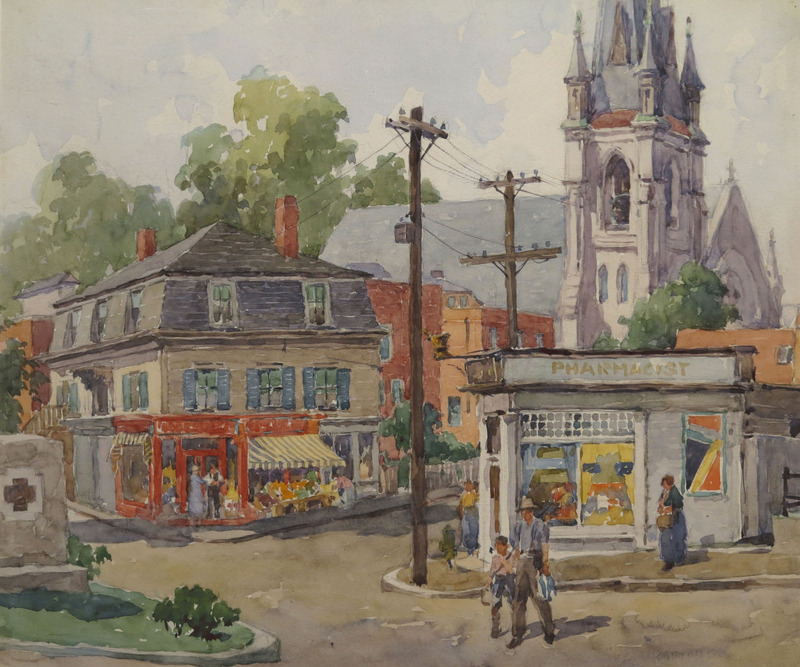
This longing was resolved in 1931 when he visited Gloucester. He returned almost every summer for the rest of his career. He was inspired by the vibrancy of life he saw here. The ocean’s fishermen, the dockside workers, rooftop vistas accentuated by iconic spires, busy urban streets and residential alleyways with washing on the line and children at play… all this and more he captured beautifully with impeccable precision.

Here are just three of his Gloucester paintings which still have a very familiar feel.

gray day

Gray Day, Gloucester Docks

StAnn (2)

St. Ann’s Church, Prospect St.

hanging Laundry (2)

Hanging Laundry, Portagee Hill


Artist: Tommy Heinsohn (!)

heinsohn

Pink House on Portuguese Hill. Tommy Heinsohn (b. 1934)

Folks who are my “friends” on Facebook know that every day I try to feature a work by a different artist, past or present, who has come to Cape Ann for inspiration. Some call it home, others are just passing through. There are so very many to choose from that rarely do I repeat a post. While searching this morning I came upon a lovely painting by an artist who really surprised me…and he probably will you too. ~ Bing

I have provided a link for more information on this unique talent.

Click here >> Tommy Heinsohn

Birdseye Photo Montage by Gloucester artist Louise Welch

eve of destruction

Montage ~ Eve of Destruction, 55 Commercial Street Flashback…Birdseye Building.

This photo montage came about when I was photographing the destruction of the Birdseye Building.

To me it was very sad and I was not happy with what was replacing this historical landmark.

I started to edit my shoot and all I could think of were the ghosts of the past who spent time working there, and I became upset on its eve of destruction.

I added a real photo of Clarence Birdseye, workers looking out windows, hands trying to stop the demolition, seagulls who hung out there to feed on discarded cod…. and tried to make it look like ghosts of the past.

Louise Welch

Gloucester photographer
Louise Welch

A Gloucester Artist Speaks Out by JoAnn Castano

We are not a community afraid of change;  we are the change, in the most creative, innovative and enduring spirit. 

Over recent years I’ve watched as we become a blueprint of Salem, now like so many communities across America,  hooked on tourism and the tourists’ dollars. We’ve become followers and not innovative leaders. We were different, but soon we will not be.  Plan 2000 was promising, the Mt. Auburn Harbor Plan was promising and the public forums were also promising.   I don’t see any resemblance to those now.  So I write the following letter and offer one more push,  as I see an opportunity for change… a united change toward openness and transparency.

Greetings Mayor Theken,

First the historic blizzards of 2015 and Patriots World Championship win, you are on a roll. Congratulations on new beginnings.

I’m writing hoping you can provide me a little more insight into the procedures and issues concerning the proposed David Black sculpture.

I understand you, the Administration, will be withdrawing the request Appropriation 2015-SA-10 – $30k of free cash.   As reported in the Gloucester Daily Times, Bruce Tobey, who is leading the project, will do the fund- raising and has implied the project will be funded with private donations.

Also being implied is that there is no urgency now for a community meeting that was required and planned but cancelled due to snow.  We are told the meeting will be held in the spring.  I respectfully disagree regarding its urgency as the $30,000 appropriation was but one part of the community’s concerns.

A remaining issue is the use of Solomon Jacobs Park and the City’s negotiation with National Grid to pay for the base and installation of the sculpture.  I understand going before City Council soon is 2015.SA-19,  the Boating Infrastructure Grant (BIG) which includes the agreement with National Grid to pay for the base of the sculpture and part of the landscaping/installation.

It is not clear whether those funds can be used somewhere else. My question is this:  If approved,  does it lock in that the sculpture would have to be placed at Solomon Jacobs Park? Do you feel the public is fully aware of City plans for this site and has had the opportunity for community input?  

Am I correct to understand that in the Boating Infrastructure Grant (BIG) there is no planning opportunity for community boating and these plans have not been fully discussed with the public?  Are we building for people of Gloucester or for general tourism? If any portion of the appropriation 2015.SA-19 in the Boating Infrastructure Grant (BIG) is being negotiated or allocated to the Black Sculpture installation, I would hope a public forum will be held before a vote, or it may be stipulated that these negotiations will be withdrawn until there has been public community input.

Working together as a community we can strengthen transparency in City governance, restoring the people’s faith and trust.  The public trust, in its growing desire for knowledge and community input,  I hope will be restored in good faith.

We are not a community afraid of change; we are the change in the most creative, innovative and enduring spirit.

I am a sculptor myself with 35 years’ experience in cultural community planning and development in Salem, Newburyport, Brockton and Gloucester. Having lived and worked in an internationally renowned sculpting capital of Pietrasanta, Italy, I have had the opportunity to work and exhibit with some of the most famous and internationally known artists.  My family has been in the gallery business before and during my entire life. My uncle had been the Newbury St., Boston,  dealer of many of the artists Gloucester has historically claimed. We have a history of knowing the arts and the business of art. Gloucester has many seasoned artists and sculptors today with more experience than I in public art installations. We collectively have a wealth of education, knowledge and experience.  I understand the contemporary and educational process of bringing community assets of art into the public arena, as well as funding structures.  I worked on Plan 2000 with efforts to integrate the arts into every part of our urban planning.  We established the Committee for the Arts and spearheaded and co-founded seARTS advocating for and bringing in well over $600,000 from the Mass Cultural Council alone in the first seven years (2003-2010) of the Creative Economy initiative. Since then the funds and MCC’s financial and social investment has continued to increase other local, public and private matching funds.  Our community has worked hard, participated as a whole to strengthen our economy and enliven the livability of Gloucester.

I thank you in advance for providing  hope for stronger communication between the City government and her people. You have given us, in the short time you have held the office of Mayor, a hope to end the divide and polarization we have been enduring for too long. The arts can transcend all,  and this may be the issue that will bring us together and return the “fun” you want to bring back.

We have heard from many of the seasoned and well- respected artists who are very concerned about their future and the direction Gloucester has taken in negotiating industry and the sustainability of living and working here.  Placing art on the harbor without proper and sensitive planning with the waterfront workers,  especially during such difficult times, as outlined in the Mt. Auburn Plan commissioned by the City, is a discredit to the fishing industry and the cultural community as well as all citizens.  This is a community- wide issue and respectfully I request you lend your ear to the people.

The artists’ #1 issue today and for many years now is to have live/work space with incentives such as 1% for the arts. Cultural tourism planning vs. general tourism is paramount to who we are.  We’ve discussed this in recent years as it was brought before City Councilors in 2013 awaiting a public forum.  We are still waiting.

Thank you for continued service to the people of Gloucester.

Respectfully,

Jo-Ann Castano

Jo-Ann Castano of Gloucester ​is a sculptor, arts educator and a community arts activist and organizer.  She is the principal of Castano Design Associates/ArtsGloucest​er​. She was on the Gloucester Plan 2000 committee​, ​was a founder, past president,and acting director of the Society for the Encouragement of the Arts (seARTS) and co-founder of the Gloucester Committee for the Arts.
What’s Your Opinion?

What are you doing Monday, Jan 26,  6 pm?

The public comment meeting taking place at the Maritime Center that night  might be your only chance to comment* on this proposal:

for the Solomon Jacobs Park at Harbor Loop :

 
A $30,000 expenditure related to this proposal will be on the agenda for the City Council meeting the following night. 


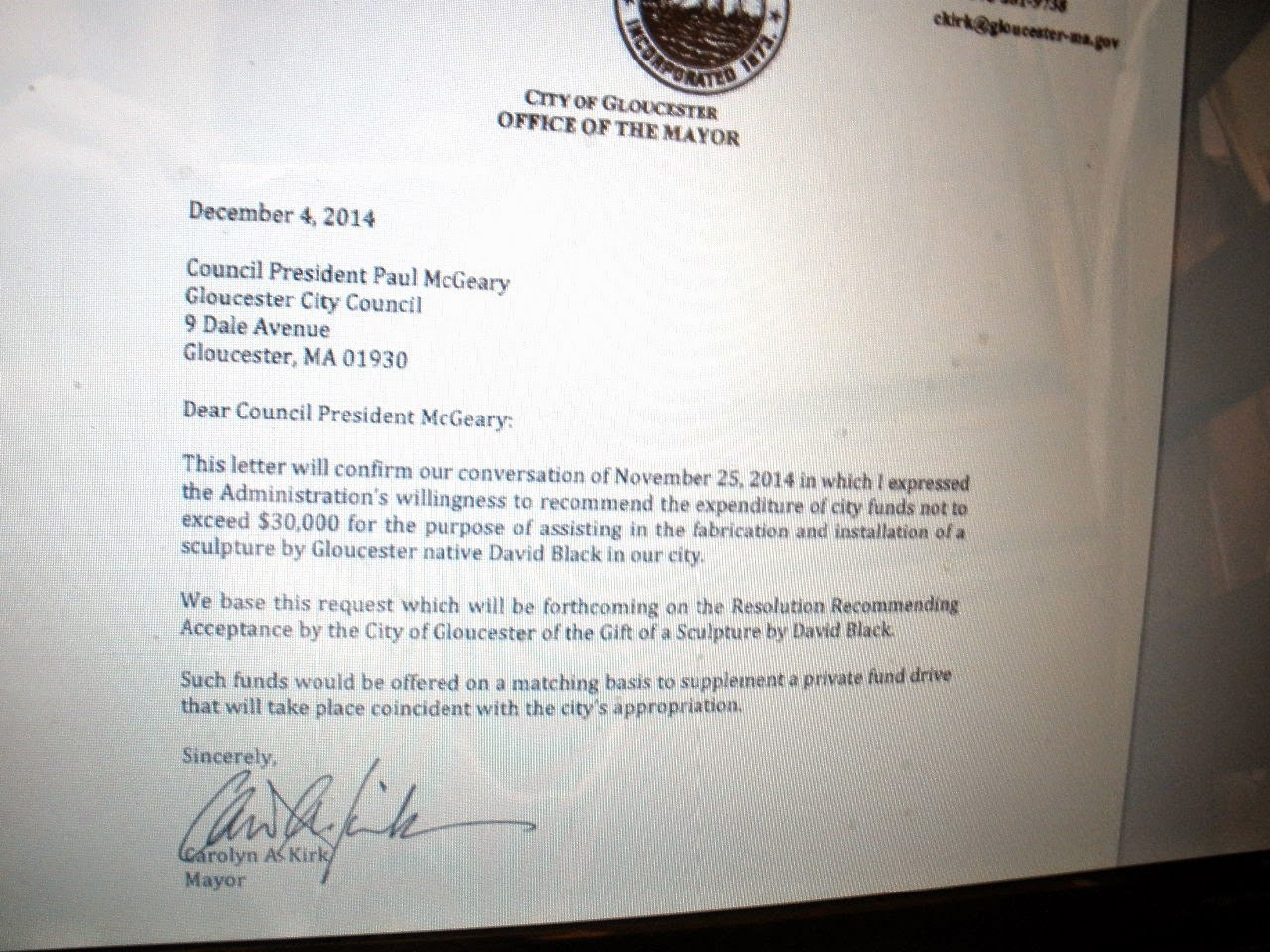
In early December, then-Mayor Kirk asked the City Council to recommend spending $30,000 in support of a gift of a sculpture……. 


(as long as a private fundraising effort provides at least that amount,)

….because the Gloucester Committee for the Arts recommended that the City accept the gift:

“…subject to
1- private fundraising to provide for all projected costs, as outlined above (fabrication, site work, maintenance fund for the future.)
2- the opportunity for public comment * on the proposal ………”

Gloucester Makes Headlines in the Wall Street Journal

Gloucester Makes Headlines in the Wall Street Journal….and some of the contributors to Enduring Gloucester  weigh in on the story. 

(Please add your comments below!) 

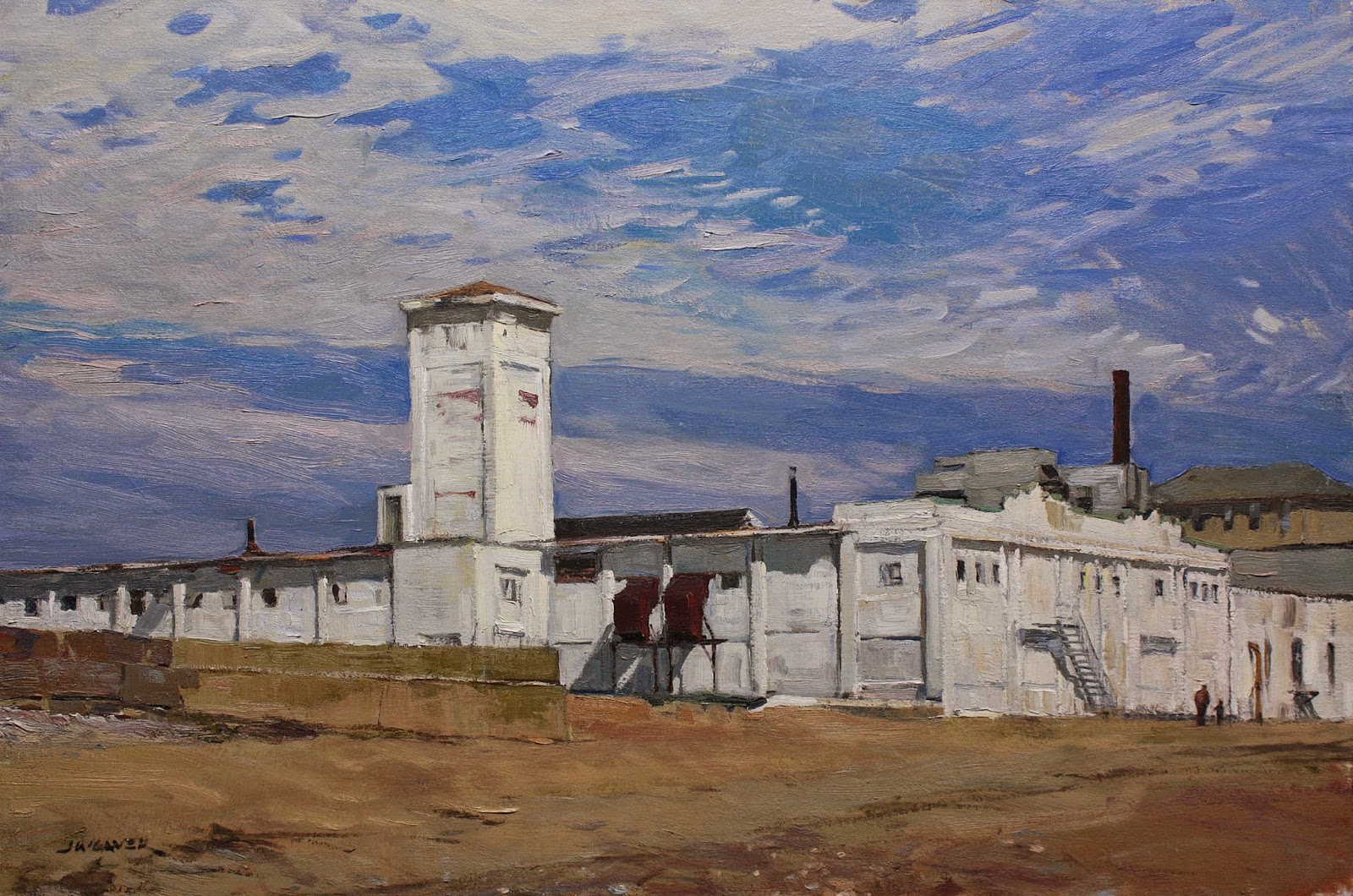
Factory on a Beach painting by Gloucester artist Jeff Weaver 2012


Wall Street Journal

December 9, 2014
Gloucester Fights Over Its Identity

by Peter Grant
A development group including athletic shoe tycoon Jim Davis has broken ground on a waterfront hotel in Gloucester, Mass. The project has been the focus of an acrimonious debate between residents who want to expand the city’s tourism sector and others who want to preserve its fishing and seafood industry.
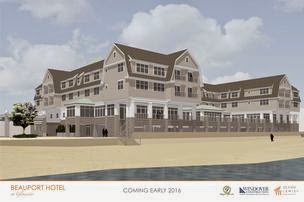
The group led by developer Sheree Zizik–and including Mr. Davis, the chairman of Boston-based New Balance Athletic Shoe Inc.–has been planning the 96-room Beauport Hotel Gloucester for more than six years. The project, to be built on the site of a historic Birds Eye food factory, is valued at more than $25 million and has support from the mayor and City Council, which believe Gloucester’s first full-service hotel is important for job creation and economic development.
“I hope to make it a destination for a lot of visitors,” Ms. Zizik said, who owns a restaurant and catering hall in Gloucester.

But other Gloucester residents fought to block the hotel, arguing that the city’s waterfront should be preserved for seafood processing and other industrial uses. Opponents have said that unless the city protects Gloucester’s working waterfront, factories and the hundreds of people that they employ will be driven out by developers of condominiums, hotels and shopping malls.
Opponents also want to preserve the city’s gritty ambience, made popular by the book and movie “The Perfect Storm.” Gloucester was the home port of the doomed boat in the true story, the Andrea Gale.
The battle over development has torn the community apart, said Valerie Nelson, a former City Council member who opposes the hotel and has lived in the area for about 30 years.
The fight in this historic Cape Ann city about 30 miles northeast of Boston resembles similar battles that have erupted in communities throughout the country over the use of waterfront real estate. Increasingly, traditional industrial users of waterfront property are being displaced by developers who are willing to pay up for prime real estate.
“In the last 20 years, waterfronts have become the hot places to develop in cities,” said Tom Murphy, a former mayor of Pittsburgh who is now a senior fellow at the Urban Land Institute.
When communities are targeted for gentrification, restaurants and bars have typically been among the first to show up, followed by upscale stores, apartments, hotels, condominiums and numerous services that appeal to the new residents and workers. Waterfront development often is supported by city governments eager for the additional property and sales-tax revenue that it can produce. Industrial users can’t compete with the rents and prices that other users can afford to pay.
“Once you start this process, you’re not going to be able to contain it, ” said Ms. Nelson. She said Gloucester residents who opposed the hotel are already girding themselves for battles at other sites.
First settled in 1623, Gloucester bills itself as the East Coast’s oldest shipping port. In recent decades, some of its food processing plants have closed, like the Birds Eye factory where Clarence Birdseye pioneered innovations in the frozen food industry. The fishing industry also has been hurt by such actions as the recent cod fishing ban in the Gulf of Maine by the National Oceanic and Atmospheric Administration.
But many of its seafood businesses have stayed strong. Businesses near the waterfront include Gorton’s Inc., a subsidiary of Japanese seafood conglomerate Nippon Suisan Kaisha Ltd., which employs close to 600 people and produces fish sticks and other frozen seafood for the U.S. market. Next door to the new hotel site is Mortillaro’s Lobster Co., which annually ships close to five million pounds of live lobsters throughout the world.
Indeed, the hotel’s opponents have questioned whether it would be popular with guests who have to listen to big trucks in the morning and smell the sometimes-pungent odors of the nearby seafood businesses.
Supporters of preserving the Gloucester waterfront for industrial uses have blocked some developments in the past. In the late 1980s, they prevented a proposed shopping center on an urban renewal site that has remained vacant. Across the harbor, they stopped residential development at the site of an old paint factory, which today is the headquarters of Ocean Alliance, a nonprofit research group.
The site of the old Birds Eye plant falls in an area that used to be zoned for marine industrial and other commercial uses but excluded hotels. The Gloucester City Council in 2012 approved an exemption that allowed the Beauport Hotel to proceed.
“If I could boil down the objection, it comes down to fear: fear of change, fear of loss of identity of our economic seaport,” said Carolyn Kirk, Gloucester’s mayor. “We had to work hard to build trust with the community.”
The Beauport Hotel will include a large conference facility, a beachside restaurant and rooftop pool. It will also display some artifacts donated by the Birdseye family, including photos and Clarence Birdseye’s microscope and snowshoes that he used when he studied the science of freezing food.
Mr. Davis, who owns a vacation home in the Gloucester area, declined to comment through a New Balance spokeswoman.
Write to Peter Grant at peter.grant@wsj.com
Melissa Cummings:
 
I was under the impression that waterfront property is to be used for marine purposes.  By law.  They want to build the building but will they fill it?  Perhaps they just want the money from the construction, could care less whether their edifice falls into disuse. Surely Pavillion Beach is too rugged for tourism, nevermind damage from the occasional storm.  Do they have a plan for taming nature?


Bing McGilvray:
 
I found Mr. Grant’s piece to be a surprisingly balanced (not New Balanced) assessment of Gloucester’s creeping ’boutiquing’, especially coming from Rupert Murdoch’s (FOX News) Wall Street Journal. There is much to read between the lines here. It’s hard to argue that those who would put an upscale hotel in this location don’t have further designs on The Fort.
Hilary Frye:
 
Not “fear of change” Ms Mayor, but dread of the monotonous homogeneity that has befallen other(former) seaports.We should look to the model set for us by Portland ,Maine.There, they have promoted and invigorated marine industry ,validating their maritime heritage.
 
 
Patti Page:
 
“If I could boil down the objection, it comes down to fear: fear of change, fear of loss of identity of our economic seaport,” said Carolyn Kirk, Gloucester’s mayor. “We had to work hard to build trust with the community.”
 
We do not fear change.  Gloucester’s successful waterfront businesses and fishermen have a strong history of changing, adapting and diversifying in the most innovative of ways to very sudden and extreme market fluctuations .  It is the very nature of waterfront industry.  If you stay the same, you die.   
It boils down to the type of change that is being imposed.  The known fear is the needless and careless loss of identity of the port.
The objectives of adequately serving the visitor economy, providing employment, supporting existing retail establishments and adding to the city tax revenue  were completely attainable at several, more appropriate locations for a business conference hotel.
No longer will mariners make approach into Gloucester harbor and be first greeted by the quaint lighthouse on Ten Pound Island, back dropped by the Tarr & Wonson Paint Factory with the white Birdseye tower to port.
How will the destination marketing folks convince visitors Gloucester remains an historic fishing port when a waterfront boutique wedding hotel is the most prominent structure in the harbor followed by a over-sized, white show boat docked at a catering hall?   And look no further than to the waterside Solomon Jacob’s Park which will be the future location of an abstract steel sculpture. 
 
Laurel Tarantino:
I’d like to address the mayor’s statement, and it had nothing to do with “fear,” and everything to do with “doing the right thing.”  Had our elected officials worked as hard for the fishermen and marine industry, as they did bending over backwards to push this hotel through, we probably wouldn’t see the community so divided.  Remember, we’d been trying to save the MI for six plus years from hotel development, not just these past couple years.  Saying, “We had to work hard to buildy. trust with the community,” is laughable.  I don’t think there will be any “trust,” bestowed anytime soon, to the mayor, or those who sat on the city council the day the re-zoning got voted through, not from me anyway and I have a feeling, there are a lot of folks out there that feel the same way.
 
Lois McNulty:
 ​
I was told by a Gloucester friend, 35 years ago, to get out of Newburyport, where I was living, and come to Gloucester, because Newburyport was losing its soul. I stayed in Newburyport, though, and witnessed  first-hand the gradual loss of the city’s identity as a beautiful city with an open public waterfront along the Merrimack River with a view to the ocean, a place where artists could live and work, where historic buildings were respected.
One man, Stephen Karp, a mall developer who made Nantucket into what it is today, has over the years acquired a substantial amount of downtown real estate in Newburyport as well as most of the marinas along the river. Karp is now being courted by city government as the developer of a large new hotel on Newburyport’s waterfront.  Stores downtown which once supplied us with groceries, hardware, stationery, clothing, and tools are long gone,  priced out by expensive restaurants and shops selling imported jewelry, mass-produced works of “art,” and gourmet food items. Many shopkeepers had to move to Amesbury or Salisbury or go out of business; local kids can’t afford the rents and real estate prices in town, so they’ve moved away.  Wealthy new residents are tearing down historic homes without impunity and replacing them with large pretentious “investment properties.” Shiny new condo developments, (some gated! ) have been crammed into open spaces and ballparks in the neighborhoods. The waterfront, once home to a small fishing fleet and seafood co-op, where people could always get jobs, has turned its moorings over to luxury yachts.
The city has become known as a playground for well-heeled tourists. And guess what? The schools are still laying off teachers and cutting programs, the sidewalks are crumbling, and the city never seems to have enough money to take care of its water and sewer lines or its library. Is it any mystery where all those glittering tourist dollars are going?
Peter Anastas:
“The Beauport Hotel will include a large conference facility, a beachside restaurant and rooftop pool. It will also display some artifacts donated by the Birdseye family, including photos and Clarence Birdseye’s microscope and snowshoes that he used when he studied the science of freezing food.”
So reads the Wall Street Journal’s sharp-eyed report on efforts to undermine Gloucester’s maritime heritage.  A beachside restaurant and rooftop pool for affluent guests; not speak of the promised bridal suite…and for Gloucester workers?  Jane Danikas said it all in her recent letter to the editor of the Gloucester Times: “As for creating new jobs with the Birdseye Hotel, who will most of them be for — chamber maids?  Yeah, that’s a great paying job.”
But the kicker for me is the display of “some artifacts donated by the Birdseye family, including photos and Clarence Birdseye’s microscope and snowshoes that he used when he studied the science of freezing food.”  That’s all that remains to memorialize a visionary scientist (my mother was his secretary after she graduated from Gloucester High School in 1928), and an industry that drove the city’s economy, in an iconic building that could have been adaptively reused to house an R&D complex, including fish processing and fish by-product development and production, along with marine and bio-tech research and education.  Now those would have been great paying jobs!  And they would have helped to provide a viable future for our children.
All that was needed was the vision, which is not lacking in Gloucester, a city full of boundless energy and imagination that our elected officials make little attempt to acknowledge or reach out to.  In fact, those who attempt to share the work of their imaginations, or to object to the lack of it in the kinds of development we have been subjected to, are shoved aside as “obstructionists.”   
 
Mayor Kirk has now uttered the ultimate wisdom:
“If I could boil down the objection, it comes down to fear: fear of change, fear of loss of identity of our economic seaport,” said Carolyn Kirk, Gloucester’s mayor. “We had to work hard to build trust with the community.” 
I believe our mayor is being disingenuous.  What kind of trust is she alluding to?  Trust in specious change or trust in those, as Charles Olson wrote, “who take away but do not have as good to offer?”   As for the fear, one does well to fear the loss, the very real fear of being driven out by the big money coming in to take possession of the city (Newell Stadium renamed New Balance), while remaking Gloucester in its own image—those rooftop pools!  As Jane Danikas writes: “We don’t care what our houses are worth, we don’t want to sell — we want to live here where we were born and raised.”
It is very real to have these fears of loss and displacement.  Australian philosopher Glenn Albrecht, has written that, “People have heart’s ease when they’re on their own country.  If you force them off that country, if you take them away from their land, they feel the loss of heart’s ease as a kind of vertigo, a disintegration of their whole life.”  Furthermore, Albrecht stresses that “the pain experienced when there is recognition that the place where one resides and that one loves is under immediate assault relates to a form of homesickness one gets when one is still at ‘home.’”  No wonder we resist certain changes—they are life threatening.
            Assault is the issue, and it is not too strong a word for what the citizens of Gloucester, who love and care for their community, have experienced.  It is bad enough to have your neighborhood rezoned out from under you, as the residents of the Fort discovered.  But when the mayor, who is elected to represent the entire city, not merely the rich and powerful, and to care for its culture and preserve our heritage, dismisses your concern as “fear of change,” (as if we did not understand the agenda underway to transform this storied seaport into a tourist haven), that could be taken as the ultimate assault, especially from an administration that has shown very little respect for the city’s identity.  For example, just think of those atrociously colored anddesigned crosswalks that came at a cost of $30,000 and were glaringly dissonant when set against the traditional redbrick of Gloucester’s downtown.  Not to speak of saddling the taxpayers with $30+M in debt for a new school in West Gloucester when a rehabilitated Fuller School would have been perfectly appropriate, and far less expensive. Oh, and the rent for St. Ann’s, plus repair and maintenance costs!  And the assisted living facility that was promised but never built at Gloucester Crossing (talk about boondoggles).  One could go on…
Like many natives and non-natives, who have come here and fallen in love with the city as they find it, I’m haunted by the loss that bears down on us at every point of our lives here.  I don’t fear substantive change, change that comes from sound economic, architectural and urban planning, little of which has happened because our Master Plan is out of date by 14 years.  What I do fear is development by default, which leads to change, driven not by what the people of Gloucester desire in terms of sustainable growth, but by what developers in collusion with our leaders force on the community, which then gets sold to us as the only possible way to go.  Woe to those who oppose it!
The Beauport Hotel is precisely that form of imposed not evolutionary change.  There was wide consensus that the city needed a downtown hotel, but not in the heart of a marine industrial zone, in a building that did not have to be demolished to create a rooftop pool for affluent guests, who would be waited on by natives, who deserved not be employed as a servant class, but to be offered permanent jobs with solid pay and comprehensive benefits.  The people of Gloucester deserved better than this, and I doubt that the hotel’s development has truly been engendered or driven by the trust the mayor so cavalierly claims she has built.