THE HOPPER PAINTING

(Rooms by the Sea, 1951)

By Dan Wilcox

Rooms By The Sea. 1951 Edward Hopper (1882-1967)

Rooms By The Sea. 1951 Edward Hopper (1882-1967)

I get up and go to the window,

The sea is right outside

there is no beach, only the sea.

The white is not foam, it is light

the sun reflecting from the high side of the waves

while the deep part is blue, bluer.

Where the black blue meets the white sky

is the same line as the wall that meets the ceiling.

I sit on the red couch and think

of immensity, of infinity

of the edges between the door and the sea

the two pieces of the sky, the doorknob

the latchwork of the jamb.

I walk from the window, around

the wall to the door

step into the light

watch the shape change.

If the door closes, I will fall into the sea.


(Dan Wilcox will be reading from his new collection of poetry, Gloucester Notes, at the Gloucester Writers Center, on Wednesday, May 4, 2016 at 7:30 PM. Reading also on the program will be Alan Casline.)


dan-wilcoxDan Wilcox is the host of the Third Thursday Poetry Night at the Social Justice Center in Albany, N.Y. and is a member of the poetry performance group “3 Guys from Albany”.  He is a frequent visitor to Gloucester and his book of poems Gloucester Notes is forthcoming this year from Foothills Publishing.  You can read his Blog about the Albany poetry scene at  dwlcx.blogspot.com


Night Train at Wiscasset Station

Peter Anastas

Showdown at Roundhouse Corral, (Boston Railyard) © 2000 ~ David Tutwiler (b. 1952)

Showdown at Roundhouse Corral, (Boston Railyard) © 2000                              David Tutwiler (b. 1952)


I come from the era of trains.  As a child during the war, I would lie in bed on Perkins Road listening to the shrill whistle of the Boston & Maine’s  Gloucester Branch crossing the trestle over the Annisquam River.  Ever since then I have associated trains with the mystery of travel.  I could never get enough of them, pestering my grandfather Angel Polisson to take my brother and me to the station in Gloucester to see the trains arrive.  I especially loved it when we could watch the passengers getting off and I could only imagine where they had been or where, if the train was about to depart, they might be headed.

As we got older, our mother took us to Boston on the train, when she went shopping at Jordan Marsh’s or Filene’s.  I’ll never forget the time I got separated from her in Filene’s basement.  I went screaming up and down the aisles of bargain clothing piled on tables that women fought over, cursing each other, sometimes tearing the garments to shreds in their furious attempts to possess them.  After that incident, my mother took to pinning a name tag on my brother and me, so that if we got lost or separated from her the clerks would know whom to page.  Luckily, it never came to that, and we quickly learned how to navigate our way around the big department stores, or the Peabody Museum in Salem, where our mother also took us so we could look at the ship models that fascinated us, or the life-like local birds and mammals that the taxidermists had exhibited in large glass cases.

Recently I thought of those cities I came to know in wartime when the gasoline ration prohibited travel by car—Boston, Salem, even New York when we got older—and the trips on trains it took to get to them.  I was on the train to New York again, racing along the Connecticut coast, in and out of harbors and across russet colored fields on the way to see my new grandson in Brooklyn.  The train was packed, the early spring day was bright, and I felt like a child again on an adventure.

It was the way I felt in Europe, where I took the train everywhere, never thinking of schedules or reservations.   If you wanted to go somewhere, you showed up at the station and there was a train waiting or about to arrive.  One night a group of us were sitting over dinner at the Buca Niccolini, on Via Ricasoli in Florence, just behind the Duomo.  It had been a grand meal, well moistened with the local red wine the Florentines call “vino nero.”  We were about to order desert when someone suddenly suggested, “Let’s go to Vienna for desert!”

We jumped up, settled the check and set out for the railroad station, a short walk from the restaurant.   The Brenner Express was about to depart.  We knew we would never get to Austria for desert, but we did arrive in time for one of those marvelous Viennese breakfasts.  We took a spin around the city and got back on the train, arriving in Florence in time for dinner.

Naturally, this was the kind of gambit you engage in when you are young—we were in our early 20s, students: Americans, English and Italian.   I never did it again, but I took the train at every opportunity—to Bologna for lunch (best pasta ever); Pisa for a run up the steps of the Leaning Tower with my high school classmate Bob Stephenson; Viareggio to get my beach fix when I missed Gloucester.

Trains were even more important for me before I lived in Europe.  I went to college in Maine and most of the time I took the train to Brunswick or back home.  I’d hop on a Gloucester train to North Station, where the Flying Yankee left for Portland, Bangor and points north.  There was a club car serving beer all the way to Portland, where it was uncoupled before the train left for Brunswick.   On many a night we could be seen stumbling up to our rooms from the Brunswick railroad station.

At midnight the mail train stopped in Brunswick, allowing those who had girlfriends in Boston to post letters that would be delivered to them that morning.   I can see myself hastily typing a letter, throwing on parka and boots, and trudging through the snow from my room on Federal Street down to the railroad station on Maine Street, often getting there just as the train was about to pull out.  The guys in the mail car knew us.  Obligingly, they would lean out of the doors to accept our letters on the fly.

At four a.m. every morning the Milk Train coming through from Northern Maine to Boston woke up those of us who lived near the railroad bridge on Federal Street.  If I was reading or studying late, I knew that its whistle in the dead of night was the sign for me to go to bed. But the big event of the day was the non-stop rush through Brunswick of the freight train.  Imagine an engine pulling 100 or more cars all the way from Aroostook County tearing through the center of town, the late afternoon traffic sometimes halted for close to 30 minutes.  Our philosophy professor told us that if we still believed in the non-existence of un-thinking matter we should stand next to that freight train as it roared through town each afternoon.

While some students had their own cars, most of us depended on the train for a fast getaway to Portland to see a movie or to eat Chinese food.   Often enough we traveled north to Rockland, and sometimes further Downeast, stopping at Wiscasset on the way to Rockland, Camden or Belfast.   There was something special about Wiscasset, a sense of arriving in a small riverine town with redbrick buildings, the train pausing, it seemed, until the very last passenger appeared out of the dark, the conductor waiting with his lantern and finally shouting, “All aboard, all aboard,” as the train pulled slowly out of the station.  I can still hear the chugging of the steam engine, the way the wheels clicked on the tracks, and the eerie whistle as the train plunged into the darkness.

It is the image of that night train at Wiscasset Station that remains with me above all others, a sense of the isolation of the station itself and the deserted town, the slowly diminishing sound of the whistle and the rhythmic clicking of the wheels on the tracks, the lights from the cars gradually becoming bright points in the darkness and then disappearing altogether as the train itself faded into the night.   It is an image that takes me back to the boy awake in his bed on Perkins Road, listening attentively each time for the train to cross the trestle over the river, imagining what it might be like to travel on it, to arrive in unknown places, connected only by the trains themselves, the infinite network of tracks, as they raced through the vast spaces of the night.


Peter at Museum (1)Peter Anastas, editorial director of Enduring Gloucesteris a Gloucester native and writer. His most recent book, A Walker in the City: Elegy for Gloucester, is a selection from columns that were published in the Gloucester Daily Times.

A Special Place

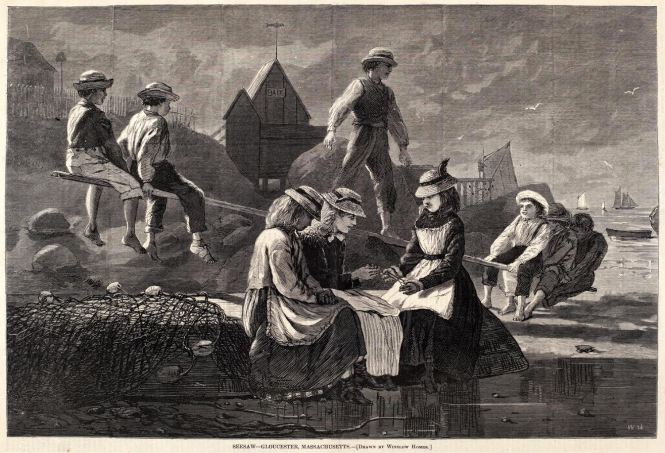
Seesaw, Gloucester. published 1874. Winslow Homer (1836-1910)

Seesaw, Gloucester. published 1874.                                                                    Winslow Homer (1836-1910)

Gloucester’s U10 Extreme (Soccer) Team lost a close one last Saturday at Danvers Indoor Sports.  Following the match, parents from the opposing side yelled at our players and, after much ado, we were encouraged to “go back to our stinking fish city.”  Aggressive, condescending and delivered to a crowd of young boys and parents who were gathering to celebrate the birthday of one of the players, this insult was jarring.  After the initial shock, however, the incident inspired us to feel something important and enduring – intense pride in our hometown.

Gloucester is a special place.  It means something to be from this island, on the edge of the continent, sometimes seemingly far from Boston and suburbs “up the line.”  We love its natural beauty, its light and art, and the way it embraces characters of all kinds.  We are proud of our fishing history and the continuing work ethic of our residents, which is evident across industries today.  We recognize our socioeconomic and ethnic diversity as essential to our strength and future prosperity.  Among our fans on Saturday, cheering on a sweet and talented group of 9 and 10-year-old boys, were a surgical assistant, a neuroscientist, a lobsterman, a communications strategist, attorneys, an office manager, a fitness coach, local business owners and a teacher, representing a broad range of ethnicities and including first-generation Americans.  On the soccer sidelines, as in our city at large, diversity catalyzes empathy, strength, creativity and cohesion and results in something bigger – a community.

One does see Gloucester in our kids out on the soccer pitch.  They play hard, have heart, focus on teamwork and celebrate and support each other.  They are strong and spirited.  They have grit.  Fishermen – every one of them – and every one of us.

So, yes, we’ll happily return to our “fish city.”  Gloucester.  Beauport.  Call it what you want.  And we’ll see you at the playoffs!

Liisa Nogelo and Doug Kerr

Magnolia


This post appeared as a Letter to the Editor of the Gloucester Times on Saturday, April 4, 2016.  We reprint it with the permission of the authors, Liisa Nogelo and Doug Kerr.

Star of the Show

Lori Sanborn

Dedicated to Mr. Z

This coming September my daughter will start kindergarten. Emmy will join hundreds of other adorable, curious, playful and crafty five year olds in the Gloucester Public School System. I know public schools pretty well because I have dedicated 13 years of my life to teaching in one. Although my classroom is not located here in our beautiful city, there are some commonalities and truths that exist in all public school settings.  Let me share a story that highlights the most important one.

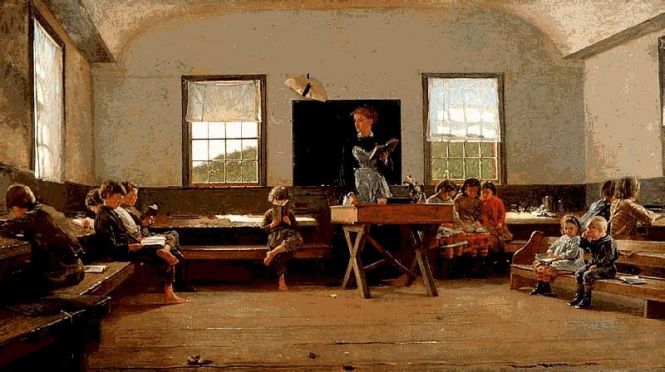
The Country Schoolroom. 1871. Winslow Homer (1836-1910)

The Country Schoolroom. 1871. Winslow Homer (1836-1910)

The overwhelming majority of school teachers love their job and their students. Once I enter my classroom each day, I am fully present. My students get all of my attention.  I notice them.  I know when they didn’t get enough sleep.  I know when it’s their birthday or when they won their big game the night before.  I know when something is bothering them.  I am always in their corner.  I am their number one fan when those that love them the most can’t physically be there to cheer them on.  My students make me laugh daily and every so often one of them makes me cry.

Just recently, one of my students brought tears of happiness to my eyes.  Every year I strive to help my students improve their public speaking skills.  This is something we work on all year long, starting in September, so we are ready for our big debate on the death penalty come March.  Most middle schoolers hate standing in front of the classroom.  Long gone are the days where they thrived off of sharing their prized possession during “show and tell.”  The majority of my 8th graders squirm at the thought of having all of their peers focusing solely upon them.  But none of my students hated it more this year than Finn.

I still remember the expression that came upon Finn’s face when I told all 80 of my students that my personal goal was to help them all improve their public speaking skills.  A panic stricken Finn fidgeted in his seat and planned for the worst.  During his first experience in front of the classroom his fear weighed heavily upon this performance.  He rocked side to side, from left foot to right foot.  He spoke as fast as a student exiting the building on the last day of school in hopes that his suffering would soon end.   He barely looked up at his audience.  When his turn was over, he sighed in deep relief and listened for my critique and suggestions for improvement.  Finn listened intently to my words and all I could do was hope that they would resonate.

Since that day, Finn and his classmates have had multiple opportunities to speak in front of the class.  Each time I observed Finn with a watchful eye and afterwards highlighted his strengths and weaknesses.  Each time, Finn listened hard and showed slight improvements with his next delivery.  The swaying was becoming less extreme, the “ummms” were almost a thing of the past.  No more sweaty palms.

Fast forward to March 17th, a day rumored to be laced with luck.   It marked the second day of our death penalty debate.  Eli, a naturally strong orator, took to the podium to prove that the death penalty is far too much of a financial burden on state taxpayers.  Upon hearing his classmate and opponent finish his introduction, Finn rose to challenge him.  What happened next was magical, despite having happened on a day shrouded in Irish luck, there was nothing lucky about Finn’s performance.

Finn delivered a strong rebuttal to Eli’s argument.  Eli came back even stronger.  This pattern continued for 18 minutes straight.  For 18 minutes, I watched two young men demonstrate eloquence, passion and intellect.  They became the educators in the room.  Their peers reacted in such awe that it brought tears to my eyes.  After 13 years in education, I was immediately reminded of why I wanted to teach in the first place.  I have always believed that all kids can truly achieve academic excellence. But I also wholeheartedly know that all kids can experience that “magic” during the years they spend in the public school’s system.  And when it happens, the student will gain the type of confidence that will transfer far beyond classroom walls.

Although I would not want time to pass any faster than it already has, I do look forward to the day when Emmy has her transformative moment in school.  The moment that inspires her to come home beaming, not because of a crush or because she got invited to a dance, but because her teacher made her feel brilliant, like the star of the show.

This magical moment is different for all.  Finn’s came loud and openly in front of his peers.  My moment was a silent exchange between a student and teacher.  When Mr. Ziergebel marked my fictional piece with an A+ and told me “you sure can write,” my mind was forever altered.  It may have taken me almost 20 years later to gain the courage to actually share my writings with the world, but I know it never would have happened had my 9th grade English teacher not made me feel that kind of special.


lori sanbornLori Sanborn was born in Gloucester and returned to live permanently in our seaside community three years ago. She has been a public educator for 12 years, teaching eighth graders.  Lori is most proud of her role as mother to her children, Emerson and Ryder.

Interested in Learning More About the State of Our Oceans?

cape ann pic

All are invited to the Rocky Neck Cultural Center for an informal talk with noted Geologist and Environmental Consultant, Dave Lincoln. The topic, Corporatization & Privatization of the Ocean, will no doubt be of great interest to all residents of America’s Oldest Seaport.

Dave Lincoln


Topic: Corporatization and Privatization of the Ocean

Who:  Dave Lincoln, Geologist and Environmental Consultant

What: Informative Session

When: WEDNESDAY March 23, 2016

Time: 6:00 PM

Where: Rocky Neck Cultural Center, 6 Wonson Street, Gloucester, MA 01930

The Consequences of Unplanned Growth

Peter Anastas

“Stop this renewing without reviewing.”

–Charles Olson, “A Scream to the Editor”

Prospect Street, Gloucester. 1928 Hopper, Edward (1882-1967)

Prospect Street, Gloucester. 1928 Hopper, Edward (1882-1967)

What do the proposed “Soones Court” Back Shore luxury housing project and the recently floated ideas for the development of Ten Pound Island have in common, aside from the fact that they have provoked vociferous public opposition?

These are projects that have no foundation in planning.  They were neither anticipated nor considered as part of an overarching plan for the growth and development of Gloucester or the protection of our natural resources.  Why is this?  Simply put, it is because the city effectively does not have a Master Plan that is currently valid.  Our Master Plan is neither valid nor relevant because, having last been drafted and voted upon in 2001, it is fifteen years out of date.  As such, it does not—and did not—anticipate major projects like Gloucester Crossing or the Beauport Hotel on the Fort, both of which also stirred divisive public opposition.

The purpose of good planning is to avoid such controversies as much as possible and make clear in a democratically created document what is needed for the orderly growth and development of the community; in other words, what should be built in the future and where it should be built.  Such a plan also provides for what the community wishes to preserve in  terms of landforms, historic sites and buildings, neighborhoods, or cherished places— iconic locations like the shore side of our Back Shore, Ten Pound Island, Dogtown, or the Magnolia Woods.  It is possible through planning to set aside such “magical places,” as Janice Stelluto, who shepherded Plan 2001 from the talking stages through to its completion, called them, so that they would remain undisturbed to be enjoyed by future generations of Gloucester citizens and visitors drawn to the natural beauty of our city.

Good planning also anticipates the impact on the economic and social well- being of the city of foreseen growth; for as a community considers what it hopes to live with in the present—which amenities it needs, what kinds of new business might be provided to create necessary jobs, how new growth and development will affect tax base—it also looks at what is not wanted.   It provides for the preservation of what is valued like the untrammeled view out to Thatcher’s Island from the Back Shore, or Ten Pound Island left in its natural state for students to study its geology and birdlife.

Plan 2001 did not call for a shopping plaza adjacent to the Fuller School, nor did it consider the marine-industrial Fort as an ideal location for a “boutique” hotel or conference and function center   These were not developments growing out of the community’s pressing desire to have them (there was consensus about a downtown hotel but not on the Fort); they were developer-driven projects, coming, as it were, from a vacuum created by a lack of planning.  Taken by surprise, as the community was when these unanticipated and unplanned for projects first surfaced, many in the community reacted like we all do when we are confronted with the unexpected.  There was anger, frustration and, naturally, resistance, creating rifts in the city, which deepened as one unanticipated and unplanned for project followed another.

To be sure, the planning process cannot anticipate or parry in advance every controversy; nor can it satisfy all sectors of the community.  But it can help us to avoid the divisive acrimony we now experience in Gloucester with the concomitant anger against and distrust of government and public officials, neither of which help to promote or sustain our wellbeing as a people, collectively hoping for a deserved quality of life in the place we call home.

Without good planning a city is helpless in the face of the relentless drive to develop that we and many seaside communities like Gloucester are facing, just as a family that does not budget its finances or plan for the future is stymied when there is job loss or catastrophic illness.  Good planning can help to avoid the raucous public hearings that have been a sad feature of local life, pitting neighbor against neighbor and ward against ward, only fueling the enmity and distrust of government that have come to characterize national life as well.  Good planning can also help the community avoid costly litigation that drains both public coffers and private citizens of funds that could be more wisely and creatively spent.

So, before we get into another battle royal over the next development proposal to come down the pike (and there will be many), would it be too much to ask if we, as a community, could take that superannuated Master Plan off the shelf and revise it?  Or better: couldn’t we begin again, utilizing all the experience we have gained during the past fifteen fractious years, and write a new one?   Call it a roadmap for the present, or a GPS helping us to navigate our way through the complex terrain of the future.  Call it what you will, but for the sake of all of us let’s not move forward without knowing what’s ahead.

(On Thursday, March 4, 2016, the Gloucester Planning Board said “No” to preliminary plans for Soones Court.  However, developers have announced that they will return in July with “a more definite proposal.”

On Monday, March 21, there will be a community meeting hosted by Ward One city councilor Scott Memhard, at the Rocky Neck Cultural Center, 6 Wonson Street, at 7 p.m., to discuss “Ten Pound Island: Recognizing its Past, Planning its Future.”  All are invited.)


Peter at Museum (1)Peter Anastas, editorial director of Enduring Gloucesteris a Gloucester native and writer. His most recent book, A Walker in the City: Elegy for Gloucester, is a selection from columns that were published in the Gloucester Daily Times.

Gloucester’s Resounding Echo: A Tribute To Kay Ellis

This slideshow requires JavaScript.

Kay Ellis, the girl could cook, and I’m not talking about a meal where you push back your seat and say “Boy that was good.”  I’m talking about the kind of magic that happens in that first bite when your taste bud’s reaction is to beg for more and all the while you’re telling someone, “You have to try this, it’s amazing,” the left side of your brain is telling you to be quiet so you can hoard it all to yourself.  Kay would gladly give you a recipe if you asked for it, but one she couldn’t give you from her kitchen was that recipe for living life.  It’s not something she or any of us have written down anywhere, on how to do it well, but she sure nailed it.

I’ve known Tom since I was a little kid, being introduced to his wife Kay years later was an added bonus.  She was so easy to get to know, what you got was Kay, no pretentious facades, nothing shy, or boastful, just a comfortable, pleasant person, a person you’d want to spend more time with.  I could easily see how she and Tom were best friends and successful business partners.  One of my father’s expressions comes to mind when I think of them together, “They work like a well oiled machine.” That doesn’t make their relationship sound very romantic, but all you had to do to see that side of them, was to look out on the harbor, they were living one of the greatest romance novels ever written.

With so many reasons to be proud, I think her face shined brightest when she was talking about her boys.  Laughing, she’d tell you Tom was her biggest, but kidding aside, it was ever apparent whenever she spoke of them.  Some moms stow away things their children make when they’re little, to be brought out and reminisced about, perhaps on a winter’s day.  In Kay’s home, they were proudly displayed, from pottery balanced on a beam; awards of merit framed and hung on a wall, to homemade paper chain garland adorning the Christmas tree year after year.  Ask her about a photograph of them and you could see and hear in her voice that she was back to the time and place the picture was taken, enjoying the moment all over again.  It is always nice to see the boys quiet pride, reflected right back at her in their respect and admiration for their mother.

I have no reason to say that Kay was my best friend.  We didn’t have lunch together every week, or double date, or go shopping together, like girlfriends do.  We did share a love of books, dogs, flowers, art…our conversations just flowed at an easy pace.  “Have you read this book?  I think you’ll really like it.” She’d be right, ten times out of ten.  Having the same birthday, our gifts to each other were more often than not, books, and she never failed to give me one I would enjoy from beginning to end.

I’d pop in at the Schooner Sail’s Office down at Seven Sea’s Wharf while out walking my dog “Pal.” It was a nice stop along the way to have a friendly chat, see how things were going.  Pal would come over to the house with me too.  Kay was quite fond of the little guy.  One day she called me over to the house because there was someone she wanted me to meet.  That someone was “Lanny,” a cute little Chocolate Lab pup, who soon grew to be a big part of the Ellis family, and a welcoming hostess aboard the Schooner “Thomas E. Lannon.” Kay told me that “Pal,” played a part in the deciding factor for them to get a dog.  Seems Tom had wanted another one for years, but the time was just never right, seeing the relationship I had with my dog had made an impact.  I am so very glad of that and for her telling me so.

It has been my great privilege to have my phone ring with Kay’s cheerful voice on the answered line saying, “Hey Laurel, we’re going out for a pot luck dinner sail, can you and Jimmy make it?” An invitation that I would be foolish to pass up.  How nice to be with Tom, Kay and their blend of friends, sailing with the sunset off the stern, and the moon slowly rising off the bow, with nothing but the sounds of the sea, splashing the hull, some wind rattling the sheets filling the sails, and the voices and laughter of friends sharing a special moment in time.

None of us will forget her kind, giving soul and all that she gave to Gloucester and those that visited this treasure we call home.  There must be thousands upon thousands of photographs people have taken aboard the Lannon to stow in their album of favorite memories.  One can’t help but wonder how many of those young students they brought aboard over the years were influenced to become sailors when they grow up, may their dreams comes true.

It was so nice to visit her, albeit briefly at Christmastime.  Sitting close to the warmth of the wood stove, patting her faithful companion “Lucy,” as she told me how she and Tom would be packing up for their annual trip out West to spend time in the mountains with friends.  There was that smile in her voice again as she spoke, and that shine on her face, the one you saw when she talked about Tom, her family, her friends, and her adventures with all of them.  With a heart as big as all outdoors, may she soar into her next adventure encompassed in love and her next home be as beautiful, warm and inviting as the one she made here.

The impact Kay has left in the hearts and minds of those who knew her is something to be treasured and she will be greatly missed. From all of us at Enduring Gloucester, it is with great heartfelt sympathy that we say, fair winds and following seas, to Kay, Tom, the entire Ellis family, and her family of friends.


Laurel TarantinoLaurel Tarantino, is happy to live in her hometown, Gloucester, with her husband, James, “Jimmy T,” daughter Marina Bella, and the family dog, Sport. She is known for “stopping to smell the roses” and loves to photograph and write about her beloved waterfront community.


The Luxury Building Boom Train

Gordon Baird

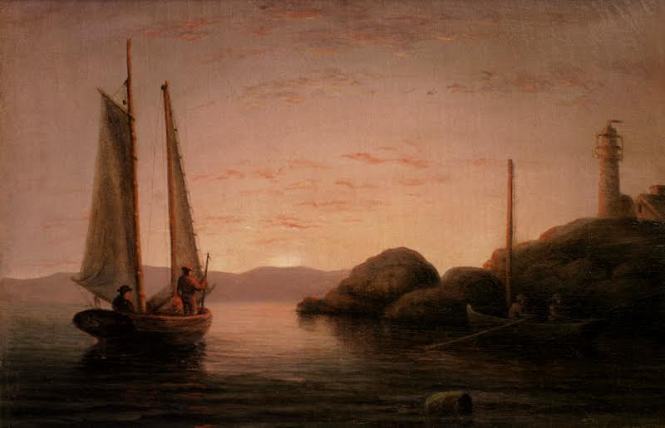
Mary Blood Mellen (1819-1886) Sunset Calm off Ten Pound Island Light, Gloucester, c. 1850s

Mary Blood Mellen (1819-1886) Sunset Calm off Ten Pound Island Light, Gloucester, c. 1850s

We’ve all recently read about the Cheryl Soones plan to build 4 houses on “the wrong side” of Atlantic Ave., i.e. the ocean side of The Back Shore. But really, why stop there?
There are a myriad of other proposals that could and should be vetted towards the great and holy objective of making money, you know, the almighty dollar, the beast of Mamon – to worship at the feet of dumptrucks full of cold, hard cash, driven up and dumped at the feet of the investors. In this era of Donald Trump, we invite readers to come up with their own ideas of other profitable building ventures in Gloucester to pump up the tax base and class up the place by bringing more of the “1%” into our ranks. Let’s start with the obvious: a full service Yacht Marina at the Lighthouse on Eastern Point. The Feds are only using the tippy-top part and the rest of it is going entirely to waste. The tower would make a heckova bar. Kick back with a Cuban cigar and a snifter of $200-a-glass brandy and watch the fish struggling their little lives away. The yachts and super yachts could tie up right alongside the actual breakwater (on the inside, of course).There would be a shuttle to the squash and paddle tennis courts at the end of the big, suddenly important Dogbar. It could be very profitable and could solve the problem of people who want to fish off the breakwater since there would no longer be room for them with the luxury cabanas and their personal bars, massage tables and big screen TV’s. And they could gaze right down the harbor to the brand new swanky health club on Ten Pound Island with its underground tramway back to Rocky neck. There would be a Trump Tower in Dogtown, as tall as the turbine windmills so as to boast the best views in the east. And just a zip trip away from the Ferrari dealership at The Man At The Wheel on the Boulevard. Hey, but what a wheel – we’d have to inport an Italian sculptor to modify the statue with an actual oversize Ferrari sterring wheel in his hands. Now that’s marketing the city!
And how have we not installed that Jet Boat Docking Terminal yet on Thatcher’s island? Another barely used asset that is just wasting it’s views and profit poptential – as The Back Shore so obviously does. That’ll all have to change. A Helipad at Stage Fort Park is a must for when VIP’s or even foreign heads of state come to town. Very welcoming and appropriate. And wouldn’t Coles Island make some classy Golf Club with all natural sand traps! Let’s not leave out Crane’s and Wingaersheek Beaches because with a wave of the rezoning wand, there’s still space for more and more houses, McMansions all. But more to the point: why couldn’t there be Luxury Apartment Towers on those beaches as well as in downtown Lanesville. We literally have to be able to “rise above” the actual zoning to get this plan to work.
Annisquam has long been itching for a sports and entertainment complex with equisitely fine dining and plenty of limo parking. I say we give it to them. That grey yacht club out there on stilts is getting too old for anyone anyway.
Gloucester itself has always felt kinda naked to me without a proper Polo Club. It can’t be sited too near Stage Fort, though, because the helicopters will spook the polo ponies. Wait, screw the Trump folks and put the Polo Club in Dogtown, far away from the noisy hoi-poloi in town. Put the Trump Tower right at the Rotary and rename the A. Piatt Andrew as the Donald J.Trump Luxury Bridge with a gold plated fence that no one will dare climb. That’ll put us on the map and we’ll get Mexico to pay for it.
Come to think of it, why are all those fish plants and smelly boats still allowed to remain downtown? They will definitely cut into our P.L.D.I. – the Potential Luxury Development Index that financial planners who make big decisions use. Come to think of it, the ocean side houses proposed for the Back Shore had a pretty strong P.L.D.I., considering just how little they paid for the lots. That’s a R.O.I. – Return on Investment – all developers can envy. Ms. Soones can set a new standard on P.L.D.I.R.O.I.
But wait! There could be a fly in the ointment for plans on our new Luxury Gloucester future. Maybe they’ll build the 4 Soones ocean side houses part Affordable Housing. After all, even non-1%-er’s want to live in the teeth of the Atlantic. Affordble housing with an ocean view! And when their houses are scattered down the length of the Back Shore, they’ll feel like the other displaced zillionaires – so that’s a bright spot when Americans feel more equal.
So send in your suggestions, ye citizens. The luxury building boom train is just getting ready to leave the station. Will you be on that train or just one of the old fashioned, stuck-in-the-mud, bleedin’ heart Back Shore protectors who think the rocks there are something special. Hah ! All you need is cash and no memory and we finally can get somewhere. Think P.L.D.I.R.O.I., people!

Gordon Baird

Gordon Baird sails, writes, sings and video edits his way through Gloucester as he has since 1950.  Musician Magazine called him co-founder, Gloucester Times calls him columnist, 3 kids call him Dad.  7 chickens, 2 goats, 2 pigs and a donkey call him breakfast, lunch and dinner.

Pimping Out Gloucester

Ten Pound Island. Photo Courtesy Laurel Tarantino

Ten Pound Island.
Photo Courtesy Laurel Tarantino

February 2016

A favorite quote of mine is one by Zelda Fitzgerald (1889~1948), “Nobody has ever measured, even poets, how much a heart can hold.”  I so understand this.  Science tells us that it’s impossible to die from a broken heart.   I beg to differ; it sure feels like it sometimes, especially when you keep taking blow after blow, seems like the damage can be irreparable.

With friends, my heart fills with gladness for all that we have and share.   These same friends have my best interest at hand when I’m sad for personal reasons.  They’ll turn me around to see the positive impact I have on people that count on me and need me.  Sometimes it’s hard to be needed.

I just took another blow to the heart again Tuesday night.  I need more than my friends for repairs this time. Before I let the tragic issues of the world get the better of me and turn me into a cynical old woman that roams the streets hurrrmmping through life, I reach out to you, anyone that may be reading this.

The injury this time, for lack of a better description, “The Pimping out of Gloucester,” in particular, Ten Pound Island, with total disregard for nature and its needs.  Where do we draw the line?  When are we going to say, “You know what, enough is enough?” When every inch of it is sold off to the highest bidder?

Put before the Waterways Board Tuesday night was a proposal for a float system on Ten Pound Island.  Sounds like a good idea, right?   It would give people access to the island, a place for people to tie up their boats, a place where people could take the Shuttle service every hour.   They even talked about tying it in with other activities…   yoga, the sailing program, the arts.  To me it sounds like another idea with an amusement park like theme.  In fact, the proposal was called “Harbor Park.”

My apologies, I’m starting to sound cynical, I can feel it.  I can’t help myself, when not one member of the board asked about the environmental impact to the area.  No one brought up the fact that the island is a safe haven for hundreds of birds, birds that migrate there, nest, roost and raise their young there.

This slideshow requires JavaScript.

“Why shouldn’t everyone be allowed to enjoy the island?” has been a question on social media.  The answer to that is that everyone can.  People visit the island now by kayak, row boat, sail boat, paddle boards and small motor boats and all these folk seem to be very respectful of the area.  They seem to understand the term “Carry In, Carry Out,” without having signs posted to tell them to do so.  As it is now, the small boat traffic is about all the island can handle.  I find the people that visit truly leave the island as they found it.  If you open the area to an unlimited number of people for adventure I feel it would be incredibly hazardous to the environment.  In the 90’s there was a shuttle you could catch a ride on that left you on the beach.  During that time, my husband and I saw an increase in litter, dirty diapers strewn into the plant life that grows beyond the wall, human feces, an overflowing trash barrel that never got emptied, a neglected picnic table that usually had the aftermath of someone’s lunch on it, basically signs of an uncaring public.

I psyched myself up to go to this meeting Tuesday night and speak on behalf of the birds, as they have no voice in City Hall.  This was going to be a great feat for me, as I’m petrified of public speaking, but I was willing to sacrifice my comfort.  I was mortified when the meeting started with the Chair Person commenting, “I don’t know why all these people are here, for what issue, but I can tell you, there will be no public input.”  I had my courage and couldn’t do anything with it and I was letting the birds down.

If you’ve never visited Ten Pound Island, you may not know what a beautiful sanctuary it is for several species of birds.

Snow Egrets. Photo Courtesy Laurel Tarantino


From late April to late October, there are Snowy Egrets that adorn the treetops in such numbers that I often refer to them as Christmas ornaments.

There are Great Egrets, Black Crowned Night Herons, Crows and occasional songbirds in the trees as well.  Along the rocks you might be entertained by the sweet little Purple Sandpipers as they dab for small crustaceans while outrunning the splash of a small wave.  Common Eiders scurry down the rocks and jump in to have a swim.  Of course, there are the ever present Seagulls and Cormorants.   All these lovely creatures can be seen if you take a quiet ride around the island in a boat.

There are also birds that nest on the ground in the interior of the island.  One must be ever aware of their footing or they could very well harm the nest of a Mallard Duck sitting on her eggs.  You might destroy an entire family of Canadian Geese if you’re not being careful,

Just Hatched Canadian Goslings. Photo Credit Denise Foley

since they may not always be sitting on their eggs, you might traipse right through them without their snarling warning.  The Herring Gulls will distract your attention away from your footing to the sky as they swarm you to protect their nests, which are plentiful along the cliffs and on the ground.

I fear it will be disastrous for the birds if people are arriving every hour.  In this day of cell phones with cameras, I’m afraid that this safe haven will slowly disappear and be replaced by 54 “Likes” on Facebook, because people will have to walk through the homes of these beautiful creatures in order to get a sought after photo of the Lighthouse.  What will happen to the babies once they’re hatched?  They’re so incredibly cute, I can see someone trying to catch one, which wouldn’t be very hard to do, since they have no defense against us humans.
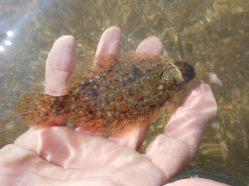
Juvenile Flounder. Photo Credit Laurel Tarantino

Juvenile Flounder.
Photo Credit Laurel Tarantino

What will happen to the thriving ecosystem in the water that surrounds the Island when you have a motor boat arriving several times a day, everyday of the week?  I cringe to think of it.

I’ll end this long winded rant with another quote, this time from Martin Luther King Jr. (1929-1968) “The time is always right to do what is right.”

Please help stop the giving away of Gloucester.  Believe me when I say (sadly) there are more great plans being drawn, but great for who is what needs to be asked.

***************************************

To learn more about the Audubon (IBA) Important Bird Areas, which Ten Pound Island is part of, visit the following site:

Massachusetts Audubon – Conservation

Locally, here is the link to our city offices should you like to contact them with your concerns on this or any other issue:

Gloucester, MA – Official Website


Laurel TarantinoLaurel Tarantino, writer, is happy to live in her hometown, Gloucester, with her husband, James,”Jimmy T,” daughter Marina Bella, and the family dog, Sport. She is known for “stopping to smell the roses” and loves to photograph and write about her beloved waterfront community.


There is Great Love

Hospital in Arles. 1889. Vincent van Gogh (1853-1890)

Hospital in Arles. 1889.
Vincent van Gogh (1853-1890) 

There is great love in this place of devastation
dire illness, rank injury, and near death
I watch from my room’s uncurtained door
the  Brownian movement of white coats
stethoscopes dangling, aids in blue, nurses white
incessant motion, seemingly without meaning
they look at a board I see the edge of and rush off
urgently beyond the narrow scope of my vision
I miss the action when they come to work on me
they draw the curtain that distracts me from my pain
I joke where there are no jokes, let them probe.
One more CAT scan before I rise to higher floors
but still must wait in the corridor and see the action newly.
Then I see them coming, the worried, anxious and fearful
lovers of those thrown up, wrecked here.
A soft eyed black family waiting to know for their son was shot,
Japanese crying, solitary women dreading their love’s fate,
There is great love in this place of devastation.

Kent Bowker     1/18/2016

Kent BowkerKent Bowker  started with poetry at Berkeley in the Fifties, then became a physicist working mainly in optics.  His new book of poems is Katharsis: Sifting Through a Mormon Past.  He lives in Essex, next to the Great Marshes and is treasurer of the Charles Olson Society.