This slideshow requires JavaScript.
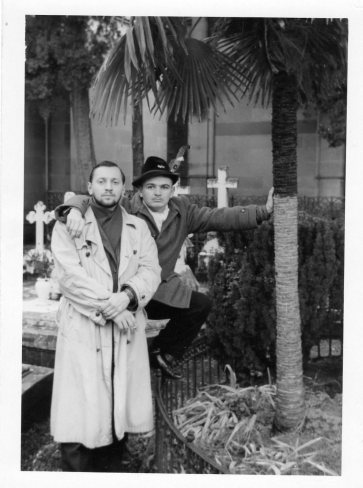
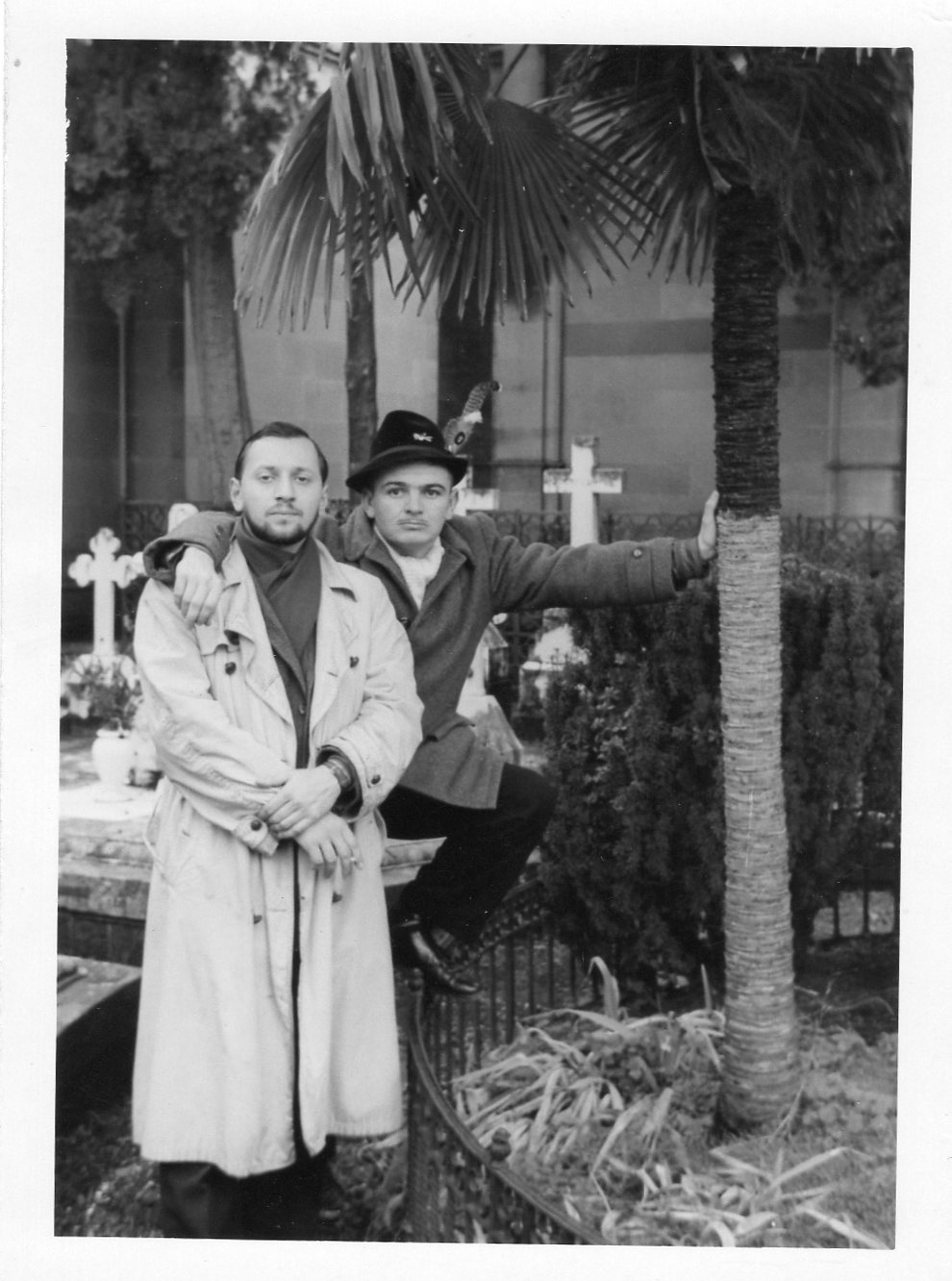
Peter Anastas and Bob Stephenson – Florence, Italy 1959
In Memoriam: Robert Douglas “Bob” Stephenson (August 21,1935 – August 9, 2015)
With the death of painter Robert Stephenson on August 9, Gloucester lost one of its most distinctive contemporary artists. We also lost a great character, a trait that is in short supply these days.
I knew Bob from the Hovey School, where we met in Miss Courant’s fifth grade class in 1947. Even then Bob was drawing and painting constantly. He was also a wit, who kept us laughing when we should have been concentrating on our studies. As befits someone as creative as Bob, he was able to turn both his art and his wit into activities that gained him academic credit.
One of our first projects together was a play we co-wrote for our unit in American history about Captain John Smith and Pocahontas, for which Bob designed the costumes, or rather, adapted them from clothing we borrowed from our mothers—today you might call it “colonial drag.” Bob’s mother, Cora Douglas, the daughter of New England lighthouse keepers, had a house full of the most interesting artifacts, many of which she and Bob’s late father, Charles Francis Stephenson, had collected during his tours of duty in the diplomatic corps. In fact, much of Bob’s sophistication, which made him seem so much older and more mature than the rest of us, was the consequence of the family’s having lived abroad. I suspect these experiences may have played a role in Bob’s becoming an incredibly accomplished linguist during his military career. It is said that he was proficient in twelve languages, including several dialects.
Once we were in Central Grammar for 7th and 8th grades, our dramatic activities did not cease. We wrote a play about Julius Caesar, which we performed with an Italian accent, followed by a Nativity play in Yiddish inflected English. How we got away with what today would be considered politically incorrect behavior is still a mystery to me; but those plays, and others we did together, including a British murder mystery, in which we played Sherlock Holmes and Doctor Watson with the appropriate British accents, were performed in the school auditorium in front of the entire school body.
During 7th grade Bob and I also initiated an activity that we would pursue well into high school. We spent every Saturday walking all over Cape Ann. Beginning with Ravenswood Park, where we explored every trail in detail, we branched out to Dogtown, which we crossed to Rockport many times. There was not a single Gloucester neighborhood we had not traversed on foot, or any place on the waterfront that we did not come to know intimately. One of our signal achievements was to have walked entirely around Cape Ann, beginning in downtown Gloucester and walking to Rockport, Pigeon Cove, Lanesville, Bay View, Riverdale and back to Bob’s house on Mansfield Street.
We did it in a single day, carrying water in canteens and packing lunches that our mothers had prepared for us. There were no cellphones or public phones from which we might report our progress. Always during these walks we observed nature carefully, gathering specimens of plants and wildflowers or marine life that we examined by microscope in the laboratory I had set up in the basement of my house on Perkins Road.
Looking back on Bob’s artistic career, it is my belief that his minute depiction of Gloucester places and objects, his grasp of buildings, wharves, rocks, beaches, tidal eddies, surf, trees, bushes, flora and fauna originated in part from the experiences of those walks during which nothing was lost on either of us. Our early walks resulted in a lifelong habit of my own of walking all over the city of my birth and writing about it in my weekly column for the Gloucester Times, “This Side of the Cut.”
Bob’s artistry was nurtured at Central Grammar by our art teachers, Jean Nugent in 7th grade and Edna Hodgkin’s in 8th. Both were practicing artists, as was the city’s art supervisor Hale Anthony Johnson, who had taught us all the rudiments of art since first grade, along with the history of the visual arts on Cape Ann.
But it was at Gloucester High School, that amazing WPA modernist building we had the privilege of attending classes in during the 1950s, where Bob came under the influence of Gloucester’s greatest art teacher, the native-born painter Howard Curtis, who was head of the art department. Comprising an entire wing of the school, the art department had state of the art equipment and the benefit of northern light, because Howard and the preceding art teacher, Muriel Spofford, had insisted to the architects that the original siting of the school be rotated to take advantage of the light itself.
It would be an understatement to say that the influence of Howard Curtis on Bob’s art was profound. Curtis, a distinguished artist who had exhibited widely, along with painting or restoring earlier murals in city buildings, was a remarkable teacher. Learned, articulate and engaging, he held sway in his two-room classroom-studio from before school in the morning until late in the afternoon. In those classrooms, whose walls were hung with the finest examples of world art, you could find students, some of whom did not even study art, in deep conversation with “Mr. Curtis,” as we all respectfully called him. The subjects were wide and diverse, from the forms of Medieval and Renaissance painting and questions of perspective to abstract philosophical issues about the origins and fate of man. Curtis himself was a deeply meditative spiritualist, a mystic, in some ways, as I look back on him. This part of his nature and his teaching must clearly have had an impact on Bob’s future art, which has a profoundly spiritual dimension, influenced as well by Bob’s immersion in Buddhism, prompted by his time spent in the Far East during his military service.
Taken together, Bob’s encyclopedic knowledge of Gloucester terrain and his spiritual vision, in part the influence of Howard Curtis and in part his Eastern knowledge and practice, provide a lens through which we can view and understand the astounding production of his paintings. Many were completed in his first studio on the top floor of Brown’s former department store, later in the studio he occupied at the Fitz Henry Lane House, and finally at his remarkable studio on Parsons Street, just off Main, a former garage, which Bob, with the help of friends, converted into a living and working space that took advantage of a marvelous view of the waterfront and wonderful light throughout the day. It was a studio, like those of the Florentine masters, that was open to all during Bob’s working hours. It was not unusual to find friends visiting while Bob painted, or a conversation ongoing about the state of the world, about which Bob had many opinions, pungently expressed.
Everyone has a story about Bob, and I will conclude with one of my own.
It was late in 1959. I was living in Florence, studying Medieval literature at the university and about to begin teaching English at the International Academy. Bob was stationed in Germany with the US Army. He wrote to tell me that he had some leave coming and wished to visit me in Florence. I had not seen Bob since I was in college and he was attending art school in Boston, prior to his induction into the army, so I jumped at the opportunity. Bob was due to arrive on the Brenner Express, so I went to meet his train at the railroad station. As I stood on the platform, I observed a group of Germans getting off the train, all of them speaking excitedly in their own language. Bob was among them, conversing in what I later learned was perfect German. He was also dressed in German clothing, a gray Loden jacket and a dark green Alpine hat with a feather in it.
Bob stayed in the Pensione Cordova in Via Cavour, where I had been living since early fall. His room had a marvelous view of the Duomo from its window. Soon Bob set about drawing everything he saw as we walked (of course) over every inch of the fabulous city that was to become my home for three years. From his study of art history Bob was familiar with the storied buildings and monuments, and his knowledge of the art was extensive. As we walked through the galleries of the Uffizi and the Pitti Palace, Bob paused to explain what artists like Botticelli had in mind as they concentrated on the placement of figures or the overall structure of the work. We explored the interiors of the great cathedrals and churches, from the Duomo to San Miniato, adjacent to which was a vast cemetery which fascinated Bob (my friend Paul Hamilton, who was studying art in Florence took some pictures of us in that cemetery, one of which is posted here).
Back in the pensione, I introduced Bob to another resident, Carlo Cirelli, a young artist from Ferrara, who worked designing shoes for a local company. When Carlo saw Bob’s drawings and watercolors of Florence he asked Bob if he would ever consider designing shoes.
“I’ll take a crack at it,” Bob said, setting to work with his pencil and watercolors he borrowed from Carlo. We left him alone for a while, and when he said the design was done, Carlo and I went to look at it. Instead of an elegant Italian shoe, Bob had painted what looked like a worn out work boot, brown, scuffed and with turned over heels. Along the edge of the boot he had painted a wooden match stick, inserted between the shoe and the sole. The match was on fire and would naturally have resulted in a “hot foot” for the wearer of the shoe. This was Bob at his best, using art to make a point about the vanity of fancy footwear.
I did not see Bob again until his retirement from the military when we were both again living in Gloucester. From time to time I would visit his Parsons Street studio to see what he had been up to. When I reminded him about his visit to Florence and the shoe, his eyes twinkled. “I wouldn’t be surprised if I’d started a fad,” he said. “You know how clever those Italians are!”
Peter Anastas
___________________________________________________________________________________
The Most Original Native Artist of His Time
by Ernest Morin
Bob Stephenson, like Fitz Henry Lane, was a Gloucester boy. He also shared with Lane a real sense of light and love of the harbor and city. I met him when he had his studio in Lane’s house.
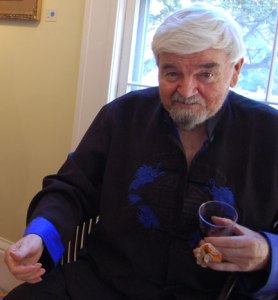
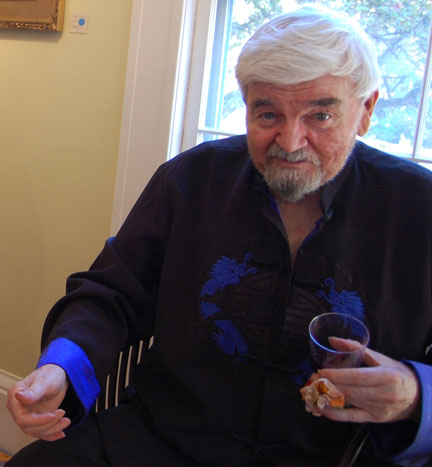
Bob Stephenson
Photo Courtesy of Greg Cook
When it came to subject matter however Bob Stephenson was not a realist. His canvas would be a place to situate dream, myth, reality, symbols and spirituality. He would combine an eastern sensibility towards use of space and western techniques of painting with scenes that were both drawn from local reality and greatly fabricated to fit artistically into the Stephenson paradigm, a very original paradigm.
His skill and technique with paint was extreme, he was a master at use of glazing, applying hot near cold color of designing a series of spaces within spaces that had strong push pull, repetitive form, harmony culminating in complex compositions that were layered with meaning.
He also did this in a way that was simple and abstract at heart – in the way an Edward Hopper is real yet truly abstract.
Stephenson labored intensely over 6 or 8 canvases at a time. They were works to be pondered, to be massaged, to be coaxed into life one nuance at a time once they were cohesive. His art wasn’t rushed; he didn’t produce product.
Continue reading →





 Enduring Gloucester