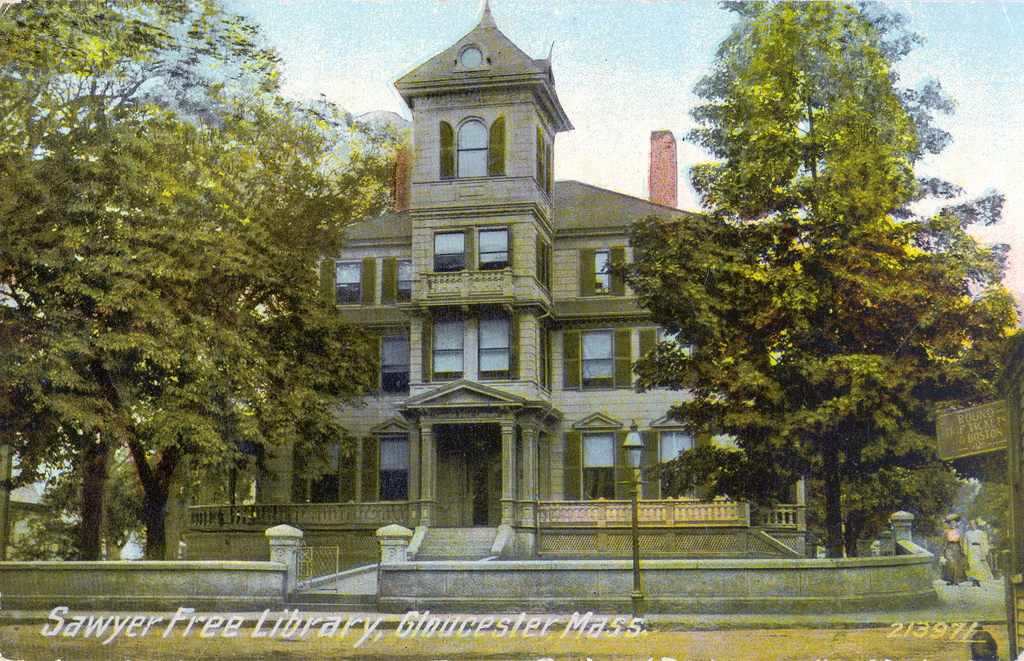
The Sawyer Free Library in Transition
Peter Anastas
“There’s a lot of passion in the community for the library! It’s not that we want to keep the place stagnant for nostalgic reasons. We are open to change; we just expect responsible, thoughtful change. Isn’t this why we hire professional librarians? “
–A Gloucester citizen, May 6, 2015
Herman Melville’s Ishmael claimed that a whale ship was his Yale College and his Harvard. I like to tell people that I graduated from the Sawyer Free Library. While I’ve enjoyed the privilege of an excellent formal education in the Gloucester Public Schools and in college, I’ve always believed that my real education began at the age of six when I first starting visiting my local library. Browsing in the stacks, I discovered many of the books that have meant the most to me, books that changed my life.
I was lucky. My Aunt Helene Lasley, a beloved elementary school teacher in Gloucester, taught me to read at an early age and helped me to obtain my first library card. This began a lifelong passion for reading and a thirst for knowledge, which the library has amply satisfied during the seventy-one years I’ve proudly held that library card.
But now our beloved public library is about to undergo a radical, though arguably necessary, transition. Not only are many of the books that have meant so much to thousands of library patrons potentially going to be weeded—the technical term is “deaccessioned”—the physical spaces of the building itself are slated for change. Many of these physical changes have been mandated by the Americans with Disabilities Act and state and local building and fire codes. But the changes to the library’s historic collection of books (videos and music will also be considered), though undertaken partially to accommodate the planned physical modifications and lack of shelf space, are potentially more worrisome, especially to patrons like me who have benefited from the riches of the current collection.
On Tuesday, May 5, a sizable group of loyal patrons attended a meeting of the library’s Board of Directors to listen to the library director Deborah Kelsey and Board members describe the menu of changes that the library’s new strategic plan outlines
(You may read the Strategic Plan for 2014-9019 HERE and the Action Plan for 2015 HERE.)
and to express our concerns and offer our views about what many of us felt could be the deleterious impact of these changes on the library, and the community itself, as we have known and loved it.
At the core of our concern is the concept of “Gloucester Picks,” which asks library patrons to choose books, videos and other materials that are meaningful to them and which they believe should be preserved. Patrons are asked to place these items in bins that have been provided, from which library staff will assemble a separate collection to be created and maintained as containing the community’s “favorites.” While on its face this concept may appear appealing, in my view it seems an arbitrary way to manage part of Gloucester’s literary heritage, leading to a potential “dumbing down” of both the collection and the library through popularization. Libraries should indeed be places where a wide segment of the community can find or discover books and other materials that appeal to them, but they must also be resources where the world’s literary, historical, aesthetic, and philosophical heritage can be at the fingertips of patrons, either through the maintenance of a rigorously curated core collection or access to books and research materials through the inter-library loan system.
The particular concern of many of us who question the Gloucester Picks program is that once the core collection has been picked through, what will happen to those books which were not chosen? Will they be weeded out; and, if not, who among the library staff will winnow them yet again, using which guidelines? Indeed, when you consider that only a small segment of the community may come into the library to choose their favorites, will this not lead to a much skewed result? In the end, will many important works of fiction or non-fiction, books that have potential appeal to browsers, who often discover them serendipitously, simply disappear?
Those of us who attended the board meeting on May 5 also learned that the guiding principles of deaccession are set forth in CREW: A Weeding Manual for Modern Libraries, a publication from the University of Texas that is meant to guide public libraries in the maintenance of their collections and the management of both their resources and their physical spaces. A reading of the CREW manual makes clear that one of its guiding tenets is a vision of the public library as a neat, clean physically attractive facility to draw patrons and make them feel comfortable once inside the doors. To achieve this goal, the manual suggests that there be no books that appear worn or with torn or dirty bindings or covers in the collection, as this would tend to discourage patrons. It seems almost as if a sanitized collection or environment is the principal goal of attraction rather than the library’s intellectual or aesthetic resources. A further reading of the manual discloses a certain political correctness in its guidelines for the addition or retention of books. One particularly glaring example is the suggestion that to maintain historical validity in one’s collection “dated” books, for example, those about the now-defunct Soviet Union, might be discarded.
Nobody argues against judicious weeding. All libraries must make room for newly acquired books and discard those which have been damaged or are no longer relevant to the permanent collection, such as multiple copies of popular bestsellers, when a single copy in good condition can be retained for patrons who might wish to read or re-read it. However, a core collection of the world’s classics must be retained, updated and maintained by the addition of fresh editions or translations, along with the acquisition of newly published books.
One could—and will—argue that the Internet provides wide access to materials that would not only supplement but surpass physical resources in politics or history, and that by providing access to the Internet in the libraries themselves, patrons are not only assisted but encouraged to explore beyond the limits of the actual collection. Nevertheless, there is no substitute for the physical book that can be taken home, read deeply and carefully, and more easily be quoted from by the student or patron than by the use of a digital text, which for many patrons is hard on the eyes and impermanent.
The May 5 meeting was, in my view, extremely productive, not only in demystifying the library’s approach to the coming changes, but also in helping the patrons who attended to gain a sense of what the director and the Board’s approach will be to implementing and managing these changes. Considering that the details involved in the transition have not been widely reported or understood, the patrons expressed a desire for transparency, about which the Board readily agreed. Furthermore, patrons were asked by the Board and director not only for their input into the evolving process of transition, but also their active involvement, thus enhancing an important public trust, which I believe has been missing from much of the current public discourse in Gloucester.
If you care about our public library, especially in this important time of transition, please visit it, learn about the coming changes and how they may affect you, and take a proactive role. It is the only way we can guarantee that the Sawyer Free Library will continue to be a valuable and important part of our community—not to speak of the crucial need to be engaged citizens ourselves.



 Enduring Gloucester